Long-Term Outcomes of Strabismus Surgery in Children with Perinatal Brain Injury: Insights and Clinical Implications
Highlight
- Children with perinatal brain injury have significantly lower 2-year motor and motor-sensory success after strabismus procedures compared to matched controls without brain injury.
- Reduced long-term success is predominantly due to undercorrection and increased postoperative drift, despite comparable surgical dosing.
- Larger preoperative horizontal deviations correlate with decreased treatment success, particularly in esotropia cases.
- Results emphasize the need for informed preoperative counseling and consideration for adjusted surgical strategies in this complex patient population.
Study Background
Strabismus, characterized by the misalignment of the eyes, frequently occurs in children with perinatal brain injuries such as intracranial hemorrhage or hypoxic-ischemic encephalopathy. These brain injuries often disrupt ocular motor control pathways, resulting in complex ocular alignment disturbances. While surgical and botulinum toxin-based interventions remain standard treatments, their long-term efficacy in children with neurologic impairment remains inadequately characterized. Given the lifelong impact of strabismus on visual function, psychosocial well-being, and quality of life, understanding the outcomes of strabismus treatment in this vulnerable group is critical for optimizing management and counseling.
Study Design
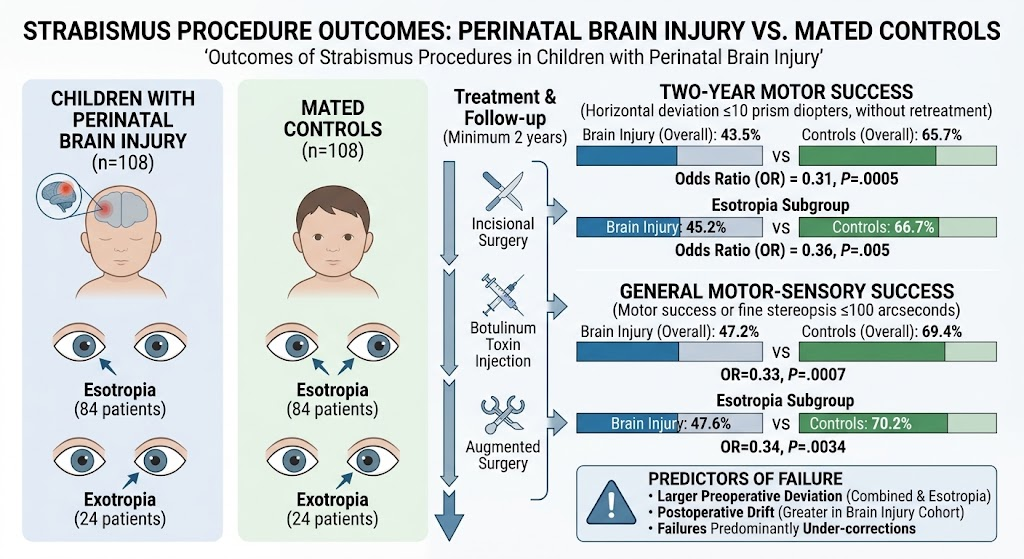
This retrospective cohort study compared long-term strabismus treatment outcomes in 108 children with perinatal brain injury and strabismus (84 esotropia, 24 exotropia) to 108 matched controls without brain injury. Matching criteria included the type of horizontal strabismus, age at intervention, and magnitude of preoperative deviation. Interventions comprised incisional strabismus surgery, botulinum toxin injections, or surgery augmented with botulinum toxin, all with a minimum follow-up of two years.
Primary outcomes were 2-year motor success, defined as horizontal deviation ≤10 prism diopters without requiring retreatment, and general motor-sensory success, defined as motor success or fine stereopsis ≤100 arcseconds without additional intervention. Secondary analyses evaluated early postoperative success at 3-6 months, magnitude of postoperative drift, surgical dosing, and factors associated with treatment failure.
Key Findings
At early follow-up (3-6 months), success rates did not significantly differ between children with perinatal brain injury and controls (52.9% vs 67.3%, P=0.098). However, at two years, the brain-injured cohort showed significantly lower motor success overall (43.5% vs 65.7%; odds ratio [OR]=0.31, 95% confidence interval [CI] 0.16-0.62; P=0.0005) and in the esotropia subgroup (45.2% vs 66.7%; OR=0.36, 95% CI 0.17-0.74; P=0.005). General motor-sensory success similarly trended lower in the brain injury group overall (47.2% vs 69.4%; OR=0.33, 95% CI 0.17-0.64; P=0.0007) and within esotropia cases (47.6% vs 70.2%; OR=0.34, 95% CI 0.17-0.71; P=0.0034).
Postoperative drift — the tendency for deviation to worsen over time after initial alignment — was significantly greater in the perinatal brain injury cohort (P=0.037), with failures predominantly due to residual undercorrection rather than overcorrection. The surgical doses administered, standardized against published norms, did not differ significantly between brain-injured and control groups (95.9% vs 96.6%; P=0.68), particularly in 60 matched esotropia pairs undergoing incisional surgery alone.
Multivariable logistic regression identified larger preoperative deviation as independently associated with lower general motor-sensory success both overall (OR=0.963 per prism diopter increase; 95% CI 0.934-0.994; P=0.019) and within esotropia patients specifically (OR=0.950; 95% CI 0.912-0.989; P=0.012). Botulinum toxin use was not an independent predictor of success after adjustment (adjusted OR=0.18; P=0.126). Notably, male sex associated with motor failure in exotropia cases (OR=0.03; P=0.015), suggesting potential sex-specific factors influencing outcome.
Expert Commentary
This study provides critical insights into the challenges of strabismus management in children with early brain injury. The lower long-term success rates despite comparable surgical dosing suggest intrinsic neurologic factors or altered muscular responsiveness may limit therapeutic efficacy. The predominance of undercorrection aligns with prior hypotheses regarding diminished innervational drive or impaired binocular sensory adaptation in this cohort.
Additionally, the association between larger baseline deviation and poorer outcomes highlights the importance of early detection and intervention before severe misalignment develops. The lack of significant effect from botulinum toxin augmentation suggests that conventional approaches may require modification, possibly through enhanced dosing or innovative therapies tailored to neural integrity.
However, this study’s retrospective design and reliance on matching limit causal inference, and prospective controlled trials are warranted. Furthermore, more comprehensive sensory function assessment and quality-of-life measures would deepen understanding of functional impact.
Conclusion
Children with perinatal brain injury undergoing strabismus procedures have significantly lower motor and sensorimotor alignment success at two-year follow-up, primarily due to undercorrection and increased postoperative drift, despite receiving comparable surgical doses. Larger preoperative deviations portend worse outcomes, especially among esotropia patients. These findings underscore the necessity of tailored preoperative counseling regarding potential for secondary interventions and support the investigation of adjusted or novel treatment protocols to improve long-term outcomes in this high-risk pediatric population.
Future prospective studies should explore individualized dosing strategies, integrate neural function biomarkers, and assess the comprehensive functional benefits of strabismus treatment beyond traditional alignment metrics to optimize care for children impacted by perinatal brain injury.
Funding and Clinical Trials
The referenced study does not specify funding sources or clinical trial registration. Further research should ensure transparency regarding these elements to bolster study credibility.
References
1. Zhou Y, Prakash E, Gaier ED, Heidary G, Gise R. Outcomes of Strabismus Procedures in Children with Perinatal Brain Injury. American Journal of Ophthalmology. 2026 Aug 23; PMID: 42633833.
2. Holmes JM, Clarke MP. Amblyopia. Lancet. 2006;367(9519):1343-51. doi:10.1016/S0140-6736(06)68581-4.
3. Birch EE. Strabismus and amblyopia in children with early brain injury. Vision Research. 2013;90:100-6. doi:10.1016/j.visres.2013.06.002.
4. Apt L, et al. The management of strabismus in children with cerebral palsy. Strabismus. 2011;19(2):55-61.
5. Sethi HS, et al. Botulinum toxin treatment for pediatric strabismus: current perspectives. Pediatric Health Med Ther. 2016;7:57-64. doi:10.2147/PHMT.S81775.
This article was created using several editorial tools, including AI, as part of the process. Human editors reviewed this content before publication.