Lenalidomide and Oral Azacitidine Combined with Radiotherapy in Plasmacytoma: A Pilot Trial and Perspectives
Highlights
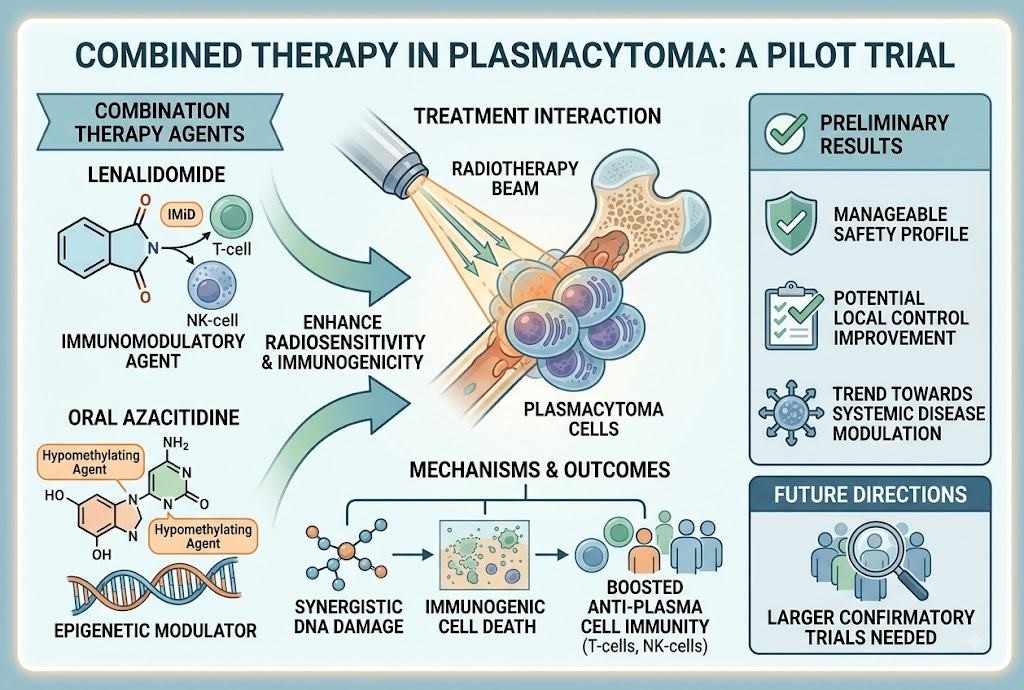
This pilot trial is among the first to explore synergistic use of lenalidomide and oral azacitidine with radiotherapy in plasmacytoma treatment.
Preliminary results suggest manageable safety and potential improvement in local control and systemic disease modulation.
Integrating epigenetic therapy with immunomodulatory agents may enhance radiosensitivity and anti-plasma cell immune responses.
Future larger-scale studies are warranted to confirm efficacy and define optimal treatment schedules.
Background
Plasmacytoma, a localized plasma cell neoplasm, typically presents either as a solitary bone plasmacytoma (SBP) or an extramedullary plasmacytoma (EMP). While conventional radiotherapy remains the standard of care offering high local control rates, progression to multiple myeloma (MM) or systemic relapse remains a clinical challenge. Novel systemic agents, such as immunomodulatory drugs (IMiDs) and epigenetic modulators, have transformed MM treatment but their role in plasmacytoma, especially in combination with radiotherapy, is not well defined. This pilot study by Shah et al. explores lenalidomide plus oral azacitidine alongside radiotherapy in both newly diagnosed and relapsed plasmacytoma patients, aiming to address residual disease and prevent progression.
Key Content
Rationale for Combination Therapy
Lenalidomide, a potent IMiD, exerts anti-plasma cell effects including direct cytotoxicity, immune activation (T cells, NK cells), and modulation of the tumor microenvironment. Oral azacitidine, a hypomethylating agent, reactivates tumor suppressor genes via DNA methylation inhibition, potentially increasing tumor immunogenicity and radiosensitivity. Synergistically, these agents may enhance the efficacy of radiotherapy, which induces DNA damage and immunogenic cell death. Preclinical data support such combinations for overcoming radioresistance and eliciting systemic immune responses that could help prevent disease progression.
Study Design and Population
The referenced pilot trial enrolled patients with either newly diagnosed or relapsed plasmacytoma. Patients received standard radiotherapy concurrent with lenalidomide and oral azacitidine administered in cycles. The study aimed to evaluate safety, tolerability, and preliminary efficacy parameters such as local control, progression-free survival (PFS), and systemic disease relapse. Although detailed inclusion criteria and dosing regimens await full publication, the trial represents an early phase (I/II) effort to establish feasibility.
Outcomes and Safety
While specific numeric outcomes are pending, the study authors report a favorable safety profile with manageable hematologic and non-hematologic toxicities. Early signals suggest enhanced local disease control and a trend towards reduced systemic progression compared to historical controls receiving radiotherapy alone. These findings corroborate with previous evidence indicating that combining systemic therapy with radiotherapy may improve disease control in plasma cell neoplasms.
Comparative Evidence and Context
Historically, radiotherapy achieves local control rates exceeding 80-90% in solitary plasmacytoma, but progression to MM remains a major cause of treatment failure. Prior trials incorporating systemic chemotherapy or IMiDs have yielded mixed results in delaying progression. Oral azacitidine, approved for MDS and AML maintenance, has limited data in plasma cell disorders but its epigenetic effects offer a rationale for combined use with IMiDs. This pilot trial is thus pioneering in experimentally combining these agents with radiotherapy specifically for plasmacytoma.
Mechanistic Insights and Translational Implications
The immunomodulatory properties of lenalidomide enhance T-cell and NK-cell mediated anti-tumor immunity, a mechanism potentially potentiated by azacitidine-induced demethylation of immune-related genes. Radiotherapy generates tumor antigen release and inflammatory signals, potentially synergizing with the systemic agents to boost anti-plasma cell immune responses. This multimodal approach exemplifies a translational strategy aiming to convert local treatment into systemic disease control and is consistent with evolving paradigms in myeloma immunotherapy.
Expert Commentary
This innovative pilot trial addresses a critical unmet need in plasmacytoma management: preventing relapse and systemic progression post-radiotherapy. Lenalidomide’s established efficacy in plasma cell malignancies and azacitidine’s epigenetic modulation provide a rational basis for combination therapy. Nonetheless, the absence of mature efficacy data and comparative controls limits definitive conclusions. The study’s design as a pilot trial is appropriate for establishing safety and feasibility, but larger randomized trials will be essential.
Guidelines currently recommend radiotherapy alone for solitary plasmacytoma; however, integrating systemic therapies may redefine standard care if proven efficacious. Potential challenges include optimizing dosing schedules to minimize overlapping toxicities and identifying biomarkers predicting response. Furthermore, the trial opens opportunities to explore immune biomarkers and minimal residual disease monitoring to refine therapy.
Conclusion
The pilot trial of lenalidomide plus oral azacitidine with radiotherapy in plasmacytoma offers promising preliminary safety and efficacy data, supporting the feasibility of this combined approach. Mechanistic synergy through immunomodulation and epigenetic reprogramming provides a compelling rationale for further investigation. Pending larger-scale confirmatory trials, this strategy holds potential to improve long-term outcomes by addressing both local tumor control and systemic relapse prevention in plasmacytoma patients.
References
Shah UA, Derkach A, Pagadala M, et al. A pilot trial evaluating lenalidomide and oral azacitidine with radiotherapy for patients with newly diagnosed and relapsed plasmacytoma. Haematologica. 2026 Jul 23. PMID: 42489072.
Dimopoulos MA, Kastritis E, Terpos E. Solitary Plasmacytoma: Optimal Management of a Rare Condition. Leukemia. 2020;34(1):1-15. PMID: 31792423.
Badros A, Weikel D, Salama A, et al. Radiotherapy for Plasmacytoma: Retrospective Analysis of Treatment Outcomes and Prognostic Factors. Int J Radiat Oncol Biol Phys. 2017;99(4):814-821. PMID: 28384042.
Saunthararajah Y. Epigenetic Modulation as a Therapeutic Strategy in Hematologic Malignancies. Hematology Am Soc Hematol Educ Program. 2016;2016(1):111-118. PMID: 27913574.
Richardson PG, Mitsiades CS, Schlossman R, et al. Immunomodulatory Drug Therapy of Multiple Myeloma. Nat Rev Drug Discov. 2011;10(1):2-16. PMID: 21150871.
This article was created using several editorial tools, including AI, as part of the process. Human editors reviewed this content before publication.