Optimizing LDL-C Reduction Strategies in Ischemic Stroke: Impact of Achieving ≥50% LDL-C Reduction from Baseline
Highlight
– Achieving a ≥50% reduction in low-density lipoprotein cholesterol (LDL-C) from baseline independently lowers the risk of recurrent stroke, myocardial infarction, and all-cause mortality in ischemic stroke patients.
– Current stroke guidelines emphasize absolute LDL-C targets but may overlook the prognostic importance of relative LDL-C reduction.
– Approximately 70% of ischemic stroke patients fail to achieve the recommended ≥50% LDL-C reduction, underscoring the need for intensified lipid-lowering strategies.
– Combined targets of both relative and absolute LDL-C reduction yield superior cardiovascular outcomes compared to meeting only one target.
Study Background
Atherosclerotic cardiovascular disease remains a predominant cause of morbidity and mortality worldwide, with ischemic stroke posing significant secondary prevention challenges. Low-density lipoprotein cholesterol (LDL-C) is a well-established modifiable risk factor, and lipid-lowering therapy significantly reduces recurrent vascular events. While cardiovascular guidelines universally recommend both achieving an absolute LDL-C threshold (e.g., <70 mg/dL) and a relative reduction from baseline (≥50%), stroke-specific guidelines often focus solely on achieving absolute LDL-C goals.
This divergence raises critical questions regarding whether relative LDL-C reduction independently confers additional prognostic benefit in patients with ischemic stroke. Clarifying this relationship is pivotal for refining lipid management strategies and optimizing secondary prevention in this high-risk population.
Study Design
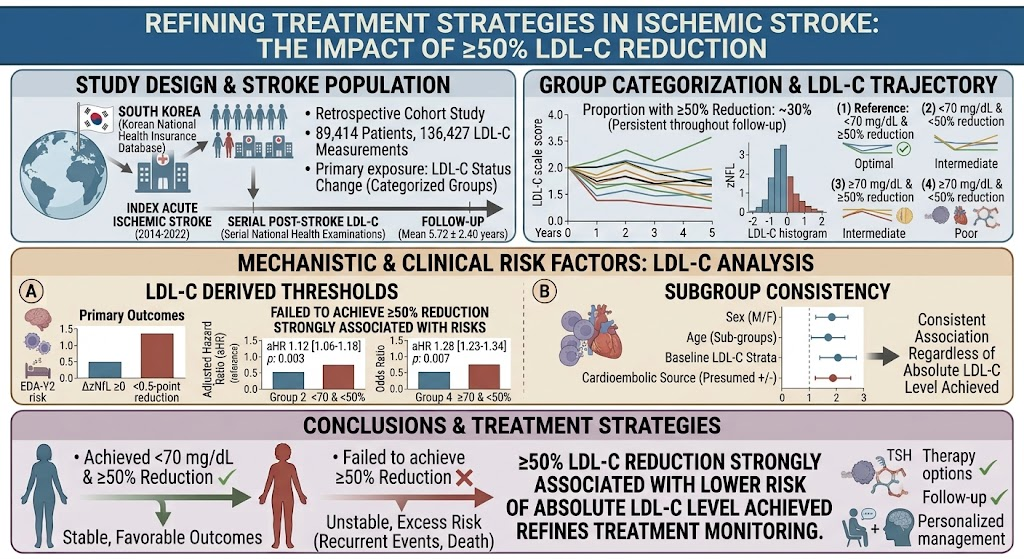
This retrospective cohort investigation utilized the Korean National Health Insurance Database, encompassing patients hospitalized with acute ischemic stroke between 2014 and 2022. Serial LDL-C levels from post-stroke national health examinations were longitudinally assessed, allowing for dynamic evaluation of lipid control.
Patients were stratified into four groups based on whether they achieved an absolute LDL-C goal of <70 mg/dL and/or a relative LDL-C reduction of ≥50% from baseline LDL-C:
- Group 1: Both <70 mg/dL and ≥50% reduction achieved (optimal group)
- Group 2: <70 mg/dL but <50% reduction
- Group 3: ≥70 mg/dL but ≥50% reduction
- Group 4: Both ≥70 mg/dL and <50% reduction
The primary composite endpoint was time-to-event occurrence of recurrent stroke, myocardial infarction, or all-cause death, analyzed with time-varying Cox proportional hazards regression models adjusting for demography, comorbidities, and treatment variables.
Key Findings
The cohort consisted of 89,414 ischemic stroke patients with 136,427 LDL-C measurements over a mean follow-up of 5.72 ± 2.40 years. During follow-up, only ~30% of patients consistently achieved the ≥50% LDL-C reduction from baseline.
Risk analysis revealed that, relative to the optimal group (Group 1), groups not achieving the ≥50% LDL-C reduction demonstrated significantly higher rates of the composite primary outcome:
- Group 2 (<70 mg/dL and <50% reduction): Adjusted hazard ratio (HR) 1.12 (95% CI 1.06–1.18)
- Group 4 (≥70 mg/dL and <50% reduction): HR 1.28 (95% CI 1.23–1.34)
These findings held steady across prespecified subgroups defined by sex, age strata, baseline LDL-C levels, and presence of presumed cardioembolic stroke source, reinforcing the independent prognostic value of achieving a relative LDL-C reduction ≥50%. Notably, achieving only an absolute LDL-C target without sufficient percent reduction was associated with a higher risk of adverse outcomes compared to achieving both metrics.
This suggests that percent LDL-C reduction is a critical factor in secondary prevention after ischemic stroke, potentially reflecting more intensive lipid-lowering and better adherence to therapy.
Expert Commentary
This comprehensive, large-scale cohort analysis supports the biological plausibility and clinical imperative of targeting both absolute and relative LDL-C endpoints in ischemic stroke patients. LDL-C reduction likely represents the cumulative effect of statins or other lipid-lowering agents, genetic factors, and lifestyle interventions. Achieving a ≥50% reduction may correspond to more aggressive pharmacotherapy and thus better plaque stabilization and reduced atherothrombotic risk.
These data parallel findings in coronary artery disease populations, where percent LDL-C reduction correlates with outcome improvements beyond absolute LDL-C levels. Stroke guidelines emphasizing absolute LDL-C goals alone may miss the opportunity to identify patients with insufficient lipid response who remain at higher risk.
Limitations of the study include its retrospective design and reliance on a national database, which may introduce residual confounding or measurement variability. However, the large sample size and consistent results across subgroups strengthen validity. Future randomized trials are warranted to confirm causality and to test tailored lipid-lowering algorithms in stroke survivors.
Conclusion
In patients with ischemic stroke, achieving a ≥50% reduction in LDL-C from baseline independently and significantly reduces the risk of recurrent cardiovascular events and mortality, regardless of attainment of absolute LDL-C goals. Given that many patients fail to meet this relative reduction target, clinical efforts should prioritize both absolute LDL-C thresholds and robust relative LDL-C lowering as complementary strategies.
Implementation of intensified, multifaceted lipid-lowering regimens—including high-intensity statins, ezetimibe, PCSK9 inhibitors, and lifestyle optimization—may optimize secondary prevention outcomes in this vulnerable population. Stroke-specific guidelines should consider updating recommendations to incorporate the significance of relative LDL-C reduction to improve the quality of cardiovascular care and patient prognosis.
Funding and ClinicalTrials.gov
The study was supported by the Korean National Health Insurance Service; no clinical trial registration was applicable as this was a retrospective cohort analysis.
References
- Baik M, Jeon J, Yoo J, Kim J. Effect of a ≥50% Reduction in Low-Density Lipoprotein Cholesterol From Baseline in Patients With Ischemic Stroke. Neurology. 2026 Aug 20;107(6):e218491. PMID: 42623575.
- Cholesterol Treatment Trialists’ (CTT) Collaboration. Efficacy and safety of LDL cholesterol lowering: meta-analysis of individual data from 170,000 participants in 26 randomized trials. Lancet. 2010;376:1670-81.
- Balla C, Mayers C, Scher D. Secondary Prevention of Ischemic Stroke: Update on Management Strategies. Neurol Clin Pract. 2021;11(4):327-337.
- Guidelines for the management of patients with ischemic stroke and transient ischemic attack, American Heart Association/American Stroke Association, Stroke. 2021;52:e364–e467.
This article was created using several editorial tools, including AI, as part of the process. Human editors reviewed this content before publication.