We use cookies

Our website uses essential cookies and, with your consent, additional cookies to measure performance and improve our services. Cookie Policy.

You can change your choice at any time.

MMedXYNews
HomeVideos
MedXY AI/MedXY News/Section: Emergency Medicine

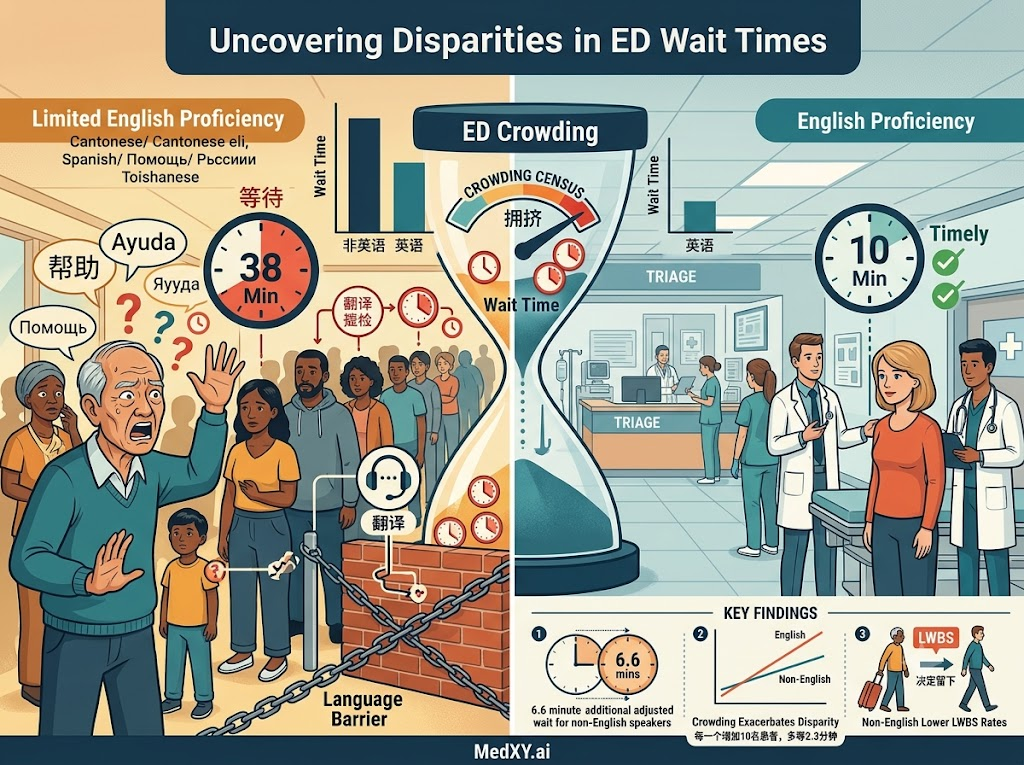
Language Barriers and Emergency Department Crowding: Uncovering Disparities in Wait Times at an Academic Medical Center
MedXY Editorial Team•Aug 4, 2026•Emergency Medicine
ED Wait Timeshealth disparitieslanguage barriersemergency medicine

Background

Emergency departments (EDs) serve as critical access points for acute medical care and often function as vital safety nets for vulnerable populations. Timely evaluation and treatment in the ED are essential for optimizing patient outcomes, as prolonged wait times are linked to increased morbidity and mortality. Despite the recognized importance of prompt care, disparities in ED wait times related to patient language preference have received limited attention. Patients with limited English proficiency (LEP) frequently face communication barriers that can affect the quality and timeliness of care they receive.

This study addresses a significant gap by investigating the association between patient primary language and ED wait times, with a further focus on how ED crowding might modify this relationship. Understanding these dynamics is crucial for devising strategies to improve health equity in acute care settings.

MedXY registered readers

Sign in free to continue reading

Create or use your MedXY account to unlock the complete article.

This article was created using several editorial tools, including AI, as part of the process. Human editors reviewed this content before publication.

Related articles

Open language-specific specialty feeds and department pages.

Evaluating the Impact of Relative Value Unit-Based Compensation on Emergency Physician Performance and Operational OutcomesA national study examining the shift from hourly to RVU-based pay for emergency physicians found no significant changes in productivity, billing intensity, or key operational metrics, suggesting compensation models may not strongly influencSep 18, 2026Social Inequalities in Gestational Diabetes: Insights from a Nationwide Swedish Cohort StudyThis Swedish cohort study reveals growing gestational diabetes prevalence with marked disparities by social determinants such as education, income, and nativity, underscoring the need for targeted prevention and equitable care.Sep 17, 2026Childhood Mental Health-Related Emergency Department Visits and Pediatric Volume Dynamics in the US (2016-2022): A Comprehensive ReviewPediatric mental health ED visits in the US have surged 2016-2022, exhibiting volume-dependent disparities in patient demographics and diagnoses, highlighting opportunities for tailored interventions to enhance care across diverse emergencySep 13, 2026
Loading comments...
MedXY briefing

Get the free newsletter

Evidence-led clinical news, trends, and analysis—delivered to your inbox.

Ask MedXY AI

Most popular

Intimate Health
Five Benefits for Women Continuing Sexual Activity After Menopause
Intimate Health
Why Some Women Have a Strong Sex Drive—And Why Men Shouldn't Worry About It
Nursing & care
How often should a couple have sex?
Intimate Health
Classic Intimacy Recommendations: How to Help Women Reach Orgasm and Enjoy Mutual Pleasure
Intimate Health
What Makes a Woman "Physiologically Addicted" Is Never Money, But These Two Relationship Qualities
© 2026 MedXY
Contact usAbout usPrivacy PolicyMedXY story
Unraveling Adherence Challenges to Bone Conduction Hearing Devices in Pediatric Microtia Patients
This study identifies unilateral hearing loss, older age, and insurance status as key factors associated with poor adherence to bone conduction hearing devices in children with microtia, emphasizing the critical role of routine monitoring o
Sep 13, 2026
Real-World Eligibility of Diabetic Macular Edema Patients for Anti-VEGF Trials: Implications for Clinical Practice and Health EquityA significant proportion of real-world diabetic macular edema patients are excluded from clinical trials of anti-VEGF therapy due to stringent systemic criteria, disproportionately affecting racial minorities. This study highlights the needSep 11, 2026
Social Determinants of Health in Early to Mid-Adulthood and Risk of Early-Onset Stroke: A Comprehensive ReviewAccumulating evidence underscores how adverse social determinants of health (SDOH) from early adulthood heighten the risk of early-onset stroke, with dose-dependent effects and disparities by race and sex.Sep 8, 2026