Ketoacidosis Risk with SGLT2 Inhibitors in Type 2 Diabetes: Insights from a Scandinavian Cohort Study
Highlight
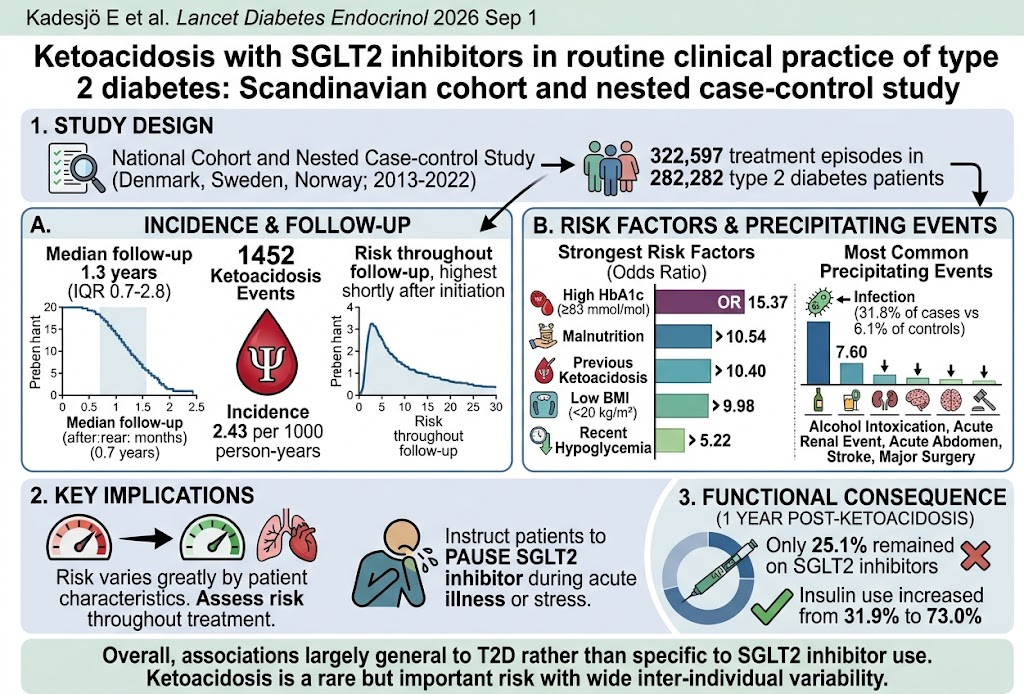
This Scandinavian study of over 280,000 type 2 diabetes patients treated with SGLT2 inhibitors demonstrates that ketoacidosis risk is present throughout treatment duration and strongly linked to poor glycemic control, malnutrition, low BMI, prior ketoacidosis, and recent hypoglycemia. Infection and acute stressors significantly precipitate ketoacidosis events. Clinical vigilance and patient education on temporarily discontinuing SGLT2 inhibitors during acute illness are essential.
Study Background
Type 2 diabetes mellitus (T2DM) widely affects global populations, imposing a substantial burden of cardiovascular and metabolic complications. Among therapeutic advances, sodium-glucose co-transporter 2 inhibitors (SGLT2i) have emerged as effective agents for glycemic control and cardiometabolic risk reduction. However, clinical trials and pharmacovigilance have reported an association between SGLT2i use and increased risk of diabetic ketoacidosis (DKA), a potentially life-threatening metabolic complication usually associated with type 1 diabetes but increasingly recognized in T2DM patients.
While randomized trials provide controlled safety data, real-world evidence regarding DKA incidence, risk factors, precipitating events, and clinical outcomes under routine clinical practice remains limited, particularly in unselected T2DM populations. Understanding these aspects is critical to stratify patients’ risk, optimize treatment strategies, and inform monitoring and patient counseling.
Study Design
This study employed a combined nationwide cohort and nested case-control design using comprehensive health registries from Sweden, Denmark, and Norway, covering the period between 2013 and 2022. The cohort comprised 322,597 treatment episodes with SGLT2 inhibitors among 282,282 patients with T2DM aged ≥18 years.
The primary outcome was the occurrence of ketoacidosis events during SGLT2i treatment episodes. The nested case-control analysis matched ketoacidosis cases to controls on multiple factors including age, sex, geographic origin, treatment initiation timing, and calendar time, enabling robust evaluation of risk factors and precipitating conditions.
Longitudinal medication changes post-ketoacidosis were also assessed to understand clinical management patterns.
Key Findings
During a median follow-up of 1.3 years, 1,452 ketoacidosis events occurred, yielding an incidence rate of 2.43 per 1,000 person-years.
Incidence and Temporal Pattern: Ketoacidosis risk was highest shortly after initiating SGLT2 inhibitors but remained elevated throughout treatment, underscoring the need for ongoing vigilance rather than short-term monitoring only.
Strongest Risk Factors (adjusted odds ratios [OR]):
- High HbA1c levels (≥83 vs ≤52 mmol/mol): OR 15.37 (95% CI 11.50–20.53)
- Malnutrition: OR 10.54 (7.32–15.18)
- Prior ketoacidosis episodes: OR 10.40 (7.09–15.24)
- Low BMI (<20 vs 20–<25 kg/m²): OR 9.98 (5.68–17.53)
- Recent hypoglycemia: OR 5.22 (2.60–10.49)
Precipitating and Co-occurring Events: Infection was the most common precipitant, occurring in 31.8% of ketoacidosis cases versus 6.1% of controls, associated with OR 7.60 (6.62–8.71). Other acute stressors with strong associations included alcohol intoxication, acute renal events, acute abdomen, stroke, and major surgery.
The study postulated that some associations with milder transient conditions might be inflated due to under-registration biases in controls.
Specificity to SGLT2 Inhibitors: Exploratory analyses suggested that many risk associations reflected general vulnerability factors in T2DM patients, not exclusively linked to SGLT2i use.
Post-Ketoacidosis Management: One year post-event, 25.1% of patients remained on SGLT2 inhibitors. Insulin use increased substantially from 31.9% at event time to 73.0% after one year, reflecting intensification of glucose-lowering therapy.
Expert Commentary
This large-scale, real-world registry study robustly characterizes ketoacidosis risk under SGLT2 inhibitor therapy in T2DM, delivering important clinical insights beyond trial populations. Its strengths include comprehensive linkage across countries and detailed evaluation of precipitating factors.
The demonstration that ketoacidosis risk is not confined to early treatment duration challenges conventional clinical assumptions and emphasizes continuous risk assessment. Identifying high-risk features such as poor glycemic control, malnutrition, and low BMI aligns with metabolic instability predisposing to ketogenesis under glycosuric therapy. The strong link to infections and major acute physiological stressors highlights the critical importance of patient education to suspend SGLT2 inhibitors during such episodes.
Limitations include potential residual confounding and under-reporting of events in controls, which may bias association estimates. Moreover, causal inference remains limited given observational design. Nevertheless, the convergence of findings with prior mechanistic and clinical knowledge enhances validity.
Current clinical guidelines should integrate these data by recommending periodic reassessment of ketoacidosis risk and clear protocols for temporary treatment discontinuation during acute illness or stress.
Conclusion
This pan-Scandinavian cohort and nested case-control study provides compelling evidence that ketoacidosis risk among patients with T2DM receiving SGLT2 inhibitors is heterogeneous and persists throughout therapy. Key risk factors include elevated HbA1c, malnutrition, prior ketoacidosis episodes, low BMI, and recent hypoglycemia, while precipitating acute illnesses such as infections significantly trigger ketoacidosis.
Clinicians should adopt continuous risk stratification and emphasize patient instructions to pause SGLT2 inhibitor use during intercurrent illness or metabolic stress to mitigate ketoacidosis risk. Further research should explore optimal monitoring strategies and tailored approaches for high-risk subgroups to improve clinical safety while maintaining the therapeutic benefits of SGLT2 inhibitors.
Funding and Clinical Trial Registration
The study was funded by Region Stockholm, the Swedish Society of Medicine, and Karolinska Institutet. There was no clinical trial registration as the study utilized observational registry data.
References
1. Kadesjö E, Söderling J, Hviid A, et al. Ketoacidosis with SGLT2 inhibitors in routine clinical practice of type 2 diabetes: Scandinavian cohort and nested case-control study. Lancet Diabetes Endocrinol. 2026 Sep; PMID: 42679839.
2. American Diabetes Association. Diabetes Care 2024;47(Suppl 1):S1-S144. Standards of Medical Care in Diabetes—2024.
3. Bonner C, Kerr-Conte J, Gmyr V, et al. Inhibition of the glucose transporter SGLT2 with dapagliflozin in pancreatic alpha cells triggers glucagon secretion. Nat Med. 2015;21(5):512-517.
4. Peters AL, Buschur EO, Buse JB, et al. Euglycemic diabetic ketoacidosis: A potential complication of treatment with sodium-glucose cotransporter 2 inhibition. Diabetes Care. 2015;38(9):1687-1693.
This article was created using several editorial tools, including AI, as part of the process. Human editors reviewed this content before publication.