We use cookies

Our website uses essential cookies and, with your consent, additional cookies to measure performance and improve our services. Cookie Policy.

You can change your choice at any time.

MMedXYNews
HomeVideos
MedXY AI/MedXY News/Section: Infectious Diseases

Intra-amniotic Categories of Preterm Prelabor Rupture of Membranes: Gestational Age-Specific Distribution, Amniotic Fluid Microbial Profiles, and Neonatal Outcomes
MedXY Editorial Team•Sep 5, 2026•Infectious Diseases
intra-amniotic infectionamniotic fluid microbiologyneonatal sepsispreterm PROM

Introduction

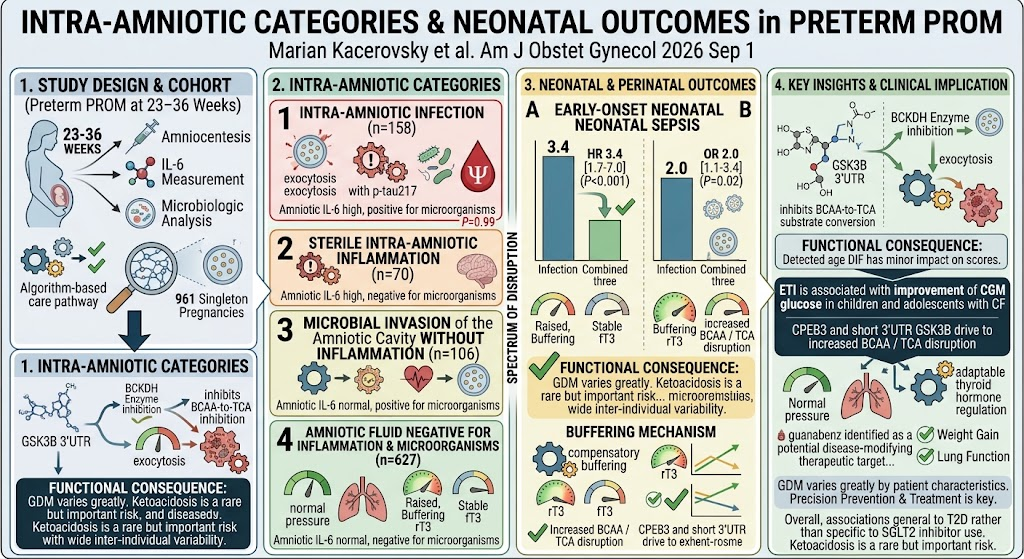
Preterm prelabor rupture of membranes (PROM), defined as rupture of the fetal membranes before the onset of labor and prior to 37 completed weeks of gestation, remains a significant cause of preterm birth and neonatal morbidity. It involves a disruption of the amniotic sac integrity, which can expose the amniotic cavity to microbial invasion, triggering inflammation and potentially leading to adverse perinatal outcomes. Understanding the intra-amniotic environment during preterm PROM is critical to optimizing neonatal outcomes and tailoring clinical interventions.

Historically, intra-amniotic involvement in preterm PROM has been characterized predominantly by the presence or absence of infection, often neglecting the spectrum of inflammatory and microbial states. This study categorizes intra-amniotic conditions into four distinct types based on the presence or absence of inflammation and microbial invasion, providing a gestational age-specific overview and associated neonatal outcomes.

MedXY registered readers

Sign in free to continue reading

Create or use your MedXY account to unlock the complete article.

This article was created using several editorial tools, including AI, as part of the process. Human editors reviewed this content before publication.

Related articles

Open language-specific specialty feeds and department pages.

Minimally Invasive Prediction Models for Intra-Amniotic Infection and Early Delivery Risk in Preterm LaborThis article examines validated minimally invasive prediction models combining ultrasound and biomarkers to identify women at high risk for intra-amniotic infection or early delivery in preterm labor, aiming to guide selective amniocentesisAug 21, 2026
Loading comments...
MedXY briefing

Get the free newsletter

Evidence-led clinical news, trends, and analysis—delivered to your inbox.

Ask MedXY AI

Most popular

Intimate Health
Five Benefits for Women Continuing Sexual Activity After Menopause
Intimate Health
Why Some Women Have a Strong Sex Drive—And Why Men Shouldn't Worry About It
Nursing & care
How often should a couple have sex?
Intimate Health
Classic Intimacy Recommendations: How to Help Women Reach Orgasm and Enjoy Mutual Pleasure
Intimate Health
What Makes a Woman "Physiologically Addicted" Is Never Money, But These Two Relationship Qualities
© 2026 MedXY
Contact usAbout usPrivacy PolicyMedXY story