Highlight
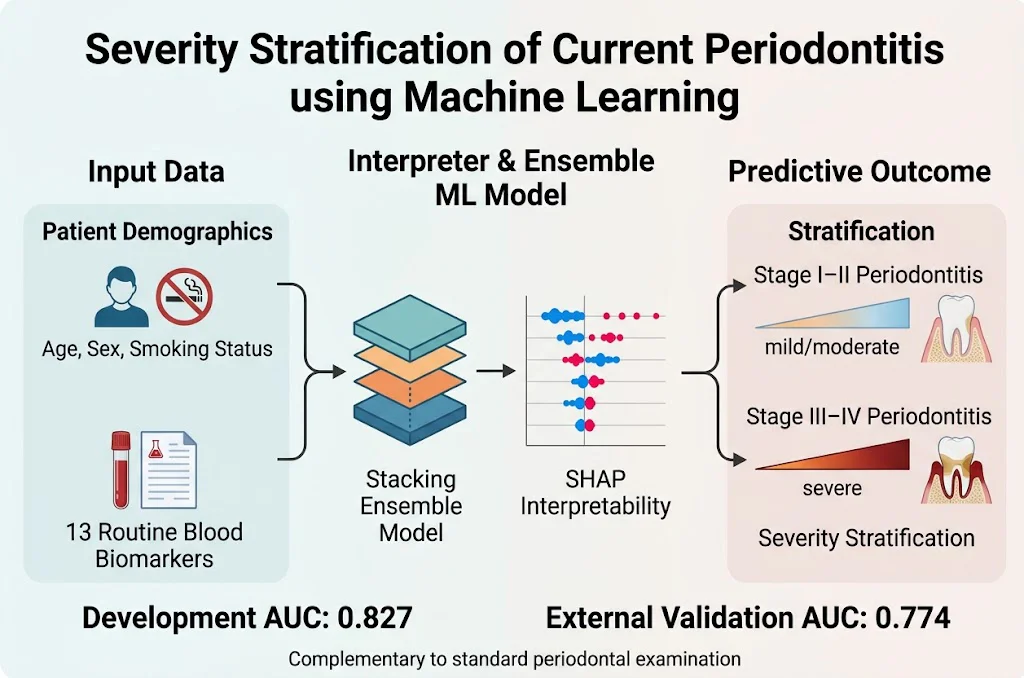
This study developed and externally validated an interpretable machine learning (ML) model to stratify the severity of periodontitis (Stage III-IV vs. Stage I-II) using routine blood biomarkers combined with demographic and behavioral factors. The stacking model showed moderate discriminatory performance with an external validation area under the curve (AUC) of 0.774. Incorporation of blood-derived markers modestly improved prediction beyond age, sex, and smoking status. However, calibration was suboptimal on external data, suggesting caution before clinical implementation. Exploratory analyses identified potential age- and sex-related variations in predictor effects, underscoring the need for further validation in diverse populations.
Study Background and Disease Burden
Periodontitis is a common chronic inflammatory disease characterized by progressive destruction of the tooth-supporting tissues, leading to tooth loss and impaired oral function. It also has systemic health implications, including associations with cardiovascular disease and diabetes. Accurate staging of periodontitis severity informs clinical management, from preventive care to surgical intervention. Currently, severity assessment primarily relies on clinical periodontal examination, including probing depths, clinical attachment loss, and radiographic bone loss—techniques requiring specialized dental expertise. Routine blood biomarkers reflecting systemic inflammation and immune status may potentially serve as surrogate indicators of periodontitis severity, enabling broader screening and risk stratification. This avenue is attractive for primary care or resource-constrained settings but lacks robust validated predictive models.
Study Design
This investigation is a two-center retrospective cohort study involving 1,321 patients from the development hospital and 584 patients from an external validation hospital affiliated with Zhejiang University School of Medicine. Inclusion criteria focused on adults with established periodontitis, classified into Stage III-IV (severe) or Stage I-II (mild to moderate) groups using standard clinical criteria. Predictors utilized were demographic variables (age, sex), smoking status (a key behavioral risk factor), and 13 routine blood-derived laboratory markers reflecting inflammation, immune function, and hematologic status. The data were sufficiently complete for model development. A stacking ensemble ML approach integrated diverse predictive algorithms to maximize performance while preserving interpretability. Model performance metrics included discrimination (area under the receiver operating characteristic curve or AUC), calibration (agreement between predicted and observed probabilities), classification accuracy, and clinical utility assessed through decision-curve analysis. The model was finalized before external validation to prevent information leakage. Exploratory subgroup analyses examined age- and sex-specific variations using SHAP (Shapley Additive Explanations) values and restricted cubic spline modeling to elucidate nonlinear predictor effects.
Key Findings
The stacking model achieved an out-of-fold AUC of 0.827 (95% confidence interval [CI]: 0.802–0.851) on development data, indicating strong discrimination between severe and milder periodontitis. External validation demonstrated a modest reduction in performance with an AUC of 0.774 (95% CI: 0.730–0.818), affirming the model’s generalizability yet highlighting some overfitting or population differences. Calibration in the external cohort was less favorable, with an intercept of 0.785 and slope of 0.822, suggesting systematic underestimation of severity risk. In simpler models using only age, sex, and smoking status, external AUC was 0.745; adding the 13 blood biomarkers improved AUC modestly to 0.763, indicating incremental but not transformational prognostic value of routine laboratory data.
Decision-curve analysis demonstrated potential net clinical benefit of the ML model over default clinical strategies across plausible risk thresholds, supporting its prospective utility as a risk stratification tool. Exploratory SHAP analyses revealed that certain blood markers (e.g., inflammatory markers) had nonlinear, age- and sex-dependent contributions to predicted severity. These insights suggest biological heterogeneity in disease expression and systemic responses that could refine patient-specific predictions with future model updates.
Expert Commentary
This study exemplifies the promise and challenges of incorporating routinely measured laboratory data into machine learning models for complex chronic diseases like periodontitis. The moderate external discrimination supports that systemic inflammation and hematologic markers reflect disease severity to some extent. However, suboptimal calibration and the modest added value beyond basic clinical features caution against immediate clinical adoption. The model does not replace specialized periodontal examination, which is the established gold standard for diagnosis and staging.
Limitations include the retrospective design, potential residual confounding, and single geographic population potentially limiting broader applicability. Future prospective, multi-center studies incorporating more diverse populations and additional biomarkers such as salivary diagnostics or microbiome profiles could enhance model robustness. Additionally, refining calibration with larger external datasets and potentially developing age- and sex-specific models are warranted.
From a mechanistic perspective, systemic blood biomarkers likely capture inflammation and immune activation associated with severe periodontitis but do not directly measure local tissue destruction. Integration with clinical and imaging data may yield a comprehensive risk prediction framework.
Conclusion
The interpretative machine learning model combining age, sex, smoking status, and routine blood biomarkers provides a moderately accurate tool for stratifying periodontitis severity in adults with established disease. While blood markers improve prediction modestly beyond demographic and behavioral factors, the model’s current limitations in external calibration and discrimination preclude its use as a standalone diagnostic substitute for clinical dental examination. Further multi-center validation, refinement, and recalibration are imperative before translation into clinical practice. This work lays groundwork for leveraging accessible blood-based biomarkers in AI-assisted periodontal risk assessment, potentially facilitating early identification and targeted management of severe periodontitis.
Funding and ClinicalTrials.gov
The study was conducted utilizing patient data from hospitals affiliated with Zhejiang University School of Medicine. No specific funding or clinical trial registration details were indicated.
References
Shi H, Yao J, Jiang Z, Chen M, Zhuge Q, Jiang C, Chen Y, Qian Y. Development and External Validation of An Interpretable Machine Learning Model for Severity Stratification of Current Periodontitis Using Routine Blood Biomarkers, With Exploratory Analyses of Age- and Sex-Specific Model Behaviour. J Clin Periodontol. 2026 Oct 28. doi: 10.1111/jcpe.70220. Epub ahead of print. PMID: 42952114.