Innovative Prosthetic Capsular Bag Enables Secure Scleral Fixation of Intraocular Lenses Without Capsular Support
Highlight
- Introduction of a prosthetic capsular bag (PCB) as a sutureless scleral fixation platform for secondary intraocular lenses (IOL) in eyes without capsular support.
- First-in-human prospective study shows favorable safety profile with only one device-related serious adverse event.
- Over 90% of patients maintain or improve best-corrected visual acuity, with significant gains in uncorrected visual acuity.
- PCB demonstrated reliable refractive accuracy with low variability in spherical equivalent outcomes.
Study Background
Patients with insufficient capsular or zonular integrity pose a significant clinical challenge when secondary intraocular lens (IOL) implantation is required. Traditional fixation options, including anterior chamber IOLs, iris-fixated IOLs, or scleral-sutured IOLs, often present technical complexity and a high incidence of complications such as IOL dislocation, conjunctival erosion, and inflammation. The absence of a stable capsular bag, which normally supports the IOL, leaves surgeons reliant on alternative fixation methods that may compromise anatomical and refractive outcomes. The prosthetic capsular bag (PCB) was developed to address this unmet clinical need by providing a secure, sutureless scleral fixation platform for posterior chamber IOLs in eyes lacking native capsular or zonular support.
Study Design
This was a multicenter, prospective, open-label, single-arm exploratory first-in-human study conducted at three retina centers in Sydney, Australia. Fifteen patients with inadequate capsular or zonular integrity necessitating secondary IOL implantation were enrolled. Indications included removal of dislocated crystalline lenses and previously implanted IOLs as clinically indicated.
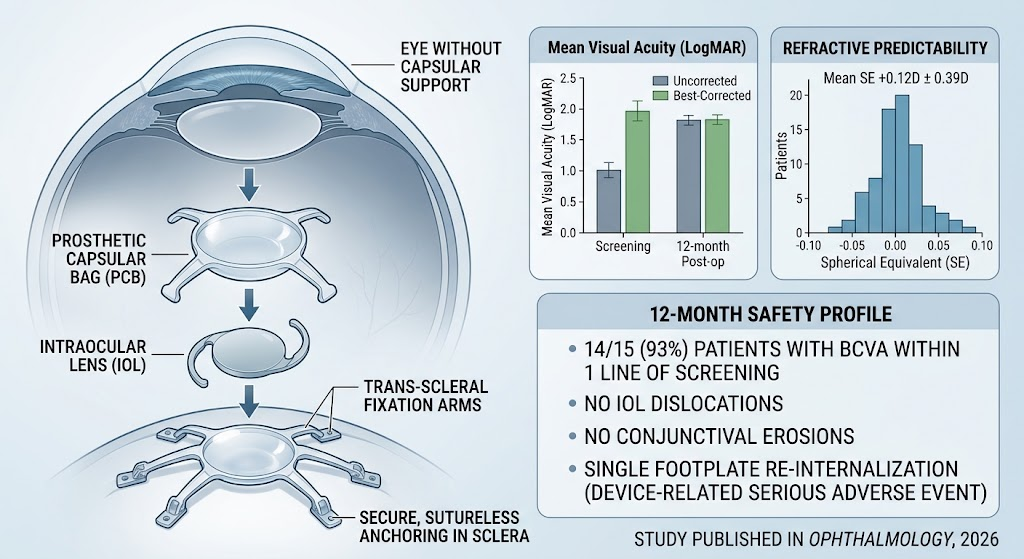
Surgical intervention entailed pars plana vitrectomy followed by insertion of the PCB through a standard IOL injector. The PCB could be inserted with or without a preloaded IOL. The PCB featured three fixation arms that were secured transsclerally without the need for sutures or scleral pockets, representing a novel sutureless fixation technique designed to minimize tissue trauma and risk of conjunctival erosion.
The primary endpoint was the incidence and characterization of adverse events related to the PCB device up to 12 months postoperatively. Secondary assessments included visual acuity outcomes, refractive stability, and device integrity.
Key Findings
All 15 patients completed the 12-month follow-up period. The safety profile of the PCB was favorable with no cases of conjunctival erosion over the fixation arms or IOL dislocation from the prosthetic bag noted. One serious device-related adverse event was reported in a patient with Marfan’s syndrome, where reinternalization of a single footplate occurred, necessitating secondary surgery to refixate the footplate. This highlights the importance of patient selection and monitoring in connective tissue disorders.
Visual acuity outcomes were robust. Ninety-three percent of patients maintained best-corrected visual acuity (BCVA) within one line of their preoperative baseline, indicating stability of vision post-implantation. Notably, uncorrected visual acuity (UCVA) improved on average by 12 lines, with 71% of patients achieving UCVA within two lines of their baseline BCVA. This suggests the PCB not only maintained but often enhanced visual function.
Refractive outcomes demonstrated excellent predictability, with a mean spherical equivalent of +0.12 diopters (standard deviation of 0.39 D), signifying minimal refractive variability and high accuracy of lens positioning within the prosthetic bag platform.
Expert Commentary
The development of a prosthetic capsular bag represents a significant advancement in secondary IOL implantation techniques, particularly for eyes lacking capsular support. Conventional scleral fixation techniques frequently rely on sutures or complex scleral flap construction, which may predispose to suture-related erosion, late IOL dislocation, and longer surgical time. By obviating the need for sutures and scleral pockets, the PCB streamlines the surgical procedure while potentially reducing the risk of complications.
The single serious adverse event in a patient with Marfan’s syndrome underscores that connective tissue disorders may pose unique challenges even with innovative devices. Further studies with larger sample sizes and longer follow-up are essential to verify long-term device safety and effectiveness. Additionally, comparative trials against established fixation methods would clarify relative benefits and limitations.
Mechanistically, the PCB mimics the anatomical support function of the natural capsular bag, providing centration and stability to the IOL and maintaining appropriate lens position within the posterior chamber—key determinants of optimal refractive outcomes. This aligns with understanding that IOL decentration or tilt can significantly impact visual quality and refractive predictability.
Conclusion
This initial human study suggests that the prosthetic capsular bag is a viable and innovative platform for secure scleral fixation of posterior chamber IOLs in eyes without residual capsular or zonular support. It offers a sutureless, stable fixation approach with encouraging visual and refractive outcomes and a low complication rate. If confirmed in subsequent larger-scale studies, the PCB may become a preferred solution for complex secondary IOL implantations, improving patient outcomes in this challenging clinical scenario.
Funding and Registration
The study disclosed proprietary or commercial interests in the footnotes and disclosures sections. Specific funding sources were not detailed in the abstract. Additional clinical studies are planned to further evaluate this technology.
References
- Brodie FL, Naseri A, Ho IV, et al. Clinical Outcomes of a Prosthetic Capsular Bag for Scleral Fixation of an Intraocular Lens in Eyes without Capsular Support. Ophthalmology. 2026;133(8):965-970. PMID: 42036076.
- Gabor SG, Roman L. Transscleral sutured posterior chamber intraocular lens implantation in the absence of capsule support. J Cataract Refract Surg. 1997 Feb;23(2):166-72.
- Sheng T, Qian T, Peng T, Liu Y, Liang S. Outcomes of scleral fixation of intraocular lenses. Eye Sci. 2017 Mar;32(1):45-50.
This article was created using several editorial tools, including AI, as part of the process. Human editors reviewed this content before publication.