We use cookies

Our website uses essential cookies and, with your consent, additional cookies to measure performance and improve our services. Cookie Policy.

You can change your choice at any time.

MMedXYNews
HomeVideos
MedXY AI/MedXY News/Section: news

Influence of Breast Reconstruction Type and Placement on Radiation Therapy Outcomes: Clinical Insights and Implications
MedXY Editorial Team•Aug 5, 2026•news
Breast Reconstructioninternal mammary noderadiation therapydose distribution

Highlight

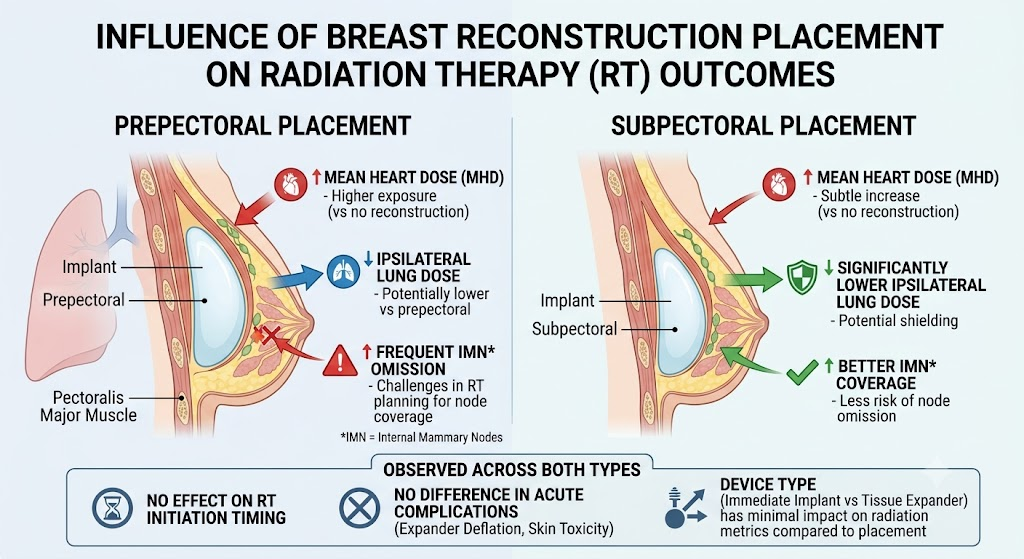
  • Prepectoral and subpectoral breast reconstructions increase mean heart radiation dose compared with nonreconstruction.

  • Subpectoral placement is associated with reduced ipsilateral lung dose during radiation therapy.

  • Prepectoral reconstruction more frequently results in internal mammary node omission during radiation planning.

  • Device type (immediate implant versus tissue expander) does not significantly affect radiation dose metrics or treatment timing.

Study Background

MedXY registered readers

Sign in free to continue reading

Create or use your MedXY account to unlock the complete article.

This article was created using several editorial tools, including AI, as part of the process. Human editors reviewed this content before publication.

Related articles

Open language-specific specialty feeds and department pages.

A Split-Muscle Support Technique for Direct-To-Implant Breast Reconstruction: A Case SeriesThis report details the first application of the split-muscle support technique in direct-to-implant breast reconstruction, highlighting its approach to reduce animation deformity and enhance implant support with less ADM use.Sep 2, 2026Defining a Quantitative Perfusion Threshold with SPY-PHI QP to Predict Mastectomy Skin Necrosis in Breast Reconstruction: Insights and Clinical ImplicationsThis prospective study identifies a 30% SPY-PHI QP perfusion threshold predictive of mastectomy skin flap necrosis in staged breast reconstruction, highlighting the confounding effect of nitroglycerin ointment and underscoring the need forAug 27, 2026Does Industry Influence Persist? Financial Conflicts and ADM Outcomes After the 2021 FDA Safety Alert: A Case Report AnalysisThis report examines the ongoing association between industry payments and positive outcomes reported in acellular dermal matrix (ADM) studies following the 2021 FDA safety alert.Aug 20, 2026
Loading comments...
MedXY briefing

Get the free newsletter

Evidence-led clinical news, trends, and analysis—delivered to your inbox.

Ask MedXY AI

Most popular

Intimate Health
Five Benefits for Women Continuing Sexual Activity After Menopause
Intimate Health
Why Some Women Have a Strong Sex Drive—And Why Men Shouldn't Worry About It
Nursing & care
How often should a couple have sex?
Intimate Health
Classic Intimacy Recommendations: How to Help Women Reach Orgasm and Enjoy Mutual Pleasure
Intimate Health
What Makes a Woman "Physiologically Addicted" Is Never Money, But These Two Relationship Qualities
© 2026 MedXY
Contact usAbout usPrivacy PolicyMedXY story
Prepectoral Direct-to-Implant Breast Reconstruction: A Viable Single-Stage Alternative?
This study examines prepectoral direct-to-implant breast reconstruction, showing it reduces complication rates and total surgeries compared to two-stage reconstruction, despite increased minor aesthetic revisions. It supports DTI as a safe,
Aug 18, 2026
Advancing Breast Flap Viability Assessment: Laser Speckle Contrast Imaging Versus Indocyanine Green FluorescenceThis article reviews a prospective study comparing Laser Speckle Contrast Imaging (LSCI) and Indocyanine Green (ICG) fluorescence for predicting necrosis in immediate breast reconstruction, highlighting LSCI’s repeatability and sensitivityAug 7, 2026
Harnessing Machine Learning to Predict Patient-Reported Outcomes After Breast Reconstruction: A Step Forward in Personalized Surgical CareRecent research demonstrates that machine learning algorithms can accurately predict patient-reported outcomes one year after breast reconstruction, potentially enhancing shared decision-making and individualized care planning.Jul 16, 2026