Impact of Surgical Unit Volume on Recurrence and Complications after Open Mesh Groin Hernia Repair: Insights from a Nationwide Swedish Cohort
Highlights
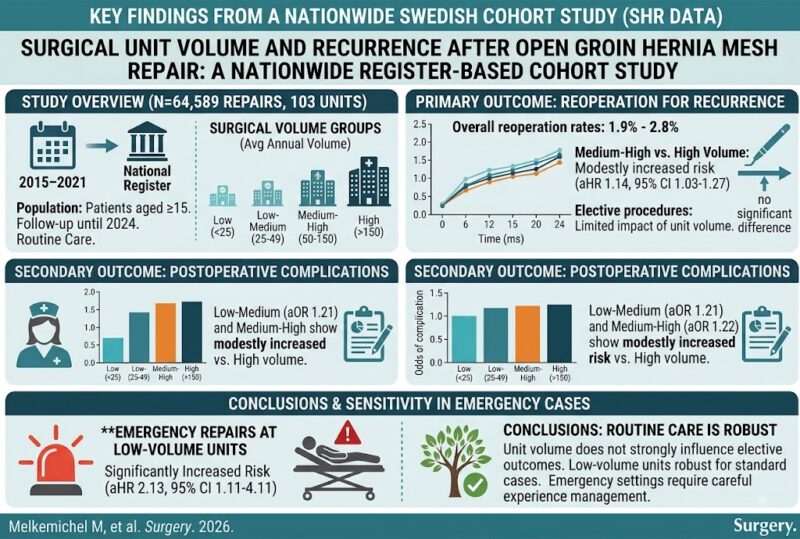
- Surgical volume showed limited influence on recurrence rates following elective open anterior mesh groin hernia repair.
- Low-volume surgical units had significantly increased recurrence and reoperation risk in emergency groin hernia repairs.
- Postoperative complications were modestly higher in low-medium and medium-high volume units compared with high-volume units.
- Findings emphasize the importance of experience especially in emergency repair settings.
Study Background
Groin hernia repair is one of the most common surgical procedures worldwide, with open anterior mesh repair remaining a widely used technique. Recurrence after hernia repair is a critical outcome reflecting surgical quality, with implications for patient morbidity and healthcare costs. Previous research has suggested that surgical experience and institutional volume may influence patient outcomes in various surgical procedures. However, the relationship between surgical unit volume and recurrence or complications after open anterior mesh groin hernia repair remains unclear. Particularly, the effect of volume on urgent or emergency repairs has not been thoroughly explored. Understanding these dynamics could inform organizational strategies and patient referral patterns to improve outcomes.
Study Design
This investigation was a nationwide population-based cohort study utilizing prospectively collected data from the Swedish Hernia Register, encompassing 64,589 open anterior mesh groin hernia repairs performed between 2015 and 2021. The study population included all patients aged 15 years and older undergoing this procedure. Surgical units were categorized into four strata based on their average annual operative volume:
- Low volume: less than 25 repairs/year
- Low-medium volume: 25 to 49 repairs/year
- Medium-high volume: 50 to 150 repairs/year
- High volume: more than 150 repairs/year
The primary outcome was reoperation for hernia recurrence with follow-up extending to 2024. Secondary outcomes included postoperative complications within 30 days of surgery. Adjusted hazard ratios (HR) and odds ratios (OR) with 95% confidence intervals (CI) were calculated to compare risks between volume groups.
Key Findings
The overall rate of reoperation for recurrence was low across all volume groups, ranging from 1.9% to 2.8%. When compared to high-volume units (reference group), medium-high volume units exhibited a modest but statistically significant increased risk of reoperation for recurrence (HR 1.14; 95% CI 1.03–1.27). Neither low-volume nor low-medium volume units showed significant differences in recurrence risk for elective repairs.
Notably, emergency groin hernia repairs performed at low-volume units displayed a markedly higher risk of reoperation for recurrence, with a hazard ratio of 2.13 (95% CI 1.11–4.11), underscoring a heightened vulnerability in the emergency context.
Postoperative complications within 30 days were more frequent in medium-high (OR 1.22; 95% CI 1.15–1.29) and low-medium volume units (OR 1.21; 95% CI 1.09–1.35) compared with high-volume centers. Low-volume units did not show a statistically significant increase in complications compared to high-volume units.
Expert Commentary
The findings suggest that for elective open anterior mesh groin hernia repairs, surgical unit volume has a limited clinical impact on the risk of recurrence and complications. This is reassuring, indicating that outcomes are relatively consistent across a wide range of institutional volumes in elective settings. However, the significantly increased risk observed during emergency repairs at low-volume centers highlights the critical role of surgical experience when managing more complex or urgent cases.
This volume-outcome relationship in emergencies may be due to the greater technical demands, complexity, or patient instability in such cases, requiring more practiced teams. The slight increase in complications in medium volume units could reflect variations in perioperative care protocols or patient case-mix, warranting further evaluation.
Limitations of the study include its observational nature, potential residual confounding, and lack of granular data on surgeon volume, mesh types, or surgical techniques. However, the large population base and national registry data enhance the generalizability and reliability of these findings.
Conclusion
This comprehensive nationwide cohort study provides strong evidence that surgical unit volume exerts limited influence on recurrence and short-term complications after elective open anterior mesh groin hernia repair. Nonetheless, emergency repairs performed at low-volume units carry a significantly elevated risk of recurrence requiring reoperation. These findings advocate for ensuring that emergency groin hernia repairs are centralized or managed by experienced teams to optimize patient outcomes. Future research might focus on surgeon-level factors and standardized care pathways to further reduce complications and recurrence rates across all settings.
Funding and Trial Registration
The study was conducted using data from the Swedish Hernia Register, supported by institutional research funding. No specific clinical trial registration information is reported.
References
1. Melkemichel M, Weiler D, Bergström M, Bringman S, Widhe B. Surgical unit volume and recurrence after open groin hernia mesh repair: A nationwide register-based cohort study. Surgery. 2026 May 22;196:110335. doi:10.1016/j.surg.2026.110335. PMID: 42275915.
2. Simons MP, Aufenacker T, Bay-Nielsen M, et al. European Hernia Society guidelines on the treatment of inguinal hernia in adult patients. Hernia. 2009 Aug;13(4):343-403.
3. Nilsson H, Styf J, Nordin P. Complications and recurrences following open and laparoscopic inguinal hernia repair. Hernia. 2001 Mar;5(1):18-22.
4. Vickers D, Mantoo S, Rodrigo S, et al. Correlation between hospital volume and outcomes in hernia repair surgery: a systematic review. Hernia. 2019 Feb;23(1):15-25.
This article was created using several editorial tools, including AI, as part of the process. Human editors reviewed this content before publication.