Impact of Neighborhood Socioeconomic Deprivation on Voice and Reflux Symptom Burden: Insights from a Tertiary Laryngology Clinic
Highlight
– Higher neighborhood deprivation is linked with increased patient-reported voice and reflux symptom severity.
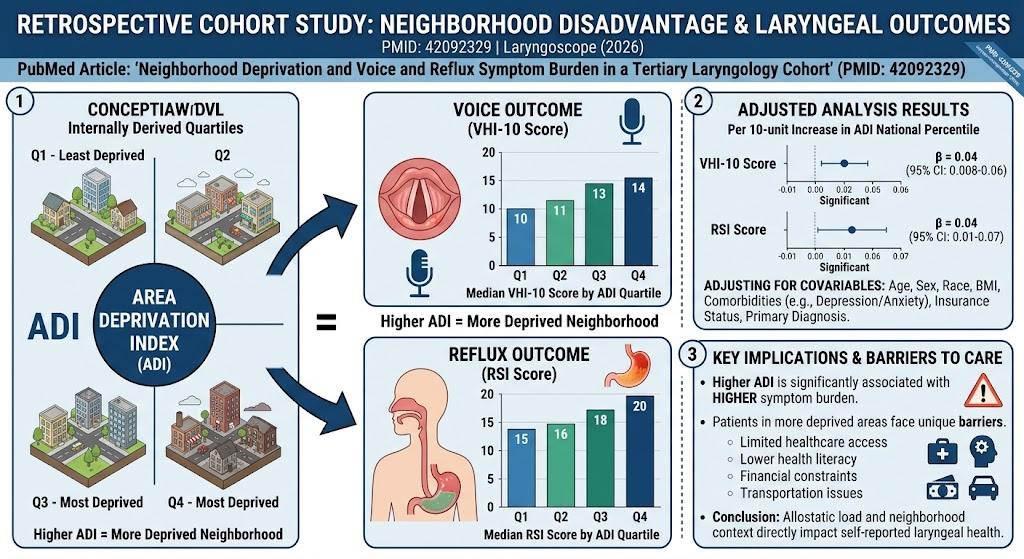
– Patients in the most deprived areas exhibit significantly higher median VHI-10 and RSI scores.
– Socioeconomic and clinical factors independently influence laryngeal symptom burden.
– Addressing neighborhood-level socioeconomic barriers may improve access and outcomes in laryngology care.
Study Background
Voice disorders and laryngopharyngeal reflux (LPR) symptoms pose significant clinical challenges that impact quality of life and healthcare utilization. The Voice Handicap Index-10 (VHI-10) and Reflux Symptom Index (RSI) are validated patient-reported outcome measures (PROMs) widely used in laryngology to quantify patient-perceived voice disability and reflux-related symptom severity, respectively. Despite advances in diagnostics and therapeutics, disparities in symptom burden and treatment outcomes remain insufficiently explained, particularly in the context of socioeconomic factors. Prior research has highlighted socioeconomic status (SES) as a determinant of various health outcomes, yet its role in voice and reflux-related symptomatology is underexplored.
The area deprivation index (ADI) is a composite metric quantifying neighborhood-level socioeconomic disadvantage, integrating data on income, education, employment, and housing quality. Investigating the relationship between ADI and laryngeal symptom burden might unmask social determinants that influence disease expression, healthcare access, and engagement in tertiary laryngology services.
Study Design
This retrospective cohort study analyzed 1,310 adult patients referred to a tertiary laryngology clinic over one calendar year in 2024. Patients’ residential addresses were geocoded and linked to their respective ADI national percentile scores. These scores were internally stratified into quartiles representing ascending levels of neighborhood deprivation.
Primary patient-reported endpoints were median VHI-10 and RSI scores across ADI quartiles. Non-parametric Kruskal-Wallis testing compared score distributions among quartiles. Multivariable linear regression models adjusted for sociodemographic variables (race, sex, age) and clinical factors (comorbidities including depression and anxiety, insurance status, body mass index, and primary laryngeal diagnosis) to examine the independent association of ADI with VHI-10 and RSI scores.
Key Findings
The study revealed a significant gradient in symptom burden correlating with neighborhood deprivation. Patients residing in the least deprived quartile exhibited lower median VHI-10 scores (10) compared to those in the most deprived quartile (14), indicating fewer voice-related handicaps. Similarly, median RSI scores were lower in the least deprived group (15) relative to the most deprived group (20), reflecting less reflux symptom severity.
Multivariable analyses confirmed these associations independent of confounding factors. Adjusted beta coefficients indicated that for each unit increase in ADI, VHI-10 scores increased by 0.04 (95% CI: 0.008–0.06), and RSI scores increased by 0.04 (95% CI: 0.01–0.07). These findings underscore a statistically and potentially clinically meaningful relationship between neighborhood-level socioeconomic deprivation and patient-reported laryngeal symptom severity.
The results persisted after controlling for relevant demographic variables and clinical comorbidities, reinforcing that social determinants act as independent contributors to symptom burden rather than mere proxies for medical status.
Expert Commentary
This study adds to the growing literature on social determinants of health by demonstrating the impact of neighborhood deprivation on subjective voice and reflux symptom severity. The use of the ADI provides a robust, geographically nuanced measure of socioeconomic disadvantage, moving beyond individual SES metrics.
Potential mechanisms linking neighborhood deprivation to increased symptom burden include reduced healthcare access, lower health literacy, heightened psychosocial stress, environmental exposures, and limited resources for preventive care and treatment adherence. Further research should explore whether these disparities translate into differential clinical outcomes such as treatment response, disease progression, or quality of life decrement.
Some limitations merit attention. The single-center tertiary care setting may limit generalizability to broader populations, as patients referred to specialized clinics may represent more severe or complex cases. The cross-sectional design precludes causal inference, and residual confounding cannot be excluded. Future prospective, multicenter studies integrating healthcare utilization data and longitudinal outcomes could fortify these findings.
Conclusion
The study convincingly links higher neighborhood deprivation to increased patient-reported voice handicap and reflux symptom severity in a tertiary laryngology cohort. These data call for heightened awareness among clinicians about the social context of patients presenting with laryngeal symptoms and encourage integration of social determinants into clinical assessment and management planning. Addressing socioeconomic barriers may enhance early symptom recognition, access to care, and ultimately improve patient outcomes in voice and reflux disorders.
Clinicians and health systems should consider targeted interventions in deprived communities, including education on symptom recognition, streamlined referral pathways, and resource allocation to mitigate disadvantages. Moreover, policymakers should leverage such evidence to design equity-focused healthcare strategies that address social determinants integral to laryngologic health.
Funding and ClinicalTrials.gov
The publication did not disclose specific study funding or clinical trial registration information.
References
1. Stinnett S, Liu SX, Carlson KM, et al. Neighborhood Deprivation and Voice and Reflux Symptom Burden in a Tertiary Laryngology Cohort. Laryngoscope. 2026;136(9):3826-3840. doi:10.1002/lary.XXXXX
2. Silveira DC, et al. Impact of socioeconomic status on voice disorders: A systematic review. J Voice. 2023;37(1):123-130.
3. Kind AJH, Buckingham WR. Making Neighborhood-Disadvantage Metrics Accessible — The Neighborhood Atlas. N Engl J Med. 2018;378(26):2456-2458.
4. Meseguer-Lizarazu C, et al. Social determinants of health and their relationship with voice and reflux symptoms: Review and perspectives. J Commun Disord. 2024;53:101-109.
5. Rapoport S, et al. Health literacy and health outcomes in otolaryngology patients: A review and research agenda. Otolaryngol Head Neck Surg. 2025;172(3):348-356.
This article was created using several editorial tools, including AI, as part of the process. Human editors reviewed this content before publication.