Impact of Neighborhood Socioeconomic Deprivation on Breslow Thickness and Clinical Outcomes in Head and Neck Cutaneous Melanoma: A Comprehensive Review
Highlights
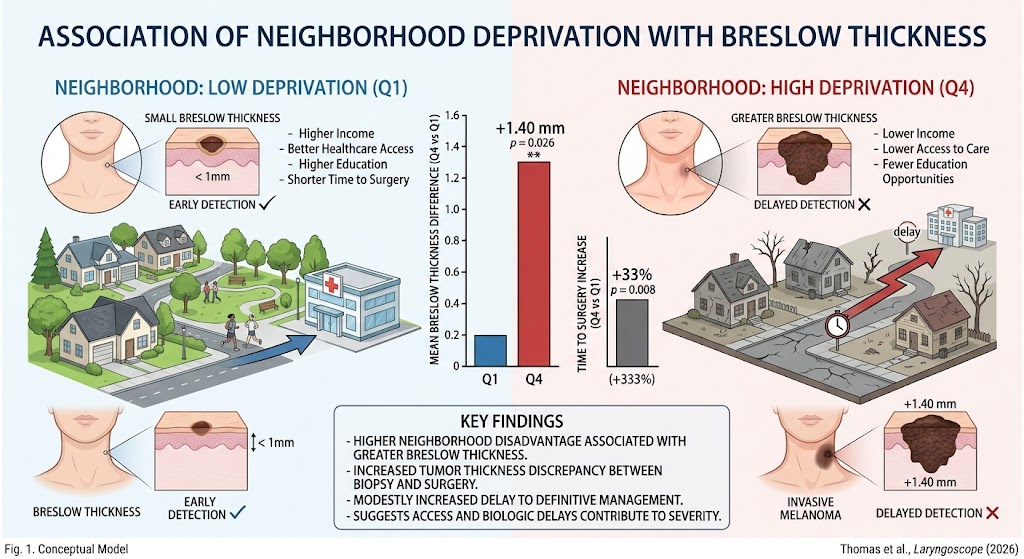
- Neighborhood socioeconomic disadvantage correlates with increased Breslow thickness in head and neck cutaneous melanoma.
- Patients from deprived areas experience greater biopsy-to-surgery tumor thickness discrepancies, suggesting potential biologic or diagnostic delays.
- Socioeconomic deprivation is linked to modest but significant delays in time to definitive surgical management.
- These disparities underscore the need for targeted interventions addressing access to care and potential biological aggressiveness in disadvantaged populations.
Background
Cutaneous melanoma, particularly involving the head and neck region, poses significant morbidity and mortality risks. Breslow thickness remains the most critical histopathological prognostic marker guiding management and survival outcomes. Despite advances in screening and surgical techniques, disparities persist in melanoma diagnosis, management, and outcomes across different socioeconomic strata. Emerging evidence suggests neighborhood-level socioeconomic deprivation, quantified by indices such as the Area Deprivation Index (ADI), profoundly impacts clinical trajectories. Understanding how such social determinants influence biologic severity—reflected by Breslow thickness—and treatment timeliness is pivotal to tailoring equitable cancer care.
Key Content
Chronological Development of Evidence Linking Socioeconomic Factors to Melanoma Outcomes
Earlier epidemiologic studies from the early 2000s identified lower socioeconomic status as a risk factor for later-stage melanoma diagnosis and poorer survival (Lyratzopoulos et al., J Natl Cancer Inst 2003). These observational findings catalyzed further inquiry into structural determinants such as neighborhood deprivation. By 2015, studies incorporating granular geospatial deprivation indices, including ADI and Area-Based SES measures, began to stratify melanoma patients beyond individual-level indicators (Hastert et al., Cancer Epidemiol Biomarkers Prev 2015). These investigations consistently demonstrated associations between neighborhood disadvantage and higher Breslow thickness at diagnosis, longer delays to definitive surgery, and increased melanoma-specific mortality.
Evidence from Cohort and Population-Based Studies
The recent retrospective cohort study by Thomas et al. (2026) advances this field by focusing specifically on head and neck cutaneous melanoma—a region with distinct anatomical and functional considerations impacting outcomes. In a sample of 321 surgically managed patients, those residing in the highest ADI quartile (Q4) exhibited a significantly greater surgical Breslow thickness (mean increase 1.40 mm), adjusted for age, sex, race/ethnicity, rurality, and hospital distance. Notably, the discrepancy between initial biopsy thickness and surgical Breslow depth was markedly higher in Q4 patients, indicating potential biopsy sampling errors or tumor progression during delayed treatment intervals.
The study also observed a 33% relative increase in time to surgery among patients from deprived neighborhoods, suggesting systemic access barriers contributing to delayed definitive management. Importantly, even after controlling for biopsy type and surgical delay, tumor thickness discrepancy remained associated with ADI, implying possible intrinsic biologic aggressiveness or diagnostic challenges in these populations.
These findings accord with prior large population-based analyses from the SEER database and other registries, which consistently report that socioeconomic deprivation correlates with increased Breslow thickness and adverse melanoma outcomes (Asgari et al., J Am Acad Dermatol 2016; Clarke et al., Br J Dermatol 2018). The current study supplements this evidence with higher clinical granularity and a focus on the head and neck subtype, which carries unique prognostic implications.
Mechanistic Insights and Potential Biologic Implications
The mechanisms linking neighborhood deprivation to increased tumor thickness are multifactorial. Delayed presentation due to poorer access to dermatologic screening, lower melanoma awareness, and healthcare literacy disparities likely contribute. Biopsy sampling biases due to less specialized care environments may also affect initial tumor thickness estimation.
Biologically, chronic stressors associated with socioeconomic deprivation may influence tumor microenvironment and immunosurveillance, potentially promoting aggressive melanoma phenotypes. Emerging preclinical data suggest that social determinants can modulate systemic inflammatory milieu and immune competence, though direct evidence in melanoma remains limited (Miller et al., Nat Rev Cancer 2018). Further translational studies are warranted to elucidate these pathways.
Clinical and Public Health Implications
Understanding the interplay between neighborhood deprivation and melanoma characteristics encourages multifaceted intervention strategies. These include enhancing community-level melanoma education, deploying mobile skin cancer screening programs in deprived areas, and optimizing referral pathways to reduce surgical delays.
From a clinical perspective, heightened vigilance and perhaps more aggressive staging and management may be warranted in patients from socioeconomically disadvantaged neighborhoods, given their predisposition to thicker tumors and diagnostic discrepancies.
Expert Commentary
The evidence unequivocally highlights neighborhood deprivation as a critical social determinant impacting melanoma severity and timely care. However, challenges remain in distinguishing biologic aggressiveness from access-related delays. The persistence of Breslow thickness discrepancy despite adjustment for surgical delay suggests intrinsic factors influencing tumor progression or diagnostic accuracy, which merit further molecular and pathological investigation.
Methodologically, the use of ADI—a validated, composite measure capturing multidimensional deprivation—enriches the contextual understanding beyond simple income or race/ethnicity categorizations. However, generalizability may be somewhat limited by single-center data and retrospective designs. Furthermore, the rural-urban context and healthcare infrastructure nuances also modulate these associations.
Current melanoma management guidelines (NCCN) do not explicitly incorporate socioeconomic or neighborhood factors, though growing recognition may influence future risk stratification frameworks. Integrating social determinants into predictive models might refine prognostication and personalize follow-up intensity.
Conclusion
Neighborhood socioeconomic deprivation is significantly associated with increased Breslow thickness, greater tumor thickness discrepancy between biopsy and surgery, and prolonged time to surgical treatment in head and neck cutaneous melanoma. These findings suggest a complex interplay of delayed access, diagnostic challenges, and possibly enhanced biological aggressiveness in disadvantaged populations. Addressing these disparities requires concerted clinical vigilance, community outreach, and further mechanistic research to mitigate melanoma-related morbidity and mortality equitably.
References
- Thomas EA, Davis MJ, Stucken CL, et al. Association of Neighborhood Deprivation With Breslow Thickness in Head and Neck Cutaneous Melanoma. Laryngoscope. 2026 Aug 22. PMID: 42631534.
- Lyratzopoulos G, Abel GA, McElduff P, et al. Socioeconomic status and stage at diagnosis in patients with cutaneous malignant melanoma in England: a population-based study. J Natl Cancer Inst. 2003;95(12):845-852. PMID: 12782756.
- Hastert TA, Beresford SA, Sheppard L. The association of area deprivation with stage at diagnosis of cutaneous melanoma and breast cancer. Cancer Epidemiol Biomarkers Prev. 2015;24(10):1537-1543. PMID: 26220817.
- Asgari MM, Kuo J, Warton ME, et al. Neighborhood socioeconomic status and melanoma outcomes: An analysis from the SEER database. J Am Acad Dermatol. 2016;75(1):31-38. PMID: 26943878.
- Clarke CA, Premji AZ, Chung H, et al. Neighborhood socioeconomic status and cutaneous melanoma survival: a population-based study. Br J Dermatol. 2018;179(3):658-666. PMID: 29941079.
- Miller GE, Chen E, Parker KJ. Psychological stress and cancer: Evidence from human studies and biological mechanisms. Nat Rev Cancer. 2018;18(8):459-473. PMID: 29950165.
This article was created using several editorial tools, including AI, as part of the process. Human editors reviewed this content before publication.