Impact of Corneal Posterior-to-Anterior Radius Ratio on Intraocular Lens Power Calculations: Rethinking the Role of Total Keratometry
Introduction
Accurate intraocular lens (IOL) power calculation is crucial for achieving optimal refractive outcomes following cataract surgery. Traditional approaches predominantly rely on standard keratometry (K), which estimates corneal power based on anterior corneal curvature, assuming a fixed relationship with the posterior corneal surface. However, developments in ocular biometry technologies, such as the IOLMaster 700, introduced total keratometry (TK) that incorporates both anterior and posterior corneal curvatures, potentially enhancing predictive precision.
Despite the promise of TK, recent evidence indicates that refractive outcomes after cataract surgery may be influenced by individual variations in the corneal posterior-to-anterior radius ratio (PAR). This parameter reflects the anatomic ratio between the posterior and anterior corneal curvature radii and may determine how differences between K and TK impact IOL power prediction accuracy.
Study Design and Methodology
This retrospective cohort study included 1,314 eyes from 1,314 patients who underwent uneventful phacoemulsification with monofocal IOL implantation. Preoperative biometrics were acquired using the IOLMaster 700 device, allowing for precise measurement of both K and TK parameters.
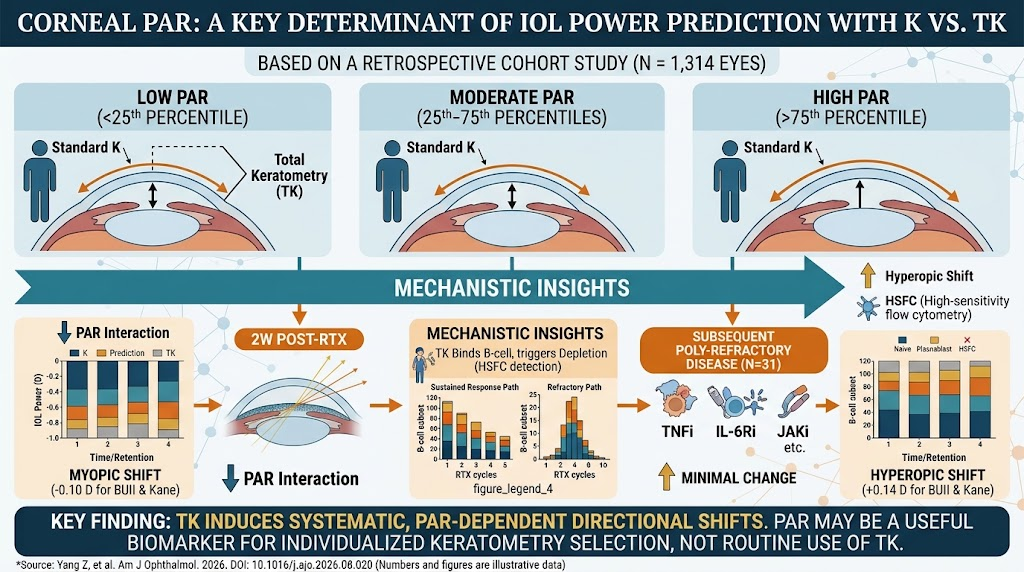
Participants were stratified into three groups according to the PAR: low (below 25th percentile), moderate (25th to 75th percentile), and high (above 75th percentile). Using two advanced IOL calculation formulas—Barrett Universal II (BUII) and Kane—the study compared refractive prediction errors (PE) derived from both standard K and TK inputs.
Main outcome measures included prediction error (PE), median absolute error (MedAE), and the proportion of eyes achieving refractive outcomes within predefined error thresholds (±0.25 D, ±0.50 D, and ±1.00 D).
Key Results
The study established that PAR independently correlates with the discrepancy observed between K- and TK-based refractive predictions. Specifically, TK induced significant directional shifts compared to K, dependent on PAR subgroup classification:
- Low PAR eyes: TK produced a consistent myopic shift of approximately -0.10 diopters (D) versus K for both BUII and Kane formulas (P<0.001).
- High PAR eyes: TK caused a hyperopic shift of +0.14 D relative to K for both formulas (P<0.001).
- Moderate PAR eyes: Minimal refractive shifts were observed.
Despite these systematic shifts, overall MedAE did not differ significantly between K- and TK-based calculations within any PAR subgroup, indicating that neither measurement approach uniformly outperformed the other in predictive accuracy.
Notably, in the high PAR subgroup, TK integration led to a statistically significant reduction in the proportion of eyes achieving refractive outcomes within ±0.50 D of the target refraction when using the BUII formula (79.9% with K vs. 75.4% with TK; P=0.041). Contrarily, the Kane formula demonstrated no significant difference related to keratometry type in this subgroup.
Interpretation and Clinical Implications
These findings highlight that PAR is a critical anatomical factor affecting the divergence between refractive outcomes predicted by standard K and TK. Rather than universally enhancing refractive precision, TK predominantly introduces systematic, PAR-dependent directional biases in refractive error predictions.
From a clinical perspective, this nuanced relationship suggests that incorporating PAR measurements into preoperative assessment can tailor the choice between K and TK-based IOL calculations to individual corneal anatomy. Such personalized selection could optimize refractive predictability, especially in eyes exhibiting atypical PAR values.
While TK technology offers sophistication by accounting for posterior corneal surface variations, its application should not be indiscriminate. Practitioners should consider the potential for paradoxical refractive shifts induced by TK in certain PAR phenotypes, potentially undermining rather than improving surgical outcomes.
Expert Commentary and Limitations
Experts emphasize the critical importance of integrating corneal biomechanical parameters, like PAR, into IOL power calculation algorithms to refine predictive models. However, this study’s retrospective design and use of a single biometry platform may limit the generalizability of results. Prospective, multicenter evaluations incorporating diverse biometry technologies are warranted to validate and expand these findings.
Moreover, future research could explore how PAR interacts with other ocular biometric factors—such as axial length and anterior chamber depth—and whether dynamic modeling incorporating these variables can further enhance IOL power prediction accuracy.
Conclusion
The posterior-to-anterior corneal radius ratio is a significant determinant of the differential refractive prediction between standard and total keratometry in IOL power calculations. Rather than universally improving refractive outcomes, total keratometry introduces systematic, PAR-dependent directional shifts that must be considered in clinical decision-making. PAR measurement may serve as a valuable biomarker to personalize keratometry input selection, contributing to optimized refractive outcomes following cataract surgery.
Funding and Disclosures
The original study did not specify funding sources or conflicts of interest. Readers should consult the primary publication for detailed disclosures.
References
- Yang Z, Yang FM, Meng ZQ, et al. Influence of the Corneal Posterior-to-Anterior Radius Ratio on IOL Power Prediction Using Standard and Total Keratometry. Am J Ophthalmol. 2026;XXX:XXX-XXX. PMID:42600885.
- Barrett GD. Barrett Universal II formula. Available at: https://www.apacrs.org/barrett_universal2.
- Kane JX, et al. Validation of the Kane formula for intraocular lens power calculation. J Cataract Refract Surg. 2017;43(11):1464-1469.
This article was created using several editorial tools, including AI, as part of the process. Human editors reviewed this content before publication.