Evaluating the Long-Term Impact of Electrical Stimulation Biofeedback Combined with Pelvic Floor Muscle Training for Postpartum Pelvic Organ Prolapse
Highlight
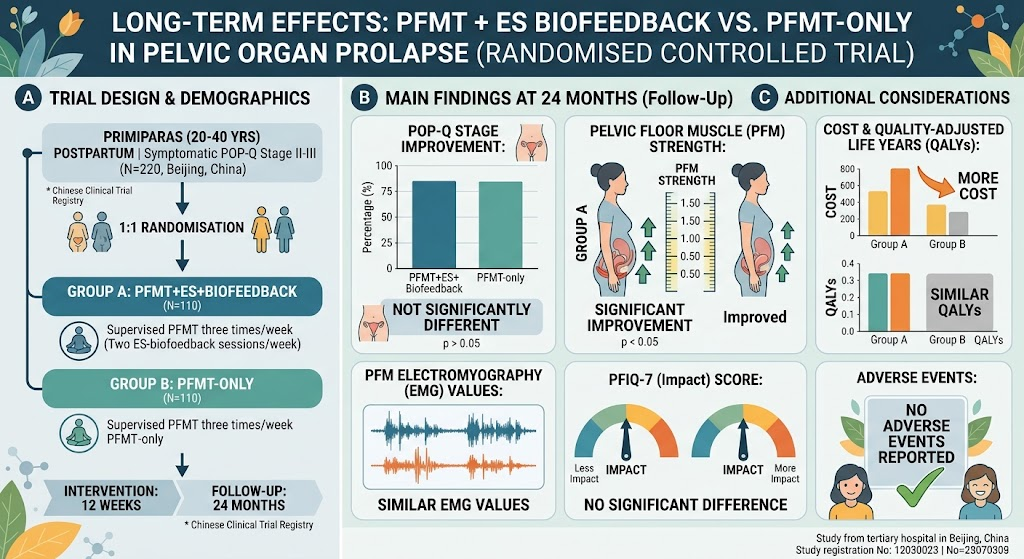
1. Adding electrical stimulation (ES) biofeedback to supervised pelvic floor muscle training (PFMT) improved pelvic floor muscle strength in postpartum women with symptomatic pelvic organ prolapse (POP).
2. No significant long-term difference in pelvic organ prolapse anatomical staging was observed between combined ES+PFMT and PFMT-only groups at 24 months postpartum.
3. Quality of life, assessed by Pelvic Floor Impact Questionnaire (PFIQ-7), and pelvic floor muscle electromyography values showed no additional benefit from ES biofeedback.
4. ES biofeedback incurred higher costs but did not improve quality-adjusted life years (QALYs); no adverse events were reported.
Study Background
Pelvic organ prolapse (POP) is a prevalent condition among postpartum women, particularly affecting primiparas following vaginal deliveries. Symptoms of POP can significantly impair quality of life, leading to discomfort, urinary and fecal dysfunction, and sexual dysfunction. Pelvic floor muscle training (PFMT) is widely recommended as a first-line conservative treatment to improve pelvic floor support and function. However, the degree to which adjunctive therapies, such as electrical stimulation (ES) biofeedback, provide additional benefits remains unclear. Electrical stimulation aims to enhance neuromuscular activation and facilitate muscle contraction, potentially improving clinical outcomes. This study addresses the evidence gap regarding long-term anatomical and functional benefits of combining ES biofeedback with supervised PFMT in postpartum women with symptomatic POP.
Study Design
This was a randomised controlled trial conducted in a tertiary hospital in Beijing, China, enrolling 220 primiparous women aged 20 to 40 years with symptomatic POP stages II to III according to the POP-Quantification (POP-Q) system at 42 to 60 days postpartum following full-term vaginal singleton deliveries.
Participants were randomized 1:1 into two groups for a 12-week intervention period:
- Control group: supervised PFMT only (15 minutes per session, three times weekly).
- Intervention group: combination of two weekly sessions of ES (10 minutes) with biofeedback-mediated PFMT (15 minutes) plus one supervised PFMT session weekly.
Primary endpoint was the POP-Q stage at 24 months after intervention initiation, reflecting anatomical changes in pelvic organ support. Secondary endpoints included the Pelvic Floor Impact Questionnaire Short Form-7 (PFIQ-7) for quality of life, pelvic floor muscle (PFM) strength measured by dynamometry, electromyography (EMG) values assessing neuromuscular activity, and an economic evaluation comparing cost-effectiveness.
Key Findings
At 24 months, no statistically significant difference was found in the proportion of women demonstrating improved POP-Q stage between the PFMT+ES+biofeedback group and the PFMT-only group, indicating no additional long-term anatomical benefit from adding ES biofeedback.
Notably, pelvic floor muscle strength showed significant improvement in the group receiving ES biofeedback in addition to PFMT. This suggests enhanced neuromuscular function attributable to the intervention.
However, PFIQ-7 scores, reflecting symptom burden and quality of life, did not differ significantly between groups, highlighting the discrepancy between muscle strength gains and patient-perceived functional improvement.
Similarly, pelvic floor muscle EMG readings showed no substantial differences, indicating that while strength improved, neuromuscular electrical activity changes were not distinct.
From a health economics perspective, use of ES biofeedback incurred higher treatment costs without producing gains in quality-adjusted life years (QALYs), suggesting limited cost-effectiveness.
The safety profile was favorable with no adverse events reported during the entire study period.
Expert Commentary
This rigorous trial provides valuable long-term data on the role of electrical stimulation biofeedback as an adjunct to PFMT in postpartum POP management. While the neuromuscular benefits are encouraging, the lack of sustained anatomical improvement and quality-of-life gains raises important questions about clinical significance and patient-centered outcomes.
Limitations include the single-center design within a relatively homogeneous population of young primiparas, potentially limiting extrapolation to multiparous or older cohorts. Additionally, adherence factors and intensity of home exercises post-intervention were not extensively detailed, which may influence outcomes.
Current guidelines endorse supervised PFMT as a cornerstone for POP treatment. This study suggests that ES biofeedback might serve as a supplementary tool to enhance muscle strength but should not be expected to independently improve anatomical or symptomatic outcomes over standard PFMT in the long term.
Conclusion
The addition of electrical stimulation biofeedback to supervised pelvic floor muscle training in postpartum women with symptomatic pelvic organ prolapse leads to improved muscle strength but does not confer additional long-term anatomical or quality-of-life benefits. Cost considerations and patient preferences should guide incorporation of ES biofeedback in clinical practice. Further research is warranted to explore optimized training protocols, patient subgroups who may derive greater benefit, and sustained adherence strategies.
Funding and Clinical Trial Registration
This trial was conducted with relevant institutional support and was registered in the Chinese Clinical Trial Registry (ChiCTR1900021719) accessible at https://www.chictr.org.cn/showproj.html?proj=35452.
References
1. Li M, Lyu Y, Li P, et al. Long-Term Effects of Pelvic Floor Muscle Training Combined With Electrical Stimulation Biofeedback Among Women With Symptomatic Pelvic Organ Prolapse: A Randomised Controlled Trial. BJOG. 2026; [Epub ahead of print]. PMID: 42584084.
2. Hay-Smith EJ, Dumoulin C, Pelvic floor muscle training versus no treatment for urinary incontinence in women. Cochrane Database Syst Rev. 2006 Jul 19;(3):CD005654.
3. Bo K, Frawley HC, Haylen BT, et al. An International Urogynecological Association (IUGA)/International Continence Society (ICS) Joint Report on the Terminology for the Conservative and Nonpharmacological Management of Female Pelvic Floor Dysfunction. Neurourol Urodyn. 2017 Jan;36(2):221-244.
This article was created using several editorial tools, including AI, as part of the process. Human editors reviewed this content before publication.