Evaluating Elective Left Ventricular Unloading in High-Risk PCI: Insights from the CHIP-BCIS3 Substudy
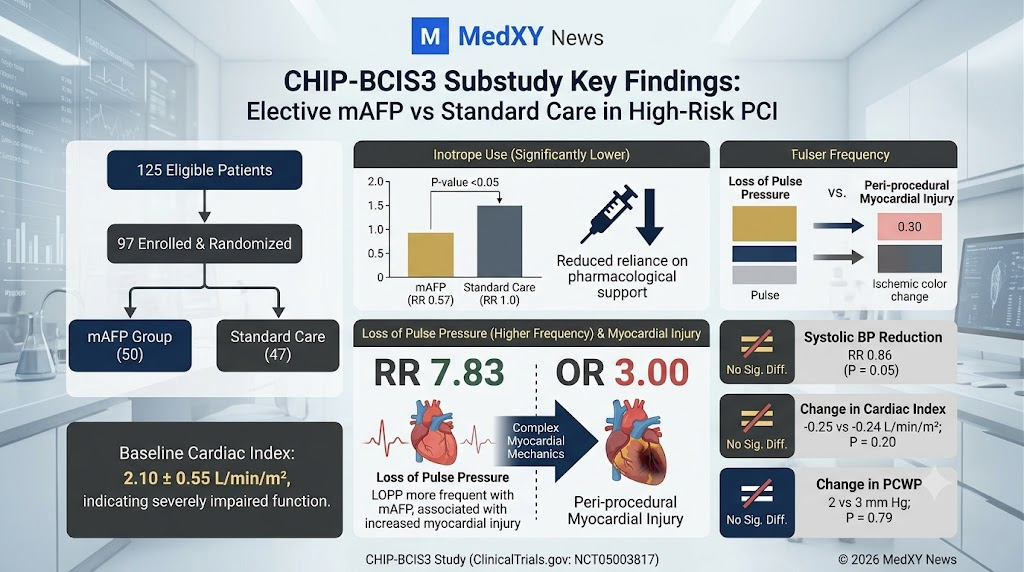
Highlight
Elective left ventricular (LV) unloading with microaxial flow pump (mAFP) during complex PCI reduces the need for inotropes.
LV unloading did not decrease the incidence of systolic blood pressure reduction during the procedure.
Loss of pulse pressure (LOPP) was more frequent with mAFP use and correlated with peri-procedural myocardial injury.
Cardiac index and LV filling pressures post-PCI were similar between unloading and standard care groups.
Study Background
Complex percutaneous coronary intervention (PCI) in patients with severe left ventricular (LV) systolic dysfunction presents a significant clinical challenge due to the risk of hemodynamic instability and myocardial stunning during the procedure. Myocardial stunning—a reversible post-ischemic contractile dysfunction—can worsen cardiac outcomes and complicate recovery. Elective LV unloading with percutaneous mechanical circulatory support devices, such as microaxial flow pumps (mAFP), has been proposed to buffer hemodynamic instability and mitigate myocardial injury; however, robust randomized data supporting this approach have been lacking. The CHIP-BCIS3 (Controlled Trial of High-risk Coronary Intervention With Percutaneous Left Ventricular Unloading) trial aimed to evaluate the impact of elective LV unloading on procedural hemodynamics and myocardial stunning in this high-risk population.
Study Design
This prespecified substudy enrolled patients with severe LV systolic dysfunction undergoing complex PCI. Participants were randomized to elective LV unloading using a microaxial flow pump (mAFP) or to standard care without mechanical support. Pulmonary artery catheterization was performed invasively to assess hemodynamic parameters at baseline and after PCI. The coprimary endpoints included systolic blood pressure reduction during the procedure, occurrence of loss of pulse pressure (LOPP), and the requirement for inotropic agents. Secondary endpoints focused on changes in cardiac index, left ventricular filling pressure measured by pulmonary capillary wedge pressure (PCWP), and the frequency of peri-procedural myocardial injury.
Key Findings
Out of 125 eligible patients, 97 were enrolled and randomized—50 to the mAFP group and 47 to standard care. Baseline cardiac index averaged 2.10 ± 0.55 L/min/m2, reflecting severely impaired cardiac function.
The incidence of systolic blood pressure reduction did not differ significantly between groups, with a relative risk (RR) of 0.86 (95% confidence interval [CI]: 0.58-1.29), indicating that LV unloading did not mitigate hypotension during PCI.
Interestingly, inotrope use was significantly lower in the mAFP group (RR: 0.57; 95% CI: 0.34-0.97), signifying reduced reliance on pharmacological support for cardiac function when mechanical unloading was provided.
However, loss of pulse pressure—a marker of diminished LV contraction—occurred more frequently with mAFP (RR: 7.83; 95% CI: 2.53-24.24). This phenomenon was associated with an increased likelihood of peri-procedural myocardial injury (odds ratio [OR]: 3.00; 95% CI: 1.00-9.03), suggesting that mechanical unloading may have complex effects on myocardial contractility or ischemic vulnerability.
Secondary hemodynamic outcomes showed no significant differences in the change of cardiac index (-0.25 vs -0.24 L/min/m2; P = 0.20) or pulmonary capillary wedge pressure (2 vs 3 mm Hg; P = 0.79) between groups post-PCI, indicating similar overall global cardiac function modulation.
Expert Commentary
This substudy provides important randomized evidence addressing the utility of elective LV unloading in complex, high-risk PCI. The finding that inotrope requirements decreased with mAFP support reinforces the clinical value of mechanical unloading in reducing pharmacologic intervention needs and possibly mitigating myocardial stress.
Nevertheless, the increased incidence of loss of pulse pressure and its association with myocardial injury raise concerns about potential adverse effects or complex myocardial mechanics under unloading conditions. It is plausible that profound LV unloading alters native contractile patterns and coronary perfusion dynamics, contributing to myocardial stunning or injury despite mechanical support.
The lack of significant improvements in systemic hemodynamic parameters such as cardiac index or PCWP suggests that unloading may have nuanced benefits that do not translate into overt changes measured by traditional invasive metrics.
Limitations include the relatively small sample size and the inherent heterogeneity of complex PCI procedures. Longer-term clinical outcome data and mechanistic studies would be valuable to elucidate whether the observed myocardial injury translates into adverse prognoses or can be mitigated by optimizing unloading strategies.
Conclusion
Elective left ventricular unloading with a microaxial flow pump during complex PCI in patients with severe LV dysfunction reduces the need for inotropic support but does not significantly improve procedural hemodynamics or prevent myocardial stunning. The increased loss of pulse pressure and its association with myocardial injury underscore the necessity of careful patient selection and monitoring when employing mechanical circulatory support. These findings highlight the complexity of managing high-risk PCI and the need for further research to refine mechanical unloading approaches to maximize safety and efficacy.
Funding and Clinical Trials Registration
This substudy was conducted under the auspices of the CHIP-BCIS3 trial (ClinicalTrials.gov identifier: NCT05003817). Funding sources were disclosed in the parent trial publication but were not specified in this substudy report.
References
Ezad SM, Ryan M, Khan SQ, Panoulas VF, Ladwiniec A, Keeble T, et al. Impact of Left Ventricular Unloading on Hemodynamics and Stunning in Complex PCI: A CHIP-BCIS3 Substudy. J Am Coll Cardiol. 2026 Jul 28. PMID: 42554527.
This article was created using several editorial tools, including AI, as part of the process. Human editors reviewed this content before publication.