Highlight
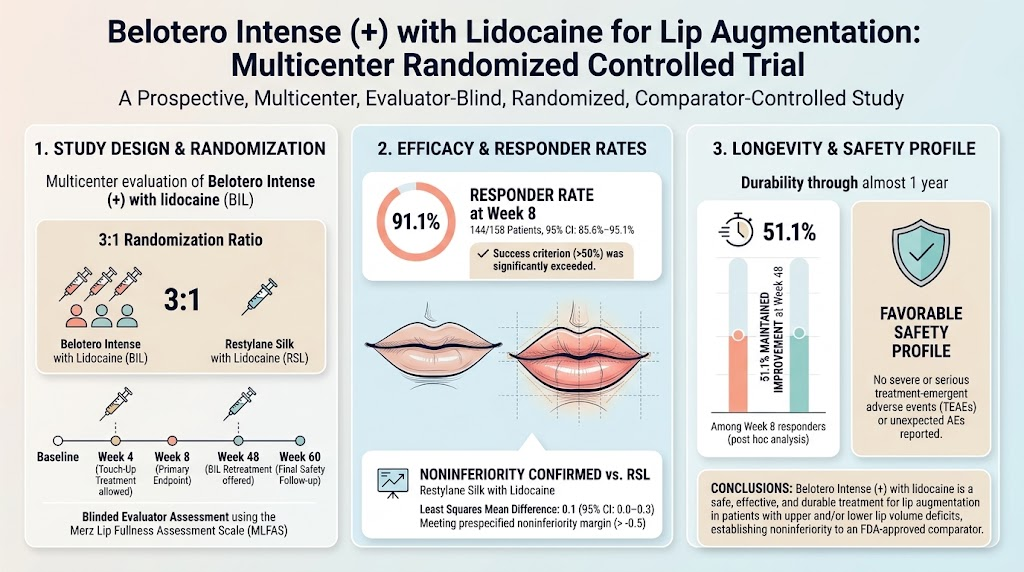
Belotero Intense with lidocaine demonstrated a 91.1% responder rate at 8 weeks post-treatment for lip fullness improvement.
The filler showed noninferiority compared to the FDA-approved Restylane Silk in enhancing lip volume and shape.
Over half of responders maintained lip fullness improvement through 48 weeks, indicating durable aesthetic results.
No severe or unexpected treatment-related adverse events were reported, supporting a favorable safety profile.
Study Background
Lip augmentation has become one of the most popular minimally invasive aesthetic procedures aimed at enhancing lip volume, shape, and symmetry. Hyaluronic acid (HA)-based dermal fillers are widely used due to their biocompatibility, reversibility, and immediate visual improvement. However, differences in filler formulation, cohesivity, and rheological properties can influence clinical outcomes and patient satisfaction. Belotero Intense with lidocaine (BIL) is a cohesive polydensified matrix HA filler designed to provide volumizing effect with lidocaine to reduce injection pain. Although Restylane Silk with lidocaine (RSL) is an FDA-approved HA filler for lip enhancement, comparative data evaluating the safety and efficacy of BIL relative to RSL remain limited. This study aimed to address this gap by investigating BIL’s performance for lip augmentation in a diverse patient population.
Study Design
This prospective, multicenter, evaluator-blind, randomized, comparator-controlled trial enrolled patients with mild to moderate lip volume deficits, characterized by a baseline Merz Lip Fullness Assessment Scale (MLFAS) rating of very thin, thin, or medium on the upper and lower lips for Fitzpatrick skin types (FST) I-IV or at least one lip affected for FST V or VI. Eligible patients were randomized in a 3:1 ratio to receive intralip injections of either BIL or RSL. A touch-up treatment was permitted at Week 4 to optimize aesthetic outcomes. Additionally, retreatment was offered to BIL patients at Week 48, enabling assessment of long-term durability. Primary effectiveness was determined by blinded evaluators using the MLFAS, focusing on changes from baseline to Week 8. Safety monitoring for treatment-emergent adverse events (TEAEs) continued through Week 60.
Key Findings
The intent-to-treat population included 158 patients treated with BIL. At Week 8, the MLFAS-responder rate—defined as achieving a clinically meaningful improvement in lip fullness—was 91.1% (144/158; 95% confidence interval [CI], 85.6–95.1%). This robust responder rate well exceeded the prespecified 50% success criterion, demonstrating significant effectiveness. The statistical comparison versus RSL found a least squares mean difference of 0.1 (95% CI, 0.0–0.3) for change from baseline in MLFAS score, with the lower confidence bound above the noninferiority margin of –0.5. This result confirms BIL’s noninferiority relative to the established comparator.
Post hoc analysis showed that among Week 8 responders, 51.1% (70/137) maintained lip fullness improvement through Week 48, indicating sustained aesthetic benefit over nearly one year following a single treatment. Safety outcomes were favorable, with no severe or serious related adverse events reported. TEAEs were mild and consistent with known injection-related events, with no unexpected safety signals.
Expert Commentary
This rigorous randomized controlled trial provides high-level evidence supporting the safety and efficacy of Belotero Intense with lidocaine as a lip augmentation option. The use of a blinded evaluator and a well-validated instrument (MLFAS) strengthens the reliability of findings. Noninferiority to Restylane Silk, an FDA-approved benchmark product, adds clinical relevance for dermatologists and plastic surgeons considering filler selection. The prolonged duration of effect observed up to 48 weeks aligns with the desirable longevity profiles sought in aesthetic procedures, potentially reducing the frequency of repeat treatments.
Limitations include the post hoc nature of durability assessment and limited ethnic diversity inherent to some clinical trials; broader population studies could confirm generalizability. Future research might explore patient-reported outcomes focusing on satisfaction, comfort, and quality of life, as well as comparisons with other emerging filler technologies.
Conclusion
Belotero Intense with lidocaine is a safe and efficacious hyaluronic acid filler for lip augmentation, demonstrating high responder rates and sustained volumizing effects over 48 weeks. Its noninferiority to Restylane Silk provides an alternative treatment choice for patients with lip volume deficits. The favorable safety profile and extended durability support its incorporation into aesthetic practice for enhancing lip volume and shape. Ongoing postmarketing surveillance and additional real-world effectiveness studies will further clarify long-term benefits and patient preferences.
Funding and Registration
The study was sponsored by Anteis SA (manufacturer of Belotero Intense). Clinical trial registration details were not provided in the abstract. Further disclosure and registration data would be available in the full publication.
References
Moradi A, Gold MH, Hill D, Dersch H, Radusky R, Schwab U. A Prospective, Multicenter, Evaluator-Blind, Randomized, Comparator-Controlled Study of Belotero Intense (+), a Hyaluronic Acid Filler With Lidocaine, for Lip Augmentation. Aesthetic Surgery Journal. 2026 Oct 15;46(11):1236-1245. PMID: 42875033.
Current literature on HA fillers underscore the importance of cohesive matrix technology in balance between volumizing effect and integration into tissue — see Sundaram H, et al. “Rheology and tissue integration of hyaluronic acid fillers in aesthetic medicine,” Dermatol Surg. 2015;41 Suppl 1:S100-8.