Enhancing Septorhinoplasty Outcomes: The Role of Internal Nasal Dilators in Improving Nostril Symmetry and Function
Highlight
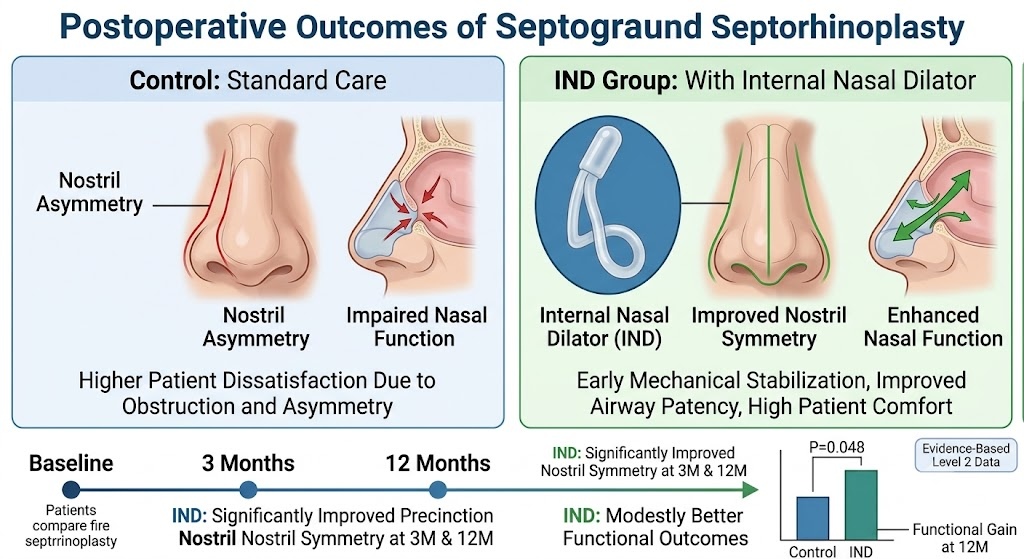
This randomized controlled trial evaluated the effectiveness of internal nasal dilators (INDs) after septorhinoplasty. Key findings demonstrated that IND use improved nostril symmetry at 3 and 12 months post-surgery and yielded modestly better functional nasal outcomes without compromising aesthetic results. The device was well tolerated with high patient comfort and no reported adverse events.
Study Background
Septorhinoplasty is a common surgical procedure aimed at correcting nasal airway obstruction and improving nasal aesthetics. However, postoperative nasal obstruction and asymmetry remain major contributors to patient dissatisfaction. Maintenance of internal nasal valve patency and symmetry is critical early in the healing process to ensure optimized functional and cosmetic outcomes. Internal nasal dilators, simple devices designed to mechanically stabilize the nasal valve, have been proposed as adjuncts to support early postoperative healing by preserving airway patency and nostril shape. Despite theoretical benefits, comprehensive, evidence-based evaluations of INDs’ efficacy following septorhinoplasty have been lacking.
Study Design
This prospective, single-center, randomized, single-blinded controlled trial enrolled 128 adult patients undergoing primary septorhinoplasty. Participants were randomly assigned in a 1:1 ratio to receive either internal nasal dilators plus standard postoperative care or standard care alone. Assessments were conducted at baseline (preoperatively), 3 months, and 12 months postoperatively.
The primary endpoint was patient-reported nostril symmetry using a numeric scale ranging from 0 (perfect symmetry) to 4 (very asymmetrical). Secondary endpoints included functional and aesthetic assessments using the validated Standardized Cosmesis and Health Nasal Outcomes Survey (SCHNOS), device comfort measured via visual analog scale (VAS), and monitoring for adverse events related to device use.
Key Findings
Baseline demographic and clinical characteristics were comparable between groups, ensuring balanced comparison.
Nostril Symmetry: At 3 months post-surgery, the IND group reported significantly improved nostril symmetry (mean score 0.78 ± 0.92) compared to controls (1.42 ± 1.09; P = .001). This advantage persisted and further improved at 12 months (0.46 ± 0.71 vs 1.40 ± 1.20; P < .001), highlighting the sustained impact of INDs on maintaining nostril shape.
Functional Outcomes: Both groups experienced improvements in functional nasal breathing as measured by the SCHNOS functional domain. However, the IND group had a slightly greater functional gain at 12 months (+10.2 ± 4.1 points) compared with controls (+7.9 ± 4.4 points; P = .048), suggesting improved airway patency attributable to early postoperative support.
Aesthetic Outcomes: Aesthetic SCHNOS scores improved similarly in the two groups with no statistically significant differences (P = .73), indicating that IND use did not compromise cosmetic results.
Device Comfort and Safety: Patient-reported comfort was high, with a mean VAS score of 8.1 ± 1.4 out of 10, indicating good tolerance. There were no reported device-related complications or adverse events, underscoring the safety profile of INDs in this setting.
Expert Commentary
This study presents level 2 evidence supporting the adjunctive use of internal nasal dilators after septorhinoplasty. The mechanical support provided by INDs during the critical early healing phase may prevent collapse or distortion of the internal nasal valve, preserving both function and nostril symmetry. The modest but statistically significant functional improvement aligns with the intended physiological mechanism of maintaining airway caliber.
Notably, the absence of adverse events and high patient comfort address common concerns about device tolerability. While aesthetic outcomes were not significantly different, the marked improvement in symmetry likely contributes positively to patient satisfaction. These findings are consistent with prior smaller studies suggesting benefits of nasal stenting but now confirmed with rigorous methodology.
Limitations include single-center design and lack of longer-term follow-up beyond 12 months. Future multicenter trials may enhance generalizability across diverse patient populations and surgical techniques. Additionally, mechanistic studies evaluating nasal valve dynamics with and without INDs could deepen understanding of observed benefits.
Conclusion
Internal nasal dilators represent a valuable adjunct to standard postoperative care after septorhinoplasty, improving nostril symmetry and providing slight but meaningful functional benefits without compromising aesthetics or comfort. Their incorporation into postoperative protocols holds promise for enhancing patient satisfaction and surgical outcomes. Further research is warranted to establish long-term efficacy and optimize device design and application timing.
Funding and Clinical Trials Registration
The study was conducted without reported external funding. Clinical trial registration details were not provided in the source material.
References
Chowdhury R, Al-Musaileem N, Alzayadneh I, Doubi A, Raman KS, Solomon P, Rival R. Internal Nasal Dilators After Septorhinoplasty: A Randomized Controlled Trial of Functional and Aesthetic Outcomes. Aesthetic Surgery Journal. 2026 Jul 15;46(8):875-880. PMID: 41549629.
Rhee JS, Sinclair C, Mace JC, et al. Development and validation of a standardized outcome measure for functional and aesthetic rhinoplasty. JAMA Facial Plast Surg. 2014;16(1):1-9.
Baguley C, McFerran DJ, Silverman B. Nasal valve surgery: an evidence-based review. Curr Opin Otolaryngol Head Neck Surg. 2017 Feb;25(1):6-12.
Constantinidis J, Stammberger H, Linthicum FH Jr. Grafting and stenting techniques for nasal valve reconstruction. Oper Tech Otolaryngol Head Neck Surg. 2009;20(2):131-138.
This article was created using several editorial tools, including AI, as part of the process. Human editors reviewed this content before publication.