Enhancing Prognostic Accuracy in Acute Myeloid Leukemia through DNA Methylation Signatures
Highlight
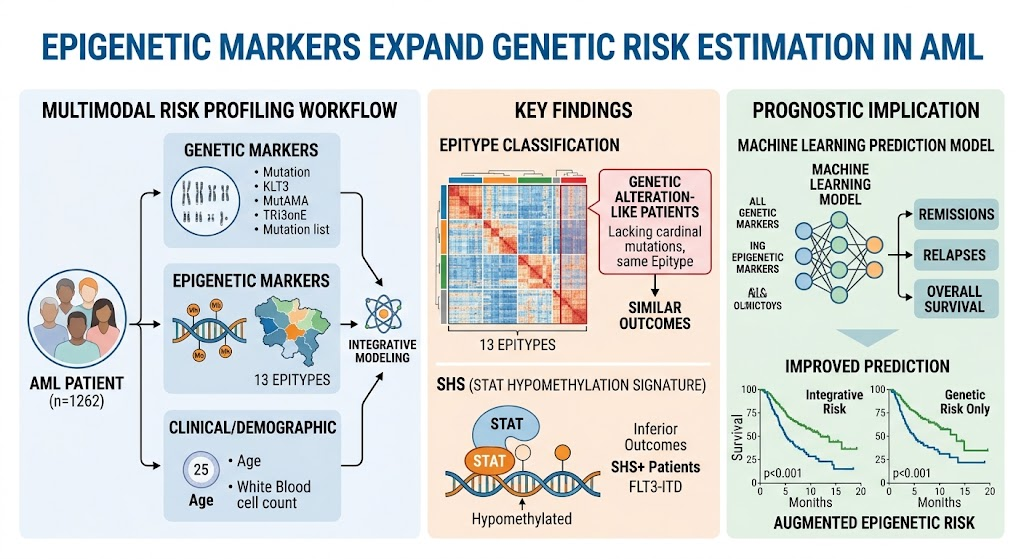
This study investigates how epigenetic signatures, specifically DNA methylation patterns, can complement existing genetic prognostic markers in acute myeloid leukemia (AML). It identifies 13 distinct DNA methylation subtypes (epitypes) closely associated with genetic alterations. Remarkably, some patients exhibit methylation patterns resembling those with cardinal genetic mutations despite lacking these mutations, with similar adverse clinical outcomes. A novel STAT hypomethylation signature (SHS) linked to FLT3-ITD mutation further refines risk prediction. Integration of epigenetic data with genetic, demographic, and clinical parameters enhances predictive accuracy for remission, relapse, and survival.
Study Background
Acute myeloid leukemia (AML) is a heterogeneous hematologic malignancy characterized by clonal proliferation of myeloid precursors in the bone marrow and peripheral blood. Accurate risk stratification is critical to guiding treatment decisions. Current prognostication relies heavily on the detection of gene mutations and chromosomal abnormalities, which underpin molecular subtypes with variable outcomes. However, some patients defy classification by these markers alone, challenging precise prediction of prognosis and therapy response. Epigenetic modifications, particularly DNA methylation changes, have emerged as important contributors to leukemogenesis and may serve as complementary biomarkers. Understanding DNA methylation patterns may thus refine molecular subclassification and provide insights into disease pathogenesis and clinical behavior.
Study Design
The study profiled DNA methylation in 1,262 patients with de novo AML, employing comprehensive unsupervised clustering to identify epigenetic subclasses termed epitypes. Each epitype predominantly corresponded to a characteristic genetic alteration (e.g., CEBPA mutations, FLT3-ITD, core-binding factor rearrangements, KMT2A rearrangements). Patients without these cardinal mutations but displaying similar methylation profiles were classified as genetic alteration-like. A focused DNA methylation signature enriched in FLT3-ITD patients was derived, highlighting hypomethylation at STAT transcription factor binding sites, designated the STAT hypomethylation signature (SHS). The study applied machine learning models integrating methylation signatures, genetic alterations, demographic, and clinical data to assess predictive performance for remission, relapse, and overall survival.
Key Findings
Identification of 13 Epitypes: Unsupervised DNA methylation clustering distinguished 13 epitypes, each largely corresponding to key genetic driver mutations or chromosomal rearrangements known to define AML molecular subgroups. This close alignment validates methylation profiling as a robust classifier of AML heterogeneity.
Alteration-like Patterns and Clinical Outcomes: Certain patients lacking cardinal mutations nonetheless manifested DNA methylation patterns mimicking those with genetic alterations (genetic alteration-like). Notably, these alteration-like cases exhibited clinical outcomes similar to those with the actual mutations, suggesting functional or pathway convergence detectable through epigenetics.
STAT Hypomethylation Signature (SHS): A distinct methylation signature associated with FLT3-ITD involved hypomethylation of STAT transcription factor binding sites. SHS positivity correlated with significantly worse survival, enhancing risk stratification beyond FLT3-ITD mutation status alone.
Improved Prognostic Modeling: Integrating epigenetic markers with genetic, demographic, and clinical variables via machine learning enhanced prediction of treatment remission, risk of relapse, and overall survival. This integrative approach surpasses prognostic accuracy of traditional models relying solely on genetics.
Expert Commentary
This study significantly advances our understanding of AML biology by demonstrating that DNA methylation profiling captures epigenetic states reflective of underlying genetic alterations and their functional effects. The recognition of genetic alteration-like epitypes underlines how epigenetic landscapes can identify high-risk patients who might be missed by conventional mutation screening. The discovery of the SHS signature is particularly impactful, as FLT3-ITD is a common AML mutation with variable outcomes influenced by co-factors; SHS adds a novel layer of prognostic refinement potentially guiding personalized therapeutic approaches.
However, several considerations merit discussion. While the patient cohort is large and diverse, validation in independent prospective cohorts is essential. The biological mechanisms linking methylation changes to gene function and leukemogenesis warrant further molecular investigation, especially the role of STAT signaling in AML pathophysiology. Additionally, translating epigenetic profiling into routine clinical practice will require standardization of assays, cost-effectiveness analyses, and integration with existing diagnostic workflows.
Overall, these findings underscore the importance of incorporating epigenetics alongside genetics for comprehensive AML risk assessment, which may inform future treatment stratification and targeted therapy development.
Conclusion
This study compellingly demonstrates that epigenetic markers, specifically DNA methylation patterns, substantially enrich genetic risk estimation in AML. By identifying methylation-defined epitypes mirroring genetic alterations and discovering a prognostically significant SHS signature, the research reveals new dimensions of AML heterogeneity with clear clinical implications. The integrative machine learning model combining epigenetic, genetic, and clinical data offers a powerful predictive tool to optimize individualized patient management. Future validation and mechanistic studies will help translate these insights into precision oncology advances for AML.
Funding and ClinicalTrials.gov
The study was supported by grants and institutional funding as reported in the original publication. No clinical trial registration is indicated for this retrospective molecular profiling study.
References
1. Abdelbaky SB, Giacopelli B, Kohlschmidt J, et al. Epigenetic markers expand genetic risk estimation in acute myeloid leukemia. Blood. 2026 Aug 25; PMID: 42640858.
2. Dohner H, Wei AH, Appelbaum FR. Diagnosis and management of AML in adults: 2022 ELN recommendations from an international expert panel. Blood. 2022;140(12):1345-1377.
3. Figueroa ME, Lugthart S, Li Y, et al. DNA methylation signatures identify biologically distinct subtypes in acute myeloid leukemia. Cancer Cell. 2010;17(1):13-27.
4. Spencer DH, Russler-Germain DA, Ketkar S, et al. DNA methylation as a biomarker in acute myeloid leukemia: emerging clinical utility. Expert Rev Mol Diagn. 2017;17(6):543-552.
This article was created using several editorial tools, including AI, as part of the process. Human editors reviewed this content before publication.