Enhancing Precision in Robotic Myomectomy: Ultrasound-Guided Enucleation Using a Drop-In Probe
Highlight
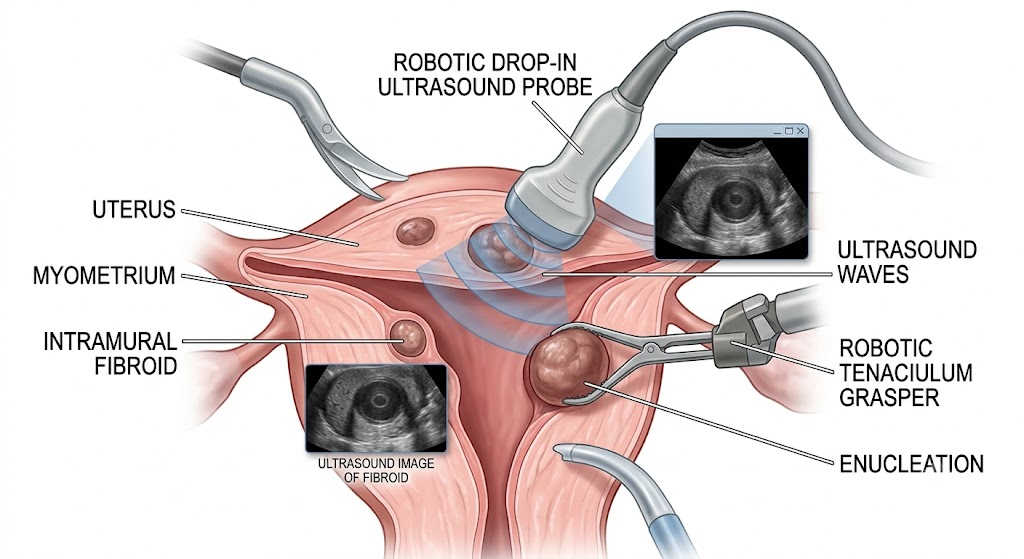
Robot-assisted myomectomy, though minimally invasive, lacks tactile feedback for identifying intramural fibroids. Integration of a drop-in ultrasound probe concurrently visualized on the robotic console facilitates real-time detection and removal of occult fibroids. This ultrasound-guided approach optimizes surgical accuracy, important for fertility preservation and in patients with multiple myomas.
Study Background
Uterine fibroids, or leiomyomas, are common benign smooth muscle tumors that frequently require surgical intervention when symptomatic, particularly for women seeking fertility preservation. Myomectomy remains the preferred surgical option for women wishing to maintain reproductive potential. Minimally invasive approaches such as robot-assisted myomectomy offer benefits including reduced blood loss, shorter hospital stays, and faster recovery compared to laparotomy. However, robot-assisted techniques lack the tactile feedback surgeons rely on to palpate and identify intramural fibroids concealed within the myometrium during open or laparoscopic surgery. This limitation poses challenges for thorough fibroid excision, potentially impacting symptom relief and fertility outcomes, especially in cases with multiple or deeply embedded fibroids.
Study Design and Intervention
The study by Stefan et al. describes a surgical technique employing a drop-in robotic ultrasound probe integrated into the robot-assisted myomectomy procedure. After initial enucleation of visually identified fibroids, the surgeon utilizes the drop-in ultrasound probe inserted into the operative field. The probe is applied directly to the uterine surface and systematically scanned across the myometrium while ultrasound images are displayed simultaneously on the robotic console screen. This approach provides the surgeon with real-time imaging that correlates with the surgical anatomy and instrument positioning, allowing identification of occult, non-palpable intramural fibroids. Subsequent ultrasound-guided enucleation is then performed as indicated. The authors provide intraoperative images and video demonstrating probe handling, scanning technique, and ultrasound-guided fibroid removal.
Key Findings
The main outcome is the successful application of the drop-in ultrasound probe during robotic myomectomy, enhancing fibroid detection beyond visual inspection alone. The combined visual and ultrasound feedback enables the surgeon to detect multiple and deeply embedded intramural fibroids that may be missed otherwise. This capability is particularly relevant in fertility-sparing surgery, where complete removal of fibroids is essential to optimize uterine function and pregnancy outcomes.
The technique’s implementation illustrates several advantages:
– Improved localization and delineation of fibroids, leading to more thorough enucleation.
– Real-time correlation between ultrasound imaging and surgical anatomy enhances surgical precision.
– Potential reduction in residual fibroid tissue and associated recurrence risk.
– Preservation of maximal healthy myometrium and minimization of unnecessary tissue disruption.
– Feasibility and safety of integrating ultrasound within robotic surgery without prolonging operative time significantly.
While the report is primarily a technical description rather than a large clinical trial, it lays important groundwork for future studies assessing clinical outcomes, such as fibroid recurrence, symptom relief, fertility success rates, and long-term safety.
Expert Commentary
The lack of tactile feedback in robot-assisted surgery is a recognized limitation when performing procedures such as myomectomy, where palpation aids fibroid identification. The innovative use of a drop-in ultrasound probe directly controlled from the robotic console represents a significant step forward in overcoming this challenge. The seamless integration of imaging and operative field visualization permits the surgeon to compensate effectively for absent haptic cues.
Similar concepts have been explored in laparoscopic myomectomy, but the adaptation to robotic platforms is less documented. This technique’s potential to reduce residual disease and improve fertility preservation aligns well with clinical practice guidelines that emphasize comprehensive fibroid management in patients wishing to conceive.
Nonetheless, broader adoption requires assessment of reproducibility, learning curves, and resource implications. Additionally, while intraoperative ultrasound improves detection, it remains operator-dependent, demanding adequate training for sonographic interpretation.
Conclusion
Ultrasound-guided robotic myomectomy using a drop-in probe enhances intraoperative fibroid detection and enucleation accuracy, addressing one of the key limitations of robot-assisted surgery in gynecology. By enabling real-time imaging integrated with the surgical console, this technique holds promise for improving outcomes in fertility-preserving myomectomy and in complex cases with multiple fibroids. Further clinical studies are warranted to quantify benefits in functional and reproductive outcomes and to optimize technique standardization.
Funding and Clinical Trials
No specific funding information or clinical trial registration was provided in the cited source.
References
1. Stefan T, Kobe D, Rob V, Wouter F. Ultrasound-guided robotic myomectomy using a drop-in probe. American Journal of Obstetrics and Gynecology. 2026 Aug 04. PMID: 42551580. DOI: 10.1016/j.ajog.2026.08.004.
2. Hurst BS, et al. Impact of robotic and laparoscopic myomectomy on fertility outcomes: a systematic review. J Minim Invasive Gynecol. 2020;27(3):473-481.
3. Touboul C, et al. Role of intraoperative ultrasound in laparoscopic myomectomy: a prospective study. Gynecol Surg. 2017;14:18.
This article was created using several editorial tools, including AI, as part of the process. Human editors reviewed this content before publication.