We use cookies

Our website uses essential cookies and, with your consent, additional cookies to measure performance and improve our services. Cookie Policy.

You can change your choice at any time.

MMedXYNews
HomeVideos
MedXY AI/MedXY News/Section: news

Enhancing Early Detection of Neonatal Hearing Loss: A Machine Learning Risk Stratification Approach
MedXY Editorial Team•Aug 31, 2026•news
risk stratificationXGBoostNeonatal Hearing Lossmachine learning

Highlight

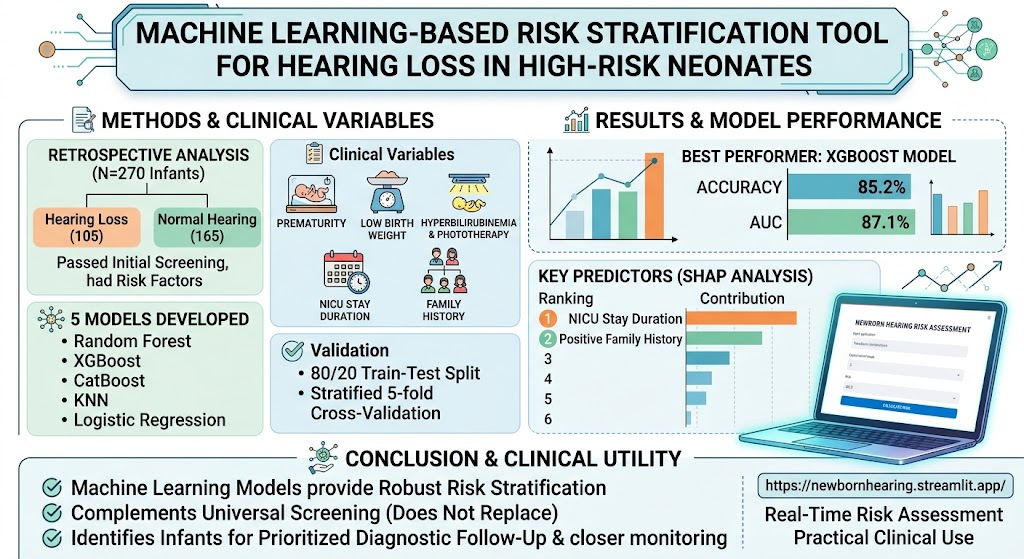
  • Development of a machine learning-based risk stratification tool to predict hearing loss in high-risk neonates using clinical parameters.
  • The XGBoost model demonstrated superior predictive performance with 85.2% accuracy and an area under the curve (AUC) of 87.1%.
  • NICU stay duration and family history emerged as the most influential risk factors via SHAP interpretability analysis.
  • A web-based clinical decision support application has been implemented for real-time risk assessment to assist clinicians in early identification and intervention.

Study Background

MedXY registered readers

Sign in free to continue reading

Create or use your MedXY account to unlock the complete article.

This article was created using several editorial tools, including AI, as part of the process. Human editors reviewed this content before publication.

Related articles

Open language-specific specialty feeds and department pages.

Machine Learning-enhanced Steroid Profiling for Rapid Diagnosis of Congenital Adrenal Steroidogenesis DisordersThis article reviews a validated machine learning decision-tree model using LC-MS/MS steroid profiles to accurately and rapidly diagnose congenital disorders of adrenal steroidogenesis (CDAS), enhancing clinical decision-making and patientSep 19, 2026Stratifying Risk for Further Retinal Intervention After Laser Retinopexy: The Impact of Cumulative Clinical FactorsA novel, cumulative risk factor approach identifies patients at increased risk for additional retinal intervention after laser retinopexy for retinal tears, improving surveillance and management strategies.Sep 15, 2026β-Cell Dysfunction Enhances Prediction of Type 1 Diabetes Progression in Individuals with Single Autoantibody PositivityAssessment of β-cell dysfunction using stimulated glucose and C-peptide measures improves risk stratification for type 1 diabetes progression among single autoantibody-positive relatives, enabling personalized monitoring and targeted intervSep 15, 2026
Loading comments...
MedXY briefing

Get the free newsletter

Evidence-led clinical news, trends, and analysis—delivered to your inbox.

Ask MedXY AI

Most popular

Intimate Health
Five Benefits for Women Continuing Sexual Activity After Menopause
Intimate Health
Why Some Women Have a Strong Sex Drive—And Why Men Shouldn't Worry About It
Nursing & care
How often should a couple have sex?
Intimate Health
Classic Intimacy Recommendations: How to Help Women Reach Orgasm and Enjoy Mutual Pleasure
Intimate Health
What Makes a Woman "Physiologically Addicted" Is Never Money, But These Two Relationship Qualities
© 2026 MedXY
Contact usAbout usPrivacy PolicyMedXY story
Physiological Left Atrial Staging as a Predictor of New-Onset Atrial Fibrillation in Hypertrophic Cardiomyopathy
A novel left atrial (LA) staging system, integrating hemodynamic load and contractile function, predicts new-onset atrial fibrillation risk in hypertrophic cardiomyopathy and may guide tailored AF surveillance.
Sep 15, 2026
Continuous Glucose Monitoring Using the FreeStyle Libre Pro iQ in Presymptomatic Type 1 Diabetes: Advancements in Early Detection and Risk StratificationThis review examines the role of FreeStyle Libre Pro iQ CGM in differentiating presymptomatic stages of type 1 diabetes and predicting progression to clinical disease, comparing its performance with Dexcom G6 and discussing implications forSep 12, 2026
Enhancing COPD Detection through Integrated Quantitative CT Biomarkers in Lung Cancer Screening ProgramsThis study demonstrates that combining quantitative CT biomarkers with clinical data significantly improves the detection of previously undiagnosed COPD within lung cancer screening populations, optimizing referrals for confirmatory spiromeSep 11, 2026