Enhanced Early Detection of Fetal Anomalies: Evaluating the StaFFAUS Protocol in First-Trimester Ultrasound Screening
Highlight
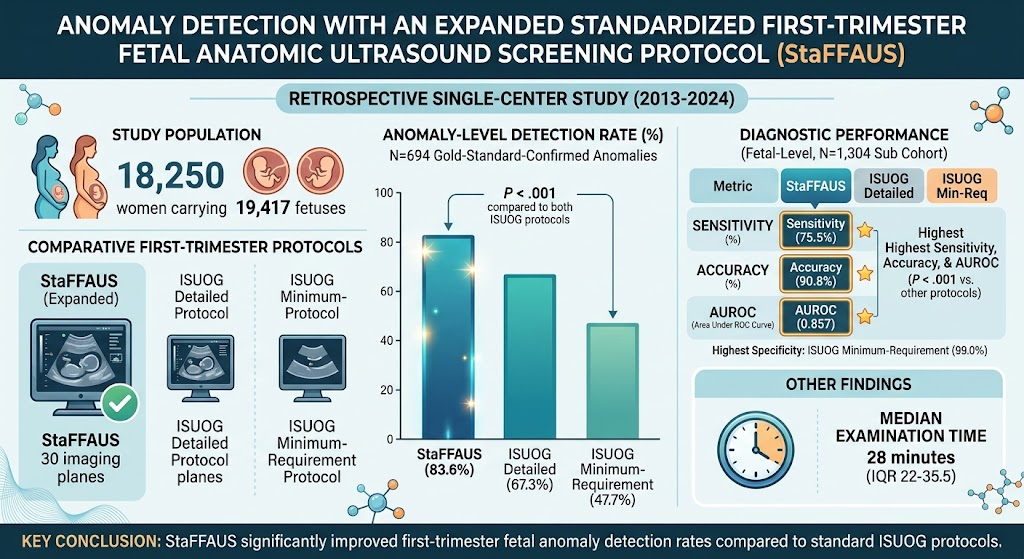
The expanded standardized first-trimester fetal anatomic ultrasound screening (StaFFAUS) protocol demonstrates a higher detection rate of fetal structural anomalies than current ISUOG protocols. StaFFAUS improves sensitivity and overall diagnostic accuracy while maintaining a feasible examination duration, enhancing early prenatal diagnosis.
Study Background
Fetal structural anomalies contribute significantly to perinatal morbidity and mortality and impact long-term child health outcomes. Early detection in the first trimester offers opportunities for timely counseling, optimized prenatal management, and decision-making. Current first-trimester ultrasound screening, primarily guided by the International Society of Ultrasound in Obstetrics and Gynecology (ISUOG) Minimum-Requirement and Detailed protocols, demonstrates limitations in sensitivity and detection rates. There is a critical unmet need for more comprehensive, yet clinically adaptable, screening approaches to enhance early anomaly detection without significantly increasing scan time or complexity.
Study Design
This retrospective, single-center study analyzed pregnant patients undergoing first-trimester ultrasound screening between 11 6/7 and 13 6/7 weeks gestation from 2013 to 2024. The study cohort included 18,250 women carrying 19,417 fetuses. The investigation focused on comparing an expanded protocol termed StaFFAUS—which encompasses 30 discrete imaging planes for a comprehensive anatomical survey—with existing ISUOG Minimum-Requirement and Detailed protocols. Gold-standard confirmation of anomalies was obtained to define true positives. A validation subset included 326 fetuses with structural abnormalities and a 1:3 matched control group of 978 fetuses without anomalies, enabling robust diagnostic performance evaluation. Examination times were recorded in a sample of 100 scans. Comparative analyses utilized pairwise DeLong tests to assess areas under the receiver operating characteristic curve (AUROC).
Key Findings
Among 19,417 fetuses scanned, 246 (3.0%) were identified with structural abnormalities, encompassing 580 distinct anomalies. Using 694 gold-standard-confirmed anomalies as a reference, StaFFAUS detected 83.6% of anomalies, significantly surpassing the ISUOG Detailed protocol (67.3%) and the Minimum-Requirement protocol (47.7%) (P < .001 for both comparisons). In the diagnostic performance cohort, StaFFAUS achieved the highest sensitivity at 75.5% and accuracy at 90.8%, with an AUROC of 0.857 (95% CI 0.830–0.884), outperforming ISUOG Detailed (AUROC 0.820) and Minimum-Requirement (AUROC 0.769) protocols (P < .001). The ISUOG Minimum-Requirement protocol showed the highest specificity at 99.0%, but at the cost of lower sensitivity. Median examination time for StaFFAUS was 28 minutes (interquartile range 22–35.5 minutes), reflecting a feasible extension beyond typical first-trimester screening durations.
Expert Commentary
The study underscores the clinical value of an expanded, standardized first-trimester fetal anatomical assessment to elevate early anomaly detection rates. By incorporating additional imaging planes beyond current ISUOG recommendations, StaFFAUS capitalizes on the earlier gestational age window to identify subtle structural abnormalities potentially missed with less comprehensive protocols. Higher sensitivity and AUROC indicate improved diagnostic confidence, which can guide prenatal counseling and intervention planning.
However, the observed increase in scan duration may impact clinical workflow and requires consideration of resource allocation and sonographer training to maintain efficiency. Furthermore, this single-center retrospective design warrants prospective multicenter validation to assess generalizability and confirm reproducibility in diverse populations. The balance between sensitivity and specificity remains critical, as false-positive findings carry psychological and management implications.
From a mechanistic perspective, enhanced visualization of key fetal structures at the anatomical plane level facilitates early detection of discordant growth patterns, malformations, and developmental anomalies, enabling a more granular assessment than summary or limited imaging methods.
Conclusion
The StaFFAUS protocol represents a promising advancement in first-trimester fetal anomaly screening, significantly outperforming established ISUOG protocols in anomaly detection and diagnostic accuracy. Its comprehensive imaging framework is clinically feasible and may contribute to improved prenatal diagnosis and management of fetal structural abnormalities. Future studies should focus on validating these findings in broader clinical settings, optimizing protocol efficiency, and integrating new technological modalities such as artificial intelligence to support early anomaly recognition.
Funding and ClinicalTrials.gov
No specific funding or clinical trial registration was reported for this retrospective study.
References
Chen P, Jie Y, Wang Z, Du G, Huang L, Xie R, Zhang S, Chen H, Liu C, Jiang Y, Luo B, Di N. Anomaly Detection With an Expanded Standardized First-Trimester Fetal Anatomic Ultrasound Screening Protocol. Obstet Gynecol. 2026 Aug 27. PMID: 42659612. Available from: https://pubmed.ncbi.nlm.nih.gov/42659612/
International Society of Ultrasound in Obstetrics and Gynecology (ISUOG) Practice Guidelines. ISUOG consensus statement on first trimester fetal anatomy assessment. Ultrasound Obstet Gynecol. 2013;41(6):102-112.
Nicolaides KH. Screening for fetal anomalies in the first trimester. Prenat Diagn. 2011;31(1):7-15.
This article was created using several editorial tools, including AI, as part of the process. Human editors reviewed this content before publication.