Early B-Cell Depletion Patterns Predict Long-Term Rituximab Outcomes and Refractory Disease in Rheumatoid Arthritis
Highlight
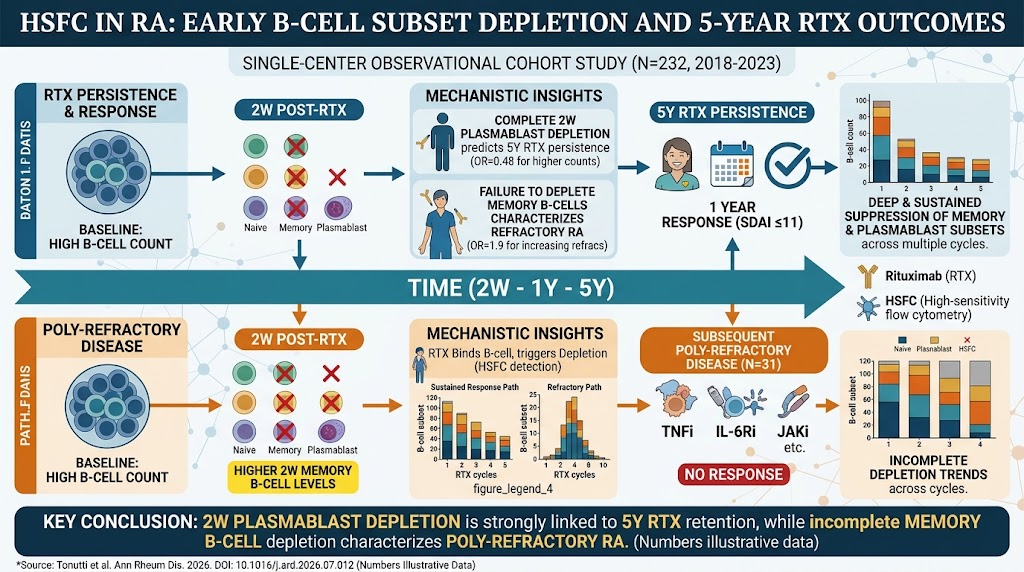
This real-world RA cohort study demonstrates that early (2-week) plasmablast depletion detected via high-sensitivity flow cytometry (HSFC) strongly predicts long-term (5-year) rituximab persistence and treatment response. In contrast, incomplete memory B-cell depletion at 2 weeks characterizes poly-refractory RA patients who fail multiple biologic and targeted synthetic DMARDs. HSFC thus holds promise for guiding personalized B-cell targeting strategies and early recognition of refractory disease.
Study Background
Rheumatoid arthritis (RA) is a chronic autoimmune inflammatory disease causing joint destruction and systemic complications. Although biologic therapies such as rituximab (RTX), an anti-CD20 monoclonal antibody that depletes B cells, have advanced treatment significantly, approximately 20%–30% of patients exhibit limited or no response. Identifying biomarkers predictive of sustained response versus refractoriness remains an unmet clinical need. Traditional flow cytometry may lack sensitivity to detect subtle changes in peripheral B-cell subsets that correlate with outcomes. High-sensitivity flow cytometry (HSFC) offers enhanced detection of rare B-cell subsets, allowing better characterization of RTX response dynamics. This study investigates whether early B-cell subset depletion assessed by HSFC correlates with short-term and long-term RTX clinical effectiveness and identifies immunophenotypic differences in poly-refractory RA.
Study Design
This was a single-center, observational cohort study enrolling 232 adult RA patients treated with RTX in routine clinical practice. Peripheral blood samples were collected before the first RTX infusion (baseline) and two weeks thereafter (2W). HSFC quantified naïve B cells, memory B cells, and plasmablasts. Complete depletion was defined as counts below 0.1 cells/µL for each subset. Clinical outcomes included 1-year response—defined as achieving simplified disease activity index (SDAI) ≤11 within 6 months and maintaining it for at least 12 months—and 5-year RTX persistence, meaning continued RTX use without therapeutic change for at least five years. Additionally, longitudinal B-cell subset trajectories over multiple RTX cycles were analyzed. Among participants, 13% (n=31) had poly-refractory RA, failing all biologic or targeted synthetic DMARD classes.
Key Findings
At two weeks post-RTX, complete depletion rates were very high for naïve (91%) and memory B cells (92%) but somewhat lower for plasmablasts (69%). Importantly, higher plasmablast counts at 2W correlated with decreased odds of 1-year clinical response (odds ratio [OR] 0.50; 95% confidence interval [CI], 0.32–0.75; P = .001) and lower likelihood of 5-year RTX persistence (OR 0.48; 95% CI, 0.30–0.79; P = .004). Conversely, complete plasmablast depletion strongly predicted both good 1-year outcomes and long-term retention of RTX treatment.
In patients with poly-refractory RA, memory B-cell levels at 2W were significantly higher compared to responders, with elevated counts correlating with increasing treatment refractoriness (OR 1.9; 95% CI, 1.3–2.9; P = .003). Longitudinal analysis revealed that patients demonstrating sustained RTX response maintained suppression of memory B cells and plasmablasts across multiple RTX cycles, whereas refractory patients showed incomplete depletion trends.
These observations link distinct B-cell immunophenotypes with clinical trajectories: early and robust plasmablast depletion associates with effective, durable RTX response, while failure to fully deplete memory B cells marks poly-refractory disease.
Expert Commentary
Rituximab efficacy in RA traditionally hinges on peripheral B-cell depletion but lacks a standardized, sensitive biomarker for predicting long-term response. This study leverages HSFC, a more sensitive assay than conventional flow cytometry, allowing precise quantification of rare B-cell subsets during early treatment phases. The strong association between 2-week plasmablast depletion and favorable 5-year RTX persistence highlights plasmablasts as a critical cellular target and candidate biomarker for therapeutic monitoring.
Moreover, the finding that incomplete memory B-cell depletion is characteristic of poly-refractory RA patients provides a potential mechanistic insight into why these patients fail multiple treatments. Memory B cells may harbor pathogenic potential or resist depletion due to microenvironmental niches or genetic factors. These results endorse integrating HSFC into clinical practice for personalized RA management, guiding decisions on continuing RTX or switching therapies early, especially in refractory cases.
Limitations include the observational design and single-center setting, which may limit generalizability. Further validation in multicenter, prospective trials and mechanistic studies dissecting memory B-cell resistance is warranted.
Conclusion
In summary, this study establishes that early plasmablast depletion measured by HSFC is a robust predictor of long-term rituximab response and treatment persistence in rheumatoid arthritis. Conversely, failure to achieve complete memory B-cell depletion identifies patients with poly-refractory disease who may benefit from alternative therapeutic approaches. These findings underscore the pathophysiological importance of B-cell subsets in mediating RTX responsiveness and resistance. Implementing HSFC in routine clinical care offers a precision medicine tool for early identification of responders versus refractory patients, optimizing therapeutic strategies in RA.
Future research should focus on elucidating mechanisms underlying memory B-cell persistence and exploring novel agents targeting refractory B-cell populations to improve outcomes in this challenging subgroup.
Funding and Registration
The study was supported by institutional research grants. No clinical trial registration number was provided.
Reference
Tonutti A, Abacar K, David P, Trunfio F, Nam JL, Wakefield R, Di Matteo A, Md Yusof MY, Saleem B, Bissell LA, Dass S, Emery P, Vital E, Mankia K, Rawstron A, McGonagle D. High-sensitivity flow cytometry in rheumatoid arthritis shows that early B-cell subset depletion is linked to 5-year rituximab response, while failure to deplete B cells occurs early in subsequent poly-refractory disease. Ann Rheum Dis. 2026 Aug 11:S0003-4967(26)00434-6. doi: 10.1016/j.ard.2026.07.012. Epub ahead of print. PMID: 42580905.
This article was created using several editorial tools, including AI, as part of the process. Human editors reviewed this content before publication.