We use cookies

Our website uses essential cookies and, with your consent, additional cookies to measure performance and improve our services. Cookie Policy.

You can change your choice at any time.

MMedXYNews
HomeVideos
MedXY AI/MedXY News/Section: Clinical Updates

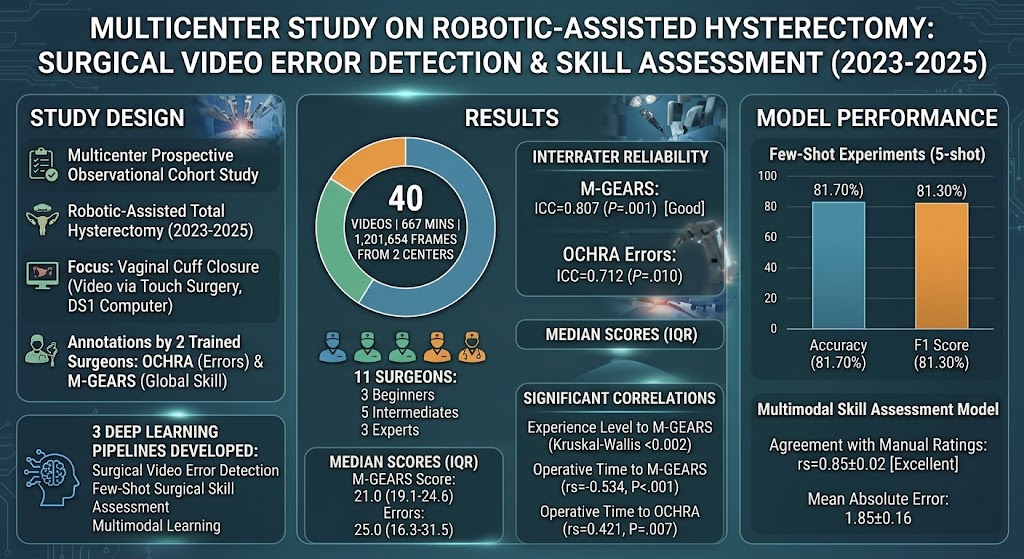
Deep Learning Applications in Evaluating and Predicting Technical Surgical Skills in Robotic-Assisted Vaginal Cuff Closure: A Multicenter Prospective Study
MedXY Editorial Team•Aug 24, 2026•Clinical Updates
surgical skill assessmentdeep learningvaginal cuff closurerobotic surgery

Highlights

  • Deep learning techniques can objectively assess surgical skills and detect technical errors during robotic-assisted vaginal cuff closure, supporting surgical education.
  • Multimodal learning models integrating video data achieve high accuracy (>80%) in skill assessment, correlating strongly with validated human expert ratings.
  • Objective metrics such as Modifiable Global Evaluative Assessment of Robotic Skills (GEARS) and Objective Clinical Human Reliability Analysis (OCHRA) correlate with surgeon experience and operative outcomes.
  • These methods lay foundational work toward AI-driven quality monitoring and evidence-based credentialing in minimally invasive gynecologic surgery.

Background

MedXY registered readers

Sign in free to continue reading

Create or use your MedXY account to unlock the complete article.

This article was created using several editorial tools, including AI, as part of the process. Human editors reviewed this content before publication.

Related articles

Open language-specific specialty feeds and department pages.

Revolutionizing Aortic Stenosis Screening: AI-Enabled Focused Cardiac Ultrasound with Novice OperatorsA novel deep learning algorithm accurately detects moderate or greater aortic stenosis using AI-guided focused cardiac ultrasound acquired by novice operators, presenting a scalable solution to expand screening accessibility.Aug 29, 2026Harnessing Deep Learning for Early Detection of Incisional Surgical Site Infections Through Wound Image AnalysisA validated deep learning model accurately detects surgical site infections from wound images, offering a promising telemedicine tool for early postoperative monitoring and timely clinical intervention.Aug 28, 2026Early Prediction of Dupilumab Efficacy in Facial Atopic Dermatitis via Reflectance Confocal Microscopy and Deep LearningReflectance confocal microscopy features at week 4 post-dupilumab treatment, combined with deep learning analysis, enable non-invasive prediction of therapeutic response in facial atopic dermatitis patients.Aug 12, 2026
Loading comments...
MedXY briefing

Get the free newsletter

Evidence-led clinical news, trends, and analysis—delivered to your inbox.

Ask MedXY AI

Most popular

Intimate Health
Five Benefits for Women Continuing Sexual Activity After Menopause
Intimate Health
Why Some Women Have a Strong Sex Drive—And Why Men Shouldn't Worry About It
Nursing & care
How often should a couple have sex?
Intimate Health
Classic Intimacy Recommendations: How to Help Women Reach Orgasm and Enjoy Mutual Pleasure
Intimate Health
What Makes a Woman "Physiologically Addicted" Is Never Money, But These Two Relationship Qualities
© 2026 MedXY
Contact usAbout usPrivacy PolicyMedXY story
Deep Learning-Driven Synthetic MR Perfusion Maps: A Breakthrough in Acute Ischemic Stroke Imaging
This study presents a deep learning model that generates synthetic T-max perfusion maps from noncontrast DWI and FLAIR sequences, potentially streamlining stroke imaging and eliminating the need for contrast agents.
Aug 12, 2026
Revolutionizing Stage II Colorectal Cancer Prognostication: Validating Semantically-Enhanced AI for Risk StratificationA novel AI model, SÉMIL, integrating vision-language and multiple instance learning, improves prognostic accuracy for stage II colorectal cancer by refining risk stratification beyond current clinical assessments, especially within NCCN higAug 4, 2026
MAIPI: A Novel AI-Powered Prognostic Index for Mantle Cell Lymphoma Using Routine HistologyThe MAIPI deep learning model offers a novel, accurate prognosis tool for mantle cell lymphoma, using standard H&E stained biopsy images, bypassing need for molecular tests or expert pathology, and enhancing risk stratification for indiJul 12, 2026