Highlight
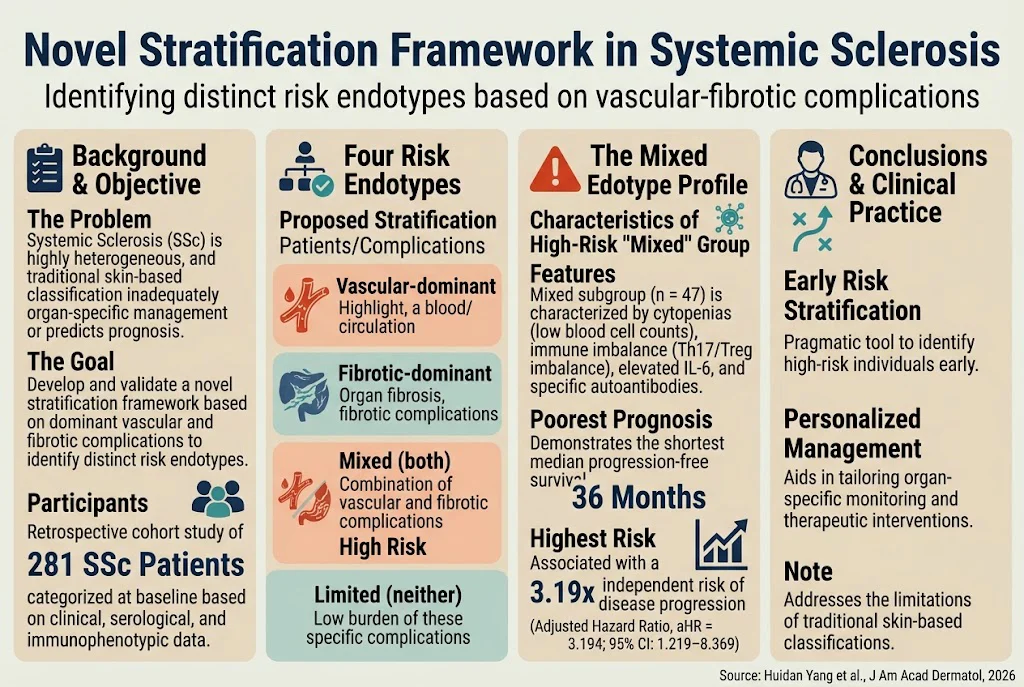
This retrospective cohort study proposes a novel stratification framework for systemic sclerosis (SSc) patients based on dominant vascular and fibrotic complications, identifying four distinct endotypes. The Mixed vascular-fibrotic subgroup demonstrates a unique immunophenotypic profile, including Th17/Treg imbalance and elevated IL-6, and carries the highest risk for disease progression. This framework offers a pragmatic approach for early risk stratification and guiding personalized management in SSc.
Study Background
Systemic sclerosis is a complex autoimmune connective tissue disease characterized by widespread vascular dysfunction and progressive fibrosis affecting the skin and multiple internal organs. Conventional classification of SSc based mainly on the extent of skin involvement (limited versus diffuse cutaneous subsets) inadequately captures the heterogeneity of organ involvement and fails to adequately predict disease progression and prognosis. Given the variable manifestations and high morbidity and mortality associated with internal organ complications, more precise classification schemes are needed to optimize risk assessment and tailor management strategies.
Vascular complications such as digital ulcers, pulmonary arterial hypertension, and renal crisis, along with fibrotic manifestations involving skin and lungs, substantially determine disease course and outcomes. However, these pathological processes often coexist and interact, complicating clinical stratification using traditional criteria. Identification of distinct endotypes with dominant vascular or fibrotic features or a combination thereof could provide enhanced prognostic insights and therapeutic guidance.
Study Design
This single-center retrospective cohort study enrolled 281 patients diagnosed with systemic sclerosis. At baseline, patients were categorized into four subgroups based on dominant complication patterns: (1) Vascular-dominant (primarily vascular complications), (2) Fibrotic-dominant (primarily fibrotic manifestations), (3) Mixed (presence of both vascular and fibrotic complications), and (4) Limited (neither dominant vascular nor fibrotic complications).
Clinical features, serological markers, immunophenotyping including T-helper 17 (Th17) and regulatory T-cell (Treg) balance, circulating cytokine levels (notably interleukin-6), and autoantibody profiles were comprehensively assessed.
Longitudinal progression was analyzed using Kaplan-Meier survival curves and multivariable Cox regression models to identify independent risk factors for disease progression, defined by organ involvement advancement or clinical deterioration. The predictive value of biomarker combinations in subgroup classification was also evaluated.
Key Findings
Four distinct endotypes of systemic sclerosis emerged from the stratification framework:
Vascular-dominant subgroup: Characterized mainly by vascular complications without significant fibrotic involvement.
Fibrotic-dominant subgroup: Exhibited major fibrotic manifestations, particularly of the skin and lungs, with fewer vascular events.
Mixed subgroup: Represented 47 patients exhibiting significant vascular and fibrotic complications concurrently.
Limited subgroup: Patients with neither prominent vascular nor fibrotic complications at baseline.
The Mixed subgroup exhibited notable peripheral blood cytopenias, a pronounced Th17/Treg imbalance indicating immune dysregulation, and elevated serum interleukin-6, a proinflammatory cytokine implicated in fibrosis and vascular damage. Specific autoantibodies, distinct from those predominating in other subgroups, were also associated with this group.
Clinically, the Mixed subgroup had the shortest median progression-free survival of 36 months and demonstrated the highest risk for disease progression, with an adjusted hazard ratio of 3.194 (95% confidence interval, 1.219-8.369), underscoring its prognostic severity.
Combined biomarker analysis produced moderate predictive accuracy for subgroup identification, suggesting the potential utility of integrated immunological and serological profiling to refine clinical classification beyond skin involvement.
Expert Commentary
The proposed vascular-fibrotic complication framework addresses a critical unmet need in systemic sclerosis clinical practice by moving beyond traditional skin-based classification. Identifying a Mixed endotype with distinct immune and inflammatory signatures highlights the complex pathobiology driving aggressive disease and poor prognosis in this subgroup. The immunophenotypic findings of Th17/Treg imbalance and elevated IL-6 align with emerging mechanistic insights implicating immune dysregulation in SSc pathogenesis.
However, the study’s constraints include its single-center design, moderate cohort size, and limited follow-up period, which temper the generalizability of findings. The biomarker panel, while informative, is incomplete, warranting incorporation of additional molecular and imaging markers in future studies. Further validation across diverse populations and prospective longitudinal analyses are necessary to consolidate the clinical utility of this novel stratification model.
Conclusion
This study introduces an innovative complication-based stratification framework for systemic sclerosis, delineating four endotypes with distinct clinical and immunological profiles. The identification of a high-risk Mixed vascular-fibrotic endotype with markedly poorer progression-free survival aids early risk stratification and could serve as a foundation for personalized management strategies and targeted therapeutic interventions. Integrating clinical, serological, and immunophenotypic data promises to enhance prognostic precision and improve outcomes in this heterogeneous disease.
Future research should focus on refining biomarker panels, validating classification in multicenter cohorts, and investigating tailored treatments addressing the vascular and fibrotic pathways underlying these identified endotypes.
References
Yang H, Cheng H, Li J, Zhang M, Zhao Q, Wang K, Yan C, Wen H. A novel stratification framework based on vascular-fibrotic complications identifies distinct risk endotypes in systemic sclerosis: A retrospective cohort study. J Am Acad Dermatol. 2026 May 16;95(4):979-987. PMID: 42144193.
Allanore Y, Distler O, Matucci-Cerinic M. Systemic sclerosis. Nat Rev Dis Primers. 2015;1:15002.
Gabrielli A, Avvedimento EV, Krieg T. Scleroderma. N Engl J Med. 2009;360(19):1989-2003.
Khanna D, et al. Clinical trials in systemic sclerosis: challenges and opportunities. Nat Rev Rheumatol. 2018;14(12):721-737.
Taroni JN, et al. Molecular stratification of systemic sclerosis reveals fibroproliferative and inflammatory subtypes. Nat Commun. 2019;10(1):5071.