Highlight
Recent research demonstrates that LABD97, a proteolyzed fragment of BP180, offers superior sensitivity in ELISA serologic testing for bullous pemphigoid compared to current commercial BP180 (NC16A) and BP230 ELISAs. This antigenic target detects a higher proportion of circulating IgG autoantibodies, including in patients who test negative with existing assays, suggesting its potential to significantly improve diagnostic accuracy.
Study Background
Bullous pemphigoid (BP) is an autoimmune blistering skin disease characterized by autoantibodies targeting components of the dermoepidermal junction, primarily BP180 and BP230 proteins. Diagnosis relies on a combination of clinical evaluation, histopathology, and immunologic assays, including indirect immunofluorescence (IIF) and ELISA-based serologic testing. However, current commercial ELISAs targeting predominantly the NC16A domain of BP180 and BP230 fail to detect circulating IgG autoantibodies in approximately 25% of clinically and immunopathologically confirmed BP patients. This gap represents a significant diagnostic challenge, potentially delaying appropriate treatment and impacting patient outcomes. LABD97, a 97-kDa proteolytic fragment from the shed ectodomain of BP180, has emerged as a promising new antigenic target that may expand the sensitivity and diagnostic yield of serologic testing in BP.
Study Design
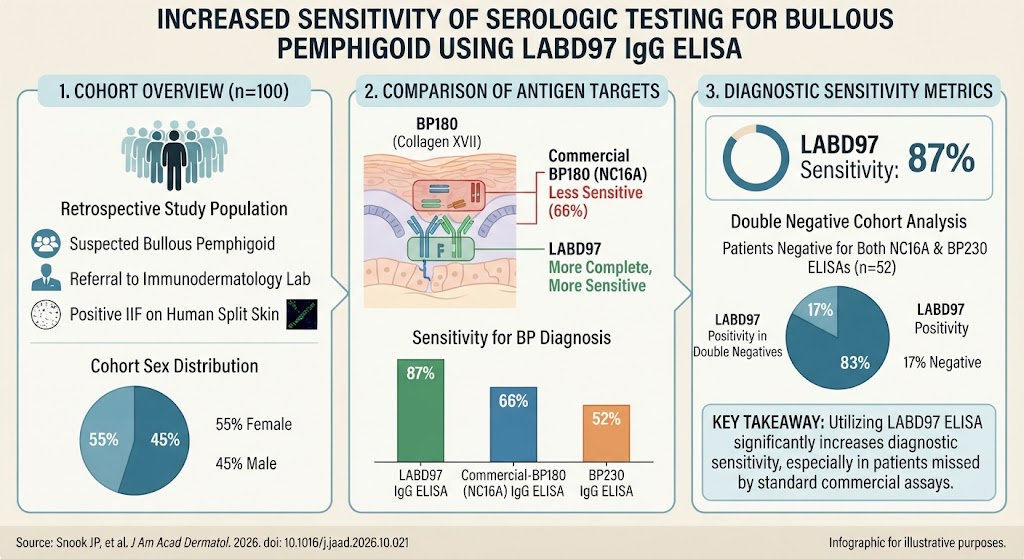
This retrospective study analyzed 100 consecutive serum samples collected from patients at the University of Utah Immunodermatology Laboratory, submitted with suspected initial diagnosis of bullous pemphigoid. Eligible sera showed an epidermal IgG/IgG4 pattern on human split skin substrate by indirect immunofluorescence. The study compared the sensitivity of LABD97 IgG ELISA with commercial ELISAs targeting BP180 NC16A and BP230, evaluating the ability of each to detect circulating autoantibodies in these clinically relevant patient samples.
Key Findings
The LABD97 IgG ELISA demonstrated a sensitivity of 87%, outperforming the commercial BP180 (NC16A) ELISA at 66% and BP230 ELISA at 52%. Among the subset of patients who were double negative for both BP180 NC16A and BP230 ELISAs, 83% were positive for LABD97 antibodies, highlighting the assay’s potential to identify cases otherwise missed by standard serologic tests. These findings suggest LABD97 encompasses antigenic epitopes not adequately represented in the NC16A fragment, rendering it a more comprehensive target for autoantibody detection in BP.
Given the retrospective design and limited clinical follow-up data, the findings warrant prospective validation. Nonetheless, the study strongly indicates that integrating LABD97 IgG ELISA into diagnostic protocols can enhance sensitivity, thereby improving early and accurate BP diagnosis.
Expert Commentary
Precision in the serologic diagnosis of bullous pemphigoid remains a challenge due to antigenic heterogeneity and epitope spreading phenomena in autoimmune blistering diseases. LABD97 as a diagnostic antigen offers biological plausibility because it derives from the shed ectodomain of BP180, capturing autoantibody repertoires targeting non-NC16A extracellular regions that are pathogenic in BP. Incorporating LABD97 ELISA may also refine diagnostic criteria and reduce reliance on more invasive or less specific tests such as direct immunofluorescence of skin biopsies.
Limitations include the single-center nature of this study, which may not reflect broader population heterogeneity or varied clinical phenotypes. Future studies should aim to validate the LABD97 ELISA across multiple centers, correlate antibody titers with disease activity and treatment response, and evaluate cost-effectiveness in routine clinical workflows.
Conclusion
The LABD97 IgG ELISA significantly increases the sensitivity of serologic testing in bullous pemphigoid diagnosis compared to currently available BP180 NC16A and BP230 ELISAs. Its ability to detect autoantibodies in cases missed by standard assays supports its use as a complementary diagnostic tool. Widespread implementation could lead to earlier diagnosis and improved management of BP, highlighting the importance of expanding antigen targets beyond conventional epitopes in autoimmune blistering disease serology.
Funding and Clinical Trials
The original study did not report specific funding sources or registered clinical trials. Further research with multi-institutional collaboration is encouraged to confirm these findings and incorporate LABD97 testing into BP diagnostic guidelines.
References
Snook JP, Khalighi MA, Cocks MM, Zone JJ. LABD97 IgG ELISA increases sensitivity of ELISA serologic testing for the diagnosis of bullous pemphigoid. Journal of the American Academy of Dermatology. 2026 Oct 13. PMID: 42869132.
Schmidt E, Zillikens D. The diagnosis and treatment of bullous pemphigoid. Dtsch Arztebl Int. 2011;108(23):399-405.
Bernard P, Antonicelli F. Bullous pemphigoid: an update on the disease and its management. Expert Rev Clin Immunol. 2017;13(12):1073-1082.
Hammers CM, Stanley JR. Mechanisms of blister induction by autoantibodies in pemphigoid diseases. Clin Dermatol. 2016;34(1):32-38.