We use cookies

Our website uses essential cookies and, with your consent, additional cookies to measure performance and improve our services. Cookie Policy.

You can change your choice at any time.

MMedXYNews
HomeVideos
MedXY AI/MedXY News/Section: Clinical Updates

Comprehensive Analysis of US Health Care Spending on Injuries: Mechanisms, Demographics, and Payer Perspectives
MedXY Editorial Team•Aug 12, 2026•Clinical Updates
injury spendingtrauma economicsUS health care卫生政策

Highlights

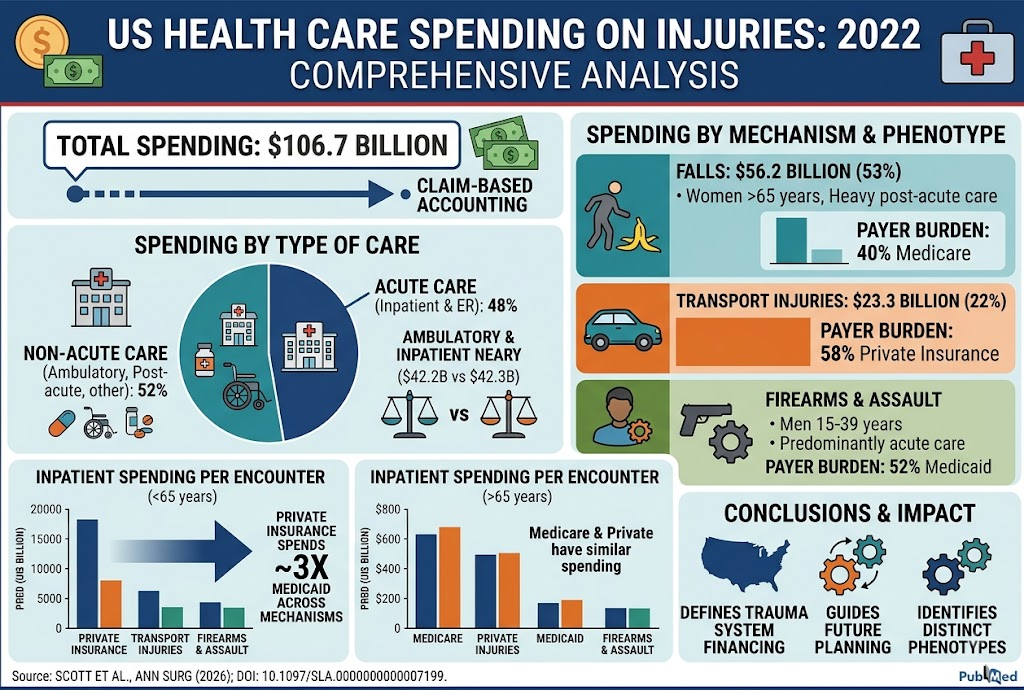
  • US injury-related health care spending reached $106.7 billion in 2022, with more than half occurring outside acute and ambulatory care settings.
  • Falls accounted for the largest share of spending, especially among older women, reflecting heavy post-acute care utilization.
  • Distinct demographic and payer-related spending phenotypes emerged: firearms and assaults predominantly affected young men with acute care needs; Medicare bore most fall-related costs while private insurance covered most transport injury expenses.
  • Private insurance spending per inpatient encounter was markedly higher than Medicaid for patients under 65, illuminating payer-based cost disparities influencing trauma system financing.

Background

MedXY registered readers

Sign in free to continue reading

Create or use your MedXY account to unlock the complete article.

This article was created using several editorial tools, including AI, as part of the process. Human editors reviewed this content before publication.

Related articles

Open language-specific specialty feeds and department pages.

Home Dialysis Underuse: Historical Policy Barriers and Enduring DisparitiesA historical analysis reveals that policy decisions, financial incentives, and for-profit dialysis centers have contributed to persistent underuse of home dialysis in the US, especially among marginalized populations.Jul 27, 2026The Oncology Care Model and Starting Systemic Therapy for CancerA Medicare-based study found the Oncology Care Model did not increase systemic therapy starts for newly diagnosed cancer and was linked to less treatment initiation and lower spending in poor-prognosis cancer.Jun 10, 2026Medicare Advantage Enforcement Has Been Inconsistent and Financially Modest Despite Expanding Federal ExposureA 2010-2023 analysis found that CMS enforcement against Medicare Advantage plans was highly variable, usually limited to modest monetary penalties, and more common among lower-rated contracts serving more socially vulnerable beneficiaries.May 30, 2026ACP Calls for Stronger Oversight of Medicare Advantage to Protect Patients, Payment Accuracy, and Quality
Loading comments...
MedXY briefing

Get the free newsletter

Evidence-led clinical news, trends, and analysis—delivered to your inbox.

Ask MedXY AI

Most popular

Intimate Health
Five Benefits for Women Continuing Sexual Activity After Menopause
Intimate Health
Why Some Women Have a Strong Sex Drive—And Why Men Shouldn't Worry About It
Nursing & care
How often should a couple have sex?
Intimate Health
Classic Intimacy Recommendations: How to Help Women Reach Orgasm and Enjoy Mutual Pleasure
Intimate Health
What Makes a Woman "Physiologically Addicted" Is Never Money, But These Two Relationship Qualities
© 2026 MedXY
Contact usAbout usPrivacy PolicyMedXY story
The American College of Physicians urges major reforms to Medicare Advantage, including more accurate payment, simpler quality measures, tighter oversight of marketing and prior authorization, and stronger transparency to better protect ben
May 21, 2026
Telemedicine After the Pandemic: Who Benefits, What Changed, and What Comes NextTelemedicine is no longer an emergency workaround. New policy guidance shows how virtual care can improve access, but only if payment, safety, equity, and prescribing rules evolve carefully.May 18, 2026
Maryland’s Global Budget Revenue Model Was Linked to Better Cancer Surgery Outcomes and Lower Medicare SpendingIn a large Medicare study, hospitals under Maryland’s global budget model showed modest but significant improvements in cancer surgery outcomes, driven by fewer complications and shorter stays, with lower inpatient spending.Apr 20, 2026