Comparing Autoaugmentation and Implant-Based Augmentation Mastopexy After Massive Weight Loss: Outcomes and Clinical Implications
Highlight
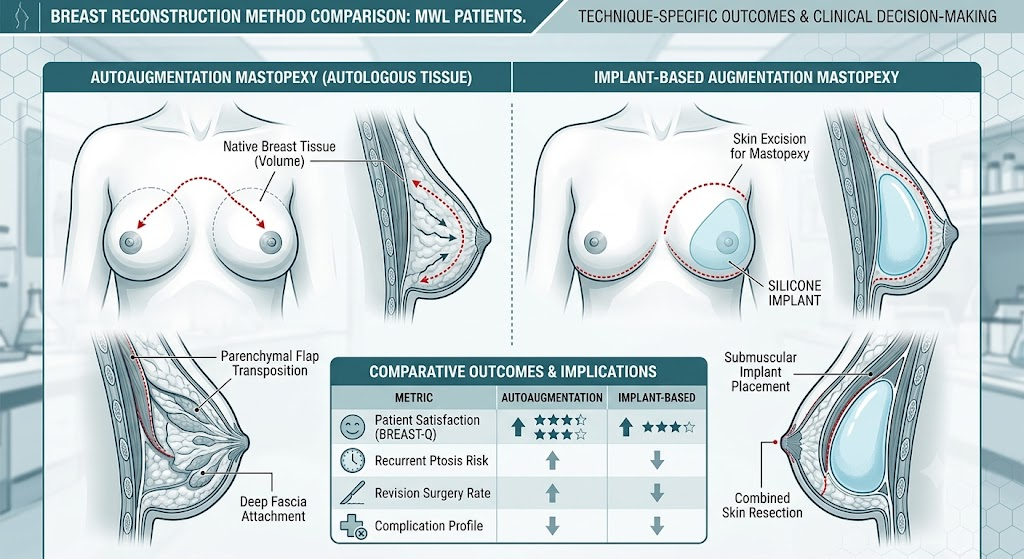
Autoaugmentation mastopexy after massive weight loss yields higher patient satisfaction and aesthetic outcome scores compared to implant-based augmentation.
Complications in autoaugmentation were mostly conservatively managed, whereas implant-based procedures frequently required surgical revision.
Recurrent breast ptosis was more common after implant-based augmentation in this patient population.
General health-related quality of life did not differ significantly between approaches based on 36-item Short Form Health Survey scores.
Study Background
Massive weight loss (MWL), frequently achieved through bariatric surgery or lifestyle modifications, leads to significant body contour changes, including ptosis and volume loss of the breast. Women who have undergone MWL often seek breast rejuvenation for both functional and aesthetic reasons. Among the surgical options, autoaugmentation and implant-based augmentation mastopexy are established techniques to restore breast shape and volume. Autoaugmentation leverages the patient’s own breast tissue by repositioning it to achieve fullness without foreign material, whereas implant-based augmentation uses silicone or saline implants alongside mastopexy. Despite widespread clinical use, direct comparative data evaluating patient-centered outcomes, complication profiles, and aesthetic results between these two techniques remain limited. Understanding these differences is critical to guiding surgical decision-making and patient counseling in this growing population.
Study Design
This retrospective cohort study included 100 consecutive women with MWL undergoing breast surgery over 7.6 years. Of these, 64 received autoaugmentation mastopexy and 36 underwent implant-based augmentation mastopexy. Data on demographics, surgical techniques, complications, and revision rates were collected from medical records. The median follow-up duration was 2.8 years (0.3–7.6 years). Outcome assessments during follow-up involved validated patient-reported outcome measures including BREAST-Q (assessing satisfaction with breasts and overall outcome) and the 36-item Short Form Health Survey (SF-36) for general health-related quality of life. Additionally, standardized aesthetic evaluations were performed by independent observers. Complications were classified using the Clavien-Dindo system to account for severity and management approaches.
Key Findings
The study population had a mean age of 39 ± 10.6 years. Key results included:
Patient-Reported Outcomes
Autoaugmentation recipients reported significantly higher BREAST-Q scores for Satisfaction with Breasts and Satisfaction with Outcome (P < 0.001 for both) compared to the implant-based group. This suggests superior subjective aesthetic and functional outcomes without introducing implants.
Aesthetic Outcomes
Objective aesthetic evaluations favored autoaugmentation across most criteria, including breast shape, contour, and natural appearance. The implant group was more prone to recurrent ptosis, a notable long-term concern affecting aesthetics and patient satisfaction.
Complication and Revision Rates
Complications graded by Clavien-Dindo classification were predominantly minor and managed conservatively in the autoaugmentation group. Conversely, implant-based mastopexy complications typically required surgical revisions (P = 0.009). This indicates a more favorable safety profile with autoaugmentation in this population.
General Health-Related Quality of Life
SF-36 results showed no significant difference between groups, implying that the choice of surgical technique did not impact overall physical or mental health status beyond localized breast satisfaction.
Expert Commentary
This study provides rigorous, real-world evidence favoring autoaugmentation mastopexy over implant-based techniques in women post-MWL, particularly when sufficient native breast tissue is available. It aligns with biomechanical reasoning that native tissue redistributions maintain the natural vascularity and innervation, reducing implant-related complications such as capsular contracture, infection, and extrusion risks. The increased revision burden associated with implants further underscores the need for careful preoperative patient selection and counseling.
Limitations include the retrospective design and potential selection bias, as more suitable candidates for autoaugmentation may have been chosen based on preoperative breast volume. Additionally, longer-term follow-up is warranted to assess durability beyond the median 2.8 years. Nonetheless, these findings support a paradigm that prioritizes autologous tissue utilization in MWL patients to optimize quality-of-life and minimize reoperation.
Conclusion
In women after massive weight loss, autoaugmentation mastopexy demonstrates superior patient satisfaction, aesthetic outcomes, and a lower incidence of complications requiring revision surgery compared to implant-based augmentation mastopexy. Surgeons should consider autoaugmentation as the first-line technique when adequate breast tissue is present, reserving implants for cases where autologous volume is insufficient. In such scenarios, comprehensive patient education regarding higher complication risks and potential for revision is essential. Future prospective studies with longer follow-up are recommended to confirm these results and refine surgical algorithms.
Funding and ClinicalTrials.gov
The original publication did not specify funding sources or clinical trial registration.
References
1. Radacher L, Zaussinger M, Ehebruster G, Bachleitner K, Feldler S, Schwartz B, Schmidt M. Autoaugmentation versus Implant-Based Augmentation Mastopexy after Massive Weight Loss: Quality-of-Life, Surgical, and Aesthetic Results. Plast Reconstr Surg. 2026 Jul 28;158(2):249-260. PMID: 42519939.
2. Hamdi M, Demuynck M, Van Landuyt K, Delay E. Breast reshaping after massive weight loss: techniques and results. Clin Plast Surg. 2009;36(4):647-654.
3. Spear SL, Boehmler JH, Clemens MW. Augmentation mastopexy: principles and techniques. Plast Reconstr Surg. 2009;124(6):1804-1813.
4. Klassen AF, Cano SJ, Scott AM, et al. Measuring patient-reported outcomes in breast surgery: domain identification and item selection for the BREAST-Q. Plast Reconstr Surg. 2009;124(2):391-399.
5. Clavien PA, Barkun J, De Oliveira ML, et al. The Clavien-Dindo classification of surgical complications: five-year experience. Ann Surg. 2009;250(2):187-196.
This article was created using several editorial tools, including AI, as part of the process. Human editors reviewed this content before publication.