We use cookies

Our website uses essential cookies and, with your consent, additional cookies to measure performance and improve our services. Cookie Policy.

You can change your choice at any time.

MMedXYNews
HomeVideos
MedXY AI/MedXY News/Section: news

Comparative Efficacy of Mepolizumab and Dupilumab in Eosinophilic COPD: Insights from a Matching-Adjusted Indirect Treatment Comparison
MedXY Editorial Team•Aug 23, 2026•news
biologicsCOPDexacerbationsdupilumabMAICEosinophilic PhenotypeMepolizumab

Highlight

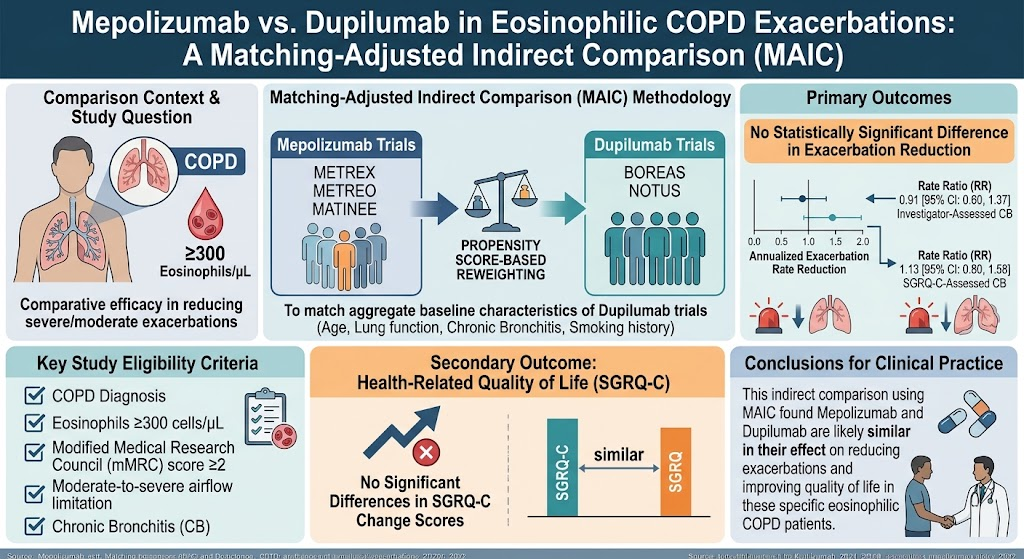
  • No statistically significant difference between mepolizumab and dupilumab in reducing moderate/severe exacerbations in eosinophilic COPD.
  • Both treatments showed comparable improvements in health-related quality of life as measured by SGRQ-C.
  • Matching-adjusted indirect comparison (MAIC) methodology allowed adjustment for population differences across clinical trials.
  • Findings support the interchangeable clinical utility of these monoclonal antibodies targeting type 2 inflammation in COPD patients with high eosinophil counts.

Study Background

MedXY registered readers

Sign in free to continue reading

Create or use your MedXY account to unlock the complete article.

This article was created using several editorial tools, including AI, as part of the process. Human editors reviewed this content before publication.

Related articles

Open language-specific specialty feeds and department pages.

From Mild-to-Moderate to Severe Asthma: Risk Factors and Patient Profiles from the NORDSTAR Cohort and Advances in Severe Asthma ManagementThis review summarizes the progression risk from mild-to-moderate to severe asthma based on the NORDSTAR cohort and integrates emerging evidence on biologic therapies that improve severe asthma outcomes across diverse patient profiles.Sep 17, 2026Astegolimab for Chronic Obstructive Pulmonary Disease with Frequent Exacerbations: Insights from the Pooled ALIENTO and ARNASA TrialsAstegolimab, an anti-ST2 monoclonal antibody, significantly reduced moderate/severe exacerbations in COPD patients with frequent exacerbations in pooled ALIENTO and ARNASA analyses, showing promise for targeting the IL-33/ST2 pathway with gSep 13, 2026Efficacy of Dupilumab in Reducing COPD Exacerbations, Emergency Department Visits, and Corticosteroid Use: Insights from a Pooled Phase 3 AnalysisDupilumab significantly reduces emergency visits, hospital admissions, and systemic corticosteroid use in COPD patients with type 2 inflammation, offering a promising therapeutic option to mitigate exacerbation-associated morbidity.Sep 12, 2026
Loading comments...
MedXY briefing

Get the free newsletter

Evidence-led clinical news, trends, and analysis—delivered to your inbox.

Ask MedXY AI

Most popular

Intimate Health
Five Benefits for Women Continuing Sexual Activity After Menopause
Intimate Health
Why Some Women Have a Strong Sex Drive—And Why Men Shouldn't Worry About It
Nursing & care
How often should a couple have sex?
Intimate Health
Classic Intimacy Recommendations: How to Help Women Reach Orgasm and Enjoy Mutual Pleasure
Intimate Health
What Makes a Woman "Physiologically Addicted" Is Never Money, But These Two Relationship Qualities
© 2026 MedXY
Contact usAbout usPrivacy PolicyMedXY story
Unveiling Dupilumab-Associated Ocular Surface Disease in Atopic Dermatitis: Insights from a Large Prospective BioDay CohortThis study reveals that 30.7% of atopic dermatitis patients treated with dupilumab develop ocular surface disease, despite prevalent ocular symptoms at baseline and increased ophthalmic treatment during therapy, linked to reduced conjunctivSep 12, 2026
Defining and Achieving Disease Stability in COPD: Insights from Phase 3 TrialsThis article explores disease stability as a key treatment target in COPD, analyzing major phase 3 trials that show stability predicts reduced exacerbations and mortality, supporting its use to guide therapy.Sep 9, 2026
Refining COPD Exacerbation Risk Categories Enhances Prediction of Future EpisodesA recent study demonstrates that defining COPD exacerbation risk by any moderate or severe event over two years improves prediction accuracy and clinical decision-making compared to the standard one-year criteria.Aug 20, 2026