Characterization of Patient-Reported Sleep and Mood Symptoms in Chronic Mild Traumatic Brain Injury: A Comprehensive Review
Highlights
- High prevalence of diverse sleep disturbances including insomnia, excessive daytime sleepiness, and obstructive sleep apnea are reported in chronic mTBI patients, often coexisting with mood disorders.
- Self-reported sleep impairments significantly correlate with neurobehavioral symptom severity, depression, and anxiety, underscoring complex symptom interdependencies.
- Sleep quality improvement through targeted interventions may reduce depressive and post-traumatic symptoms and enhance neurocognitive outcomes.
- Comprehensive screening for sleep disorders should be embedded within chronic mTBI care to optimize recovery and functional outcomes.
Background
Traumatic brain injury (TBI) affects approximately two million individuals annually in the United States, with mild traumatic brain injury (mTBI), often synonymous with concussion, constituting the majority of cases. While mTBI is characterized by transient neurological impairment, many patients develop chronic symptoms, including cognitive deficits, mood disturbances, and sleep disorders, contributing substantially to long-term disability and diminished quality of life. Sleep disturbances reported in mTBI include insomnia, excessive daytime sleepiness (EDS), and obstructive sleep apnea (OSA), with prevalence varying between 30% and 70%. The complex interplay among sleep impairments, mood symptoms, and cognitive dysfunction demands a better understanding to guide comprehensive management strategies.
Key Content
Patient-Reported Sleep and Mood Symptoms in Chronic mTBI
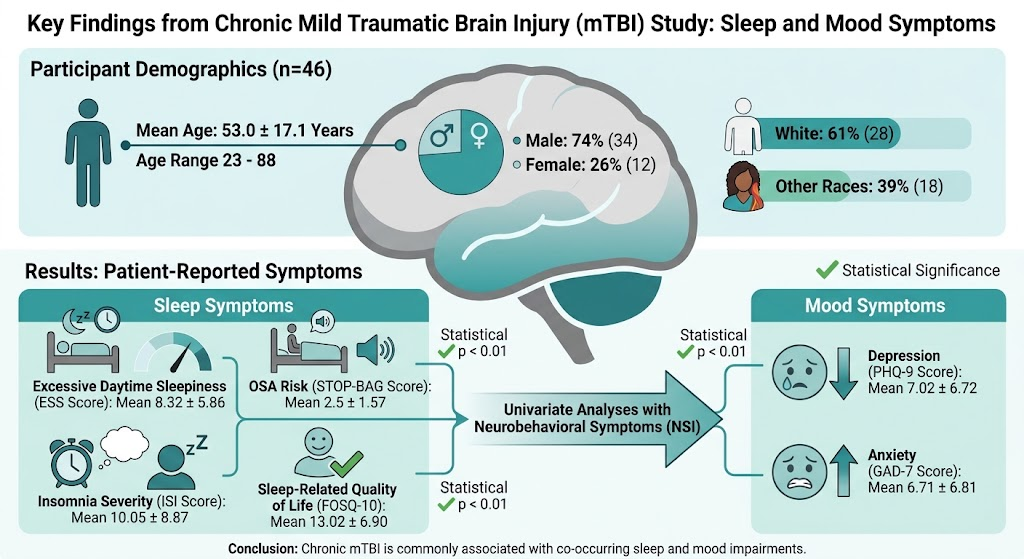
Johnson et al. (2026) conducted a cross-sectional retrospective analysis of 46 adults with chronic mTBI (>6 months post-injury) at a Level 1 trauma center, employing validated patient-reported measures: Neurobehavioral Symptom Inventory (NSI), Epworth Sleepiness Scale (ESS), STOP-Bang questionnaire, Insomnia Severity Index (ISI), Functional Outcome of Sleep Questionnaire-10 (FOSQ-10), Patient Health Questionnaire-9 (PHQ-9), and Generalized Anxiety Disorder-7 (GAD-7). The cohort was predominantly male (74%) with a mean age of 53 years. Significant associations were identified between NSI scores and measures of daytime sleepiness, insomnia severity, sleep-related functional impairment, depression, and anxiety (p < 0.01 for all), after controlling for age, BMI, and time from injury. These findings corroborate chronic sleep and mood impairments tightly linked to neurobehavioral symptom burden in mTBI. Importantly, the study excluded substance-dependent individuals, increasing the specificity of results to injury-related factors.
Sleep Disturbance, Fatigue, and Cognitive Function Post-mTBI
Shany-Ur et al. (2021) investigated the relationship between sleep disturbance, fatigue, and cognitive performance in 60 premorbidly healthy adults approximately 8 weeks post-mTBI. Using the Pittsburgh Sleep Quality Index (PSQI), Multidimensional Fatigue Inventory, and neuropsychological assessments targeting processing speed, attention, memory, and executive function, they found sleep disturbance was strongly associated with poorer cognitive functioning (r2=0.586, p<0.001), especially executive function, independent of psychological distress and age. Intriguingly, higher fatigue correlated with better cognitive performance, potentially reflecting compensatory mechanisms. This study emphasizes the detrimental impact of sleep dysfunction on cognition early post-injury and implies that sleep interventions may enhance cognitive recovery.
Subjective Sleep Quality and Postconcussive Symptoms Severity
Siobhan et al. (2015) performed an online survey of 158 individuals with history of mTBI, assessing subjective sleep quality via PSQI alongside postconcussive symptoms (PCS) measured by NSI and psychological distress by Brief Symptom Inventory-18. A striking 92% reported poor sleep quality. Regression analyses demonstrated that subjective sleep quality significantly predicted PCS severity beyond demographic factors, time since injury, and psychological distress (p < 0.001), though psychological distress explained greater variance. This study highlights the ubiquity of poor sleep post-mTBI and its contributory role to persistent symptomatology.
Impact of Improved Sleep on Mood and Neurobiological Markers
Spoormaker et al. (2015) studied military personnel with insomnia, a population with relevant overlapping features given mTBI prevalence. Among 44 subjects undergoing cognitive behavioral therapy for insomnia and positive airway pressure treatment, those exhibiting improved sleep quality demonstrated significant reductions in depressive and posttraumatic arousal symptoms (p=0.005 and p=0.006, respectively) and increased insulin-like growth factor-1 (IGF-1) concentrations (p=0.009), a neurotrophic factor implicated in neuronal repair and neuroplasticity. This evidence suggests that sleep quality enhancement may attenuate mood symptom burden and promote neurobiological recovery mechanisms relevant in mTBI.
Integrative Perspectives on Mechanistic and Clinical Implications
Sleep disruption in mTBI likely arises from multifactorial etiologies, including neuroinflammatory cascades, autonomic dysregulation, and structural and functional network injuries affecting sleep regulation centers. Sleep disturbances exacerbate cognitive impairments, fatigue, and mood disorders, creating a vicious cycle that impairs recovery. Trophic factors such as IGF-1 and brain derived neurotrophic factor (BDNF) appear modulated by sleep states and may represent targets for enhancing neurorepair. Clinical interventions improving sleep, including cognitive behavioral therapy for insomnia and treatment of OSA, are associated with symptomatic and functional improvement.
Expert Commentary
The evidence consistently underscores the high prevalence of sleep disturbances among patients with chronic mTBI and their strong interrelationship with mood and cognitive symptoms. Johnson et al.’s study extends the literature by detailed phenotyping with multiple patient-reported instruments and statistically robust control of confounders, highlighting the critical need to comprehensively assess sleep symptoms in this population. The correlation between neurobehavioral symptom severity and sleep/mood parameters suggests that addressing sleep dysfunction may mitigate overall symptom burden.
However, limitations of current studies include reliance on subjective measures, limited sample sizes, and cross-sectional designs. Objective sleep assessments with polysomnography and longitudinal studies are required to unravel causal pathways and temporal patterns. Additionally, heterogeneity in injury mechanisms, comorbidities, and demographic factors complicate generalization. Future research should prioritize randomized controlled trials of tailored sleep interventions to determine their effect on mood, cognition, and functional recovery post-mTBI.
Conclusion
Chronic mTBI patients frequently experience persistent sleep disturbances, including insomnia and excessive daytime sleepiness, which strongly associate with mood symptoms and neurobehavioral impairments. Interventional studies suggest that improving sleep quality can alleviate depressive symptoms and may foster neurobiological recovery through modulation of trophic factors. These findings advocate for routine screening and integrated management of sleep disorders as a fundamental component of holistic mTBI care. Addressing sleep dysfunction holds promise to improve cognitive and emotional outcomes and reduce disability in this prevalent neurological condition.
References
- Johnson K, Civantos AM, Patel N, et al. Characterization of Patient-Reported Sleep and Mood Symptoms in Chronic Mild Traumatic Brain Injury. Laryngoscope. 2026 Aug 16. PMID: 42604462.
- Shany-Ur T, Woolard AA, Notenboom RGE, et al. An observational study of the association between sleep disturbance, fatigue and cognition in the post-acute period after mild traumatic brain injury. Neuropsychol Rehabil. 2021 Oct;31(9):1444-1465. PMID: 32558623.
- Shores EA, Skarbinski J, Fortier CB, et al. Subjective sleep quality and postconcussion symptoms following mild traumatic brain injury. Brain Inj. 2015;29(11):1337-41. PMID: 26288022.
- Spoormaker VI, Nyklícek I, van den Bout J. Improved Sleep Quality is Associated with Reductions in Depression and PTSD Arousal Symptoms and Increases in IGF-1 Concentrations. J Clin Sleep Med. 2015 Jun 15;11(6):615-23. PMID: 25766717.
This article was created using several editorial tools, including AI, as part of the process. Human editors reviewed this content before publication.