Bridging the Gap: Evaluating Global Surgery Education Among Medical Students in Australia and New Zealand
Highlight
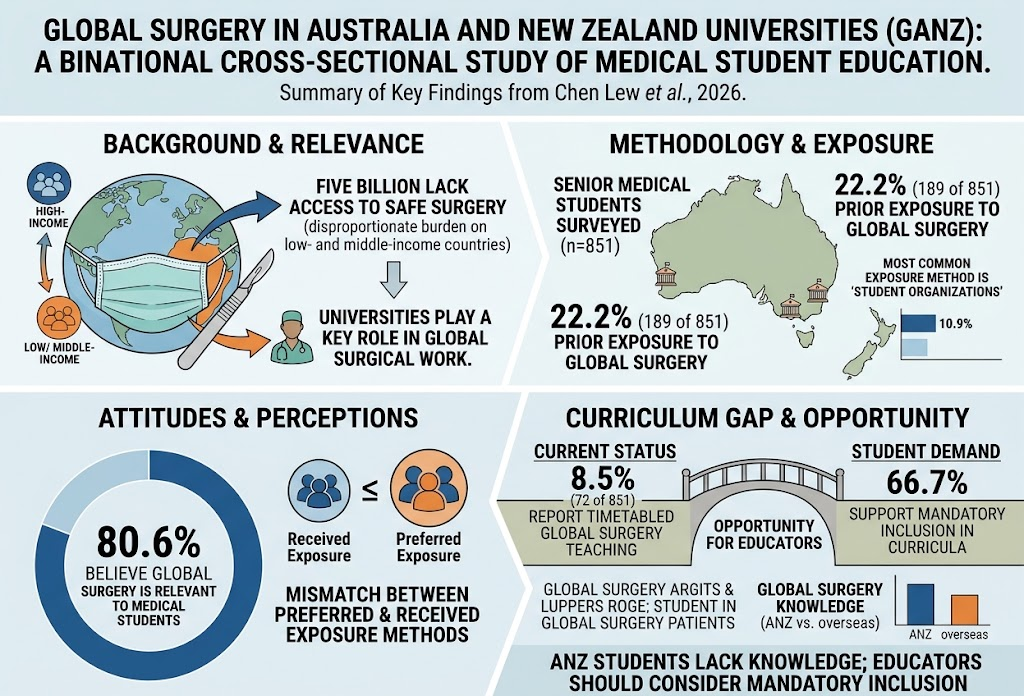
- Over 80% of surveyed medical students in Australia and New Zealand consider global surgery relevant to their training.
- Only 8.5% report formal curricular teaching on global surgery, with most exposure occurring via student societies and social media.
- Global surgery knowledge among these students is limited and lags behind that of peers in other countries.
- Two-thirds support mandatory global surgery education in their medical school curricula, highlighting a significant interest and perceived need for structured teaching.
Study Background
Global surgery is recognized as an essential field addressing the vast unmet need for safe, affordable surgical care worldwide. It encompasses clinical practice, research, and advocacy aiming to improve surgical outcomes, especially in low- and middle-income countries (LMICs). Despite this, an estimated five billion people globally remain without adequate access to surgical services. High-income countries, including Australia and New Zealand (ANZ), contribute significantly to global surgery efforts and hold responsibility for educating future healthcare professionals about these disparities. Medical students represent a pivotal cohort whose knowledge and attitudes towards global surgery can influence future engagement and advocacy. Understanding their current educational exposure and perspectives is critical for curricular development to better prepare surgeons and clinicians for global health challenges.
Study Design
This investigation was a binational cross-sectional study conducted between August and October 2022, surveying senior medical students across 24 medical schools in Australia and New Zealand. Recruitment methods included official university channels, social media platforms, and snowball sampling techniques to maximize reach. Participants completed structured questionnaires designed to assess their attitudes towards global surgery, the extent of their exposure to global surgery content, and their baseline knowledge. The study focused on identifying the sources of global surgery education accessed by students, their perceived relevance of global surgery to their careers, and preferences regarding the integration of global surgery topics into formal medical curricula.
Key Findings
A total of 851 eligible responses formed the dataset for analysis. Among participants, only 22.2% had any prior exposure to global surgery content, predominantly through student-led organizations (10.9%), social media, or extracurricular activities rather than through institutional curricular offerings. Only 8.5% of students reported any scheduled teaching related to global surgery incorporated into their medical education.
Importantly, 80.6% of respondents recognized global surgery as relevant to medical students, indicating strong acknowledgment of its importance. Despite this, global surgery knowledge scores were low relative to international cohorts, indicating a gap in understanding foundational concepts and issues relevant to global surgical care.
Moreover, 66.7% of students supported the introduction of mandatory global surgery education within their medical school curricula, demonstrating their interest in formal, structured learning on this topic. Preferred methods for global surgery exposure included lectures, workshops, and clinical electives focused on global surgery principles, differing from the current reliance on informal sources.
These results expose a misalignment between student enthusiasm and institutional offerings, suggesting missed opportunities for integrating global surgery principles into medical training in ANZ.
Expert Commentary
The findings reflect a broader challenge in medical education worldwide where emerging fields such as global surgery struggle for curricular inclusion despite increasing relevance in clinical practice and health equity. Expert commentators emphasize that embedding global surgery education into undergraduate medical programs fosters early interest and commitment to addressing surgical inequities globally.
Limitations of the study include reliance on self-reported data and potential sampling biases inherent in snowball recruitment that may affect representativeness. Nevertheless, the large sample size and binational scope provide valuable insights into regional educational gaps.
Aligning curricula with student interest and global health priorities requires collaborative efforts between educators, professional bodies, and student organizations. Innovative curricular models incorporating global surgery case studies, interdisciplinary teaching, and international electives could enhance knowledge acquisition and skills development.
Conclusion
This binational study reveals a substantial gap between the recognized importance of global surgery by medical students in Australia and New Zealand and the limited curricular exposure to this critical subject. With most global surgery education occurring through informal non-academic avenues, there is a clear need for formal integration of global surgery into undergraduate medical curricula.
Addressing this educational gap can equip future healthcare professionals with essential knowledge and competencies to participate effectively in global surgery initiatives and ultimately improve surgical care accessibility worldwide. Medical schools should heed these data and student preferences to develop robust, mandatory global surgery educational components that align with current global health imperatives.
References
1. Meara JG, Leather AJM, Hagander L, et al. Global Surgery 2030: evidence and solutions for achieving health, welfare, and economic development. Lancet. 2015;386(9993):569-624.
2. Mock CN, Donkor P, Gawande A, et al. Essential surgery: key messages from Disease Control Priorities, 3rd edition. Lancet. 2015;385(9983):2209-2219.
3. Lew C, Robinson SJA, Goh S, Karim MN, Ilic D. Global surgery in Australia and New Zealand universities (GANZ): A binational cross-sectional study of medical student education. Surgery. 2026 May 8;196:110310. doi:10.1016/j.surg.2026.110310.
4. Alkire BC, Raykar NP, Shrime MG, et al. Global access to surgical care: a modelling study. Lancet Glob Health. 2015;3(6):e316-323.
This article was created using several editorial tools, including AI, as part of the process. Human editors reviewed this content before publication.