We use cookies

Our website uses essential cookies and, with your consent, additional cookies to measure performance and improve our services. Cookie Policy.

You can change your choice at any time.

MMedXYNews
HomeVideos
MedXY AI/MedXY News/Section: Anesthesiology

Bridging the Communication Gap in Shared Airway Management: Insights from a Multicenter Survey of Anesthesiologists
MedXY Editorial Team•Aug 26, 2026•Anesthesiology
anesthesiologyotolaryngologyshared airwayinterdisciplinary collaborationcommunication

Highlight

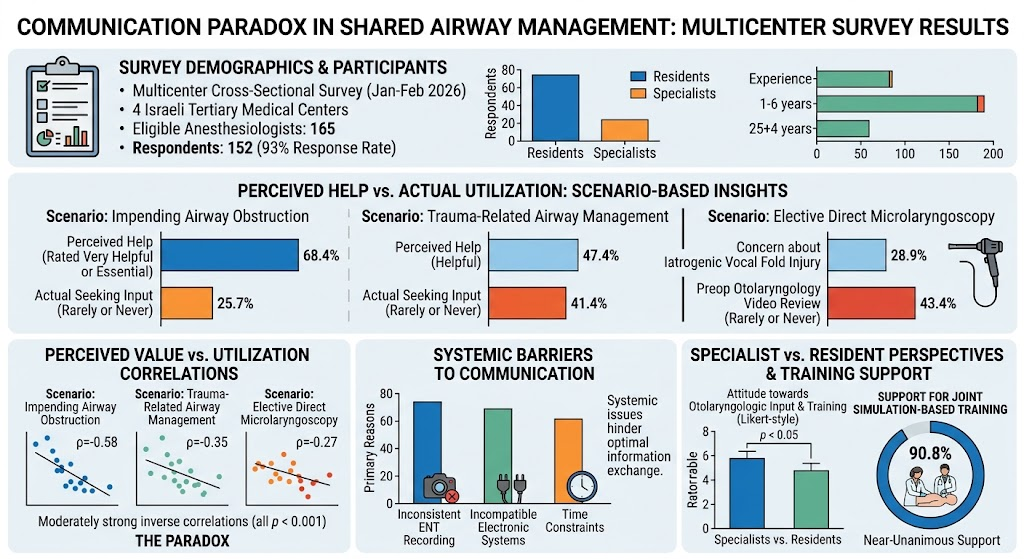
Anesthesiologists highly value otolaryngologic input in shared airway scenarios but frequently underutilize this resource due to systemic barriers rather than lack of appreciation or willingness. The study identifies the critical role of interoperable electronic health records (EHRs), standardized perioperative communication protocols, and joint training in addressing this gap. Near-unanimous support for simulation-based interdisciplinary training further underscores opportunities for improving collaboration and patient safety in airway management.

Background

MedXY registered readers

Sign in free to continue reading

Create or use your MedXY account to unlock the complete article.

This article was created using several editorial tools, including AI, as part of the process. Human editors reviewed this content before publication.

Related articles

Open language-specific specialty feeds and department pages.

Evaluating the True Impact of a Dedicated Research Year on Otolaryngology Residency Applicants’ Scholarly OutputThis article examines whether taking a dedicated research year increases meaningful scholarly output among 2025 otolaryngology residency applicants, highlighting that increases are mainly in unpublished and middle-author work rather than puSep 9, 2026Neurodivergent-responsive obstetric care: Practical communication strategies for pregnancy and birthA concise clinical summary of a new neurodivergent-responsive framework for obstetric care, outlining practical communication plans and intrapartum adaptations to improve consent, cooperation, and safety.Aug 12, 2026Mapping the Gap: Geographic Disparities in Otolaryngologist Availability Versus Patient Demand in the U.S.This study reveals significant geographic disparities between otolaryngologist supply and patient demand across U.S. states, using workforce data and Google Trends to quantify regional imbalances and identify underserved areas.Aug 2, 2026
Loading comments...
MedXY briefing

Get the free newsletter

Evidence-led clinical news, trends, and analysis—delivered to your inbox.

Ask MedXY AI

Most popular

Intimate Health
Five Benefits for Women Continuing Sexual Activity After Menopause
Intimate Health
Why Some Women Have a Strong Sex Drive—And Why Men Shouldn't Worry About It
Nursing & care
How often should a couple have sex?
Intimate Health
Classic Intimacy Recommendations: How to Help Women Reach Orgasm and Enjoy Mutual Pleasure
Intimate Health
What Makes a Woman "Physiologically Addicted" Is Never Money, But These Two Relationship Qualities
© 2026 MedXY
Contact usAbout usPrivacy PolicyMedXY story
Digital Vestibular Rehabilitation After Acute Vertigo: What a Negative Superiority Trial Means
A 2026 PLOS One superiority trial found that internet-based vestibular rehabilitation was not superior to structured written instructions after acute vertigo. The result is clinically useful because the comparator was active, adherence was
Jun 16, 2026
Ergonomic Strain Is Common in Otolaryngology Surgery, With Pain Rising as Cases Become More Difficult and ProlongedA prospective study found frequent medium-to-high ergonomic risk and measurable postoperative pain among otolaryngology surgeons, highlighting modifiable occupational hazards in routine head and neck surgery.May 4, 2026
Remimazolam Besylate Matches Propofol for Short-Term ICU Sedation: The SHOSREB TrialThe SHOSREB trial demonstrates that remimazolam besylate is non-inferior to propofol for short-term light sedation in mechanically ventilated ICU patients, with both agents achieving 97.5% successful sedation rates and comparable time withiApr 13, 2026