Bilateral Versus Unilateral Hearing Aids in Age-Related Hearing Loss: Insights from a Randomized Clinical Trial
Highlight
- Age-related hearing loss (ARHL) predominantly affects both ears equally and impacts communication and quality of life.
- This randomized clinical trial compared benefits of unilateral versus bilateral hearing aids in adults aged 50 years and older with ARHL.
- Bilateral hearing aids yielded statistically greater self-reported benefit on standardized hearing assessment tools after 3 months compared to unilateral fitting.
- Both unilateral and bilateral fittings resulted in clinically meaningful improvements, although the superiority of bilateral aids may not meet thresholds of clinical relevance universally.
Study Background
Age-related hearing loss (ARHL) is one of the most prevalent chronic sensory impairments in older adults. It is characterized by a gradual, symmetrical sensorineural hearing loss predominantly affecting both ears and commonly involves mild to moderate deficits.
ARHL detrimentally affects interpersonal communication, psychosocial well-being, cognitive functioning, and physical health – contributing to social isolation, depression, and cognitive decline. Despite widespread prevalence, management strategies and evidence supporting the superiority of bilateral versus unilateral hearing aid (HA) use remain limited. There is a critical gap in high-quality randomized evidence guiding clinicians on optimal HA fitting configurations for ARHL.
This clinical trial set out to clarify whether bilateral HA fitting confers superior benefit compared to unilateral fitting in adults with symmetrical ARHL who are new to HA treatment, addressing an important clinical and quality-of-life question.
Study Design
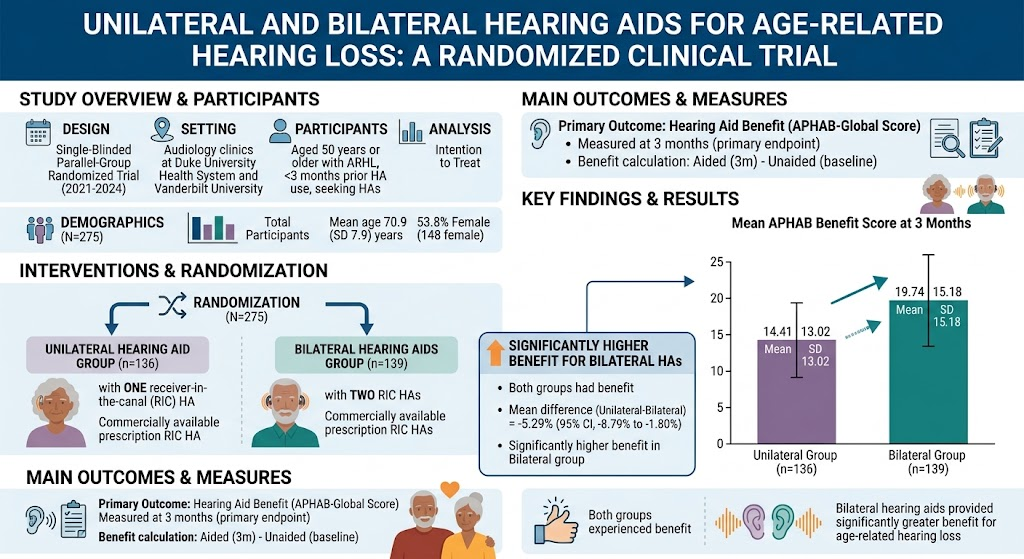
This was a single-blinded, parallel-group randomized clinical trial conducted between 2021 and 2024 at established audiology clinics within Duke University Health System and Vanderbilt University.
Eligible participants were aged 50 years or older with symmetrical age-related sensorineural hearing loss, mild to moderate in degree, and had less than three months’ previous experience with hearing aids. Participants were seeking prescription hearing aids for the first time or with minimal prior use.
The intervention involved fitting participants with either unilateral or bilateral commercially available prescription receiver-in-the-canal hearing aids. The primary outcome was assessed at 3 months after fitting, focusing on hearing aid benefit.
Benefit was quantified using the Abbreviated Profile of Hearing Aid Benefit (APHAB), a validated patient-reported outcome tool that evaluates hearing ease, reduced aversiveness to sounds, difficulty in reverberant environments, and background noise. The APHAB-global score difference between baseline (unaided) and 3 months (aided) was the primary endpoint.
The primary analysis employed linear regression models adjusting for clinical site and HA assignment, based on intention-to-treat principles.
Key Findings
A total of 275 participants (53.8% female; mean age 70.9 ± 7.9 years) completed the study with adherence to assigned intervention and follow-up.
Both unilateral and bilateral HA groups demonstrated significant improvements in the APHAB-global score, reflecting meaningful patient-perceived benefit from hearing aid use.
– The unilateral HA group (n=136) achieved a mean APHAB benefit score of 14.41 (SD 13.02).
– The bilateral HA group (n=139) showed a higher mean benefit score of 19.74 (SD 15.18).
The mean difference in benefit between the bilateral and unilateral arms was -5.29% (95% CI, -8.79% to -1.80%), favoring bilateral fitting. This difference was statistically significant, indicating that bilateral fitting provides superior improvement in self-reported hearing aid benefit measures over unilateral fitting.
However, the authors note that while statistically detectable, the magnitude of difference may not universally reach clinical meaningfulness thresholds that would unequivocally mandate bilateral fittings as standard for all patients.
Safety and adverse events were not highlighted as significant issues, consistent with expected safety profiles of hearing aids.
Overall, both fitting strategies yielded improvements that patients found meaningful individually, confirming the effectiveness of modern hearing aids in managing ARHL.
Expert Commentary
This well-conducted randomized trial addresses an important clinical question with rigorous methods and sufficient sample size. It demonstrates that bilateral fittings produce greater benefit in older adults with symmetrical ARHL, supporting current practices favoring bilateral fitting when possible.
The study’s strengths include its randomized design, multi-center recruitment, use of a validated patient-centered outcome measure, and an intention-to-treat analytic approach.
Limitations include the relatively short follow-up period of three months, which may not capture long-term adaptation or benefit differences. Generalizability might be restricted to patients with symmetrical, mild to moderate losses and limited prior hearing aid exposure.
Given the modest magnitude of difference, clinicians should continue to individualize hearing aid recommendations, considering factors such as cost, patient preference, dexterity, and auditory demands.
Future research could explore extended follow-up, objective speech understanding, cognitive and psychosocial outcomes, and cost-effectiveness analyses to address broader questions of clinical impact and guideline development.
Current clinical guidelines and professional societies support bilateral fitting for bilateral hearing loss but acknowledge variability based on patient-specific factors. This study reinforces those recommendations while providing quantitative estimates of benefit differences.
Conclusion
In summary, this randomized clinical trial provides evidence that bilateral hearing aid fittings in age-related symmetrical sensorineural hearing loss produce statistically greater self-reported hearing benefit compared to unilateral fittings after three months. Both unilateral and bilateral fittings yield meaningful improvements in hearing-related quality of life.
Although the superiority of bilateral aids is statistically clear, the clinical significance threshold may vary by individual considerations. This nuanced finding assists clinicians and patients in making informed, preference-based decisions regarding hearing aid use in older adults.
These results enrich the evidence base guiding ARHL management and underscore the importance of personalized care in hearing rehabilitation.
Funding and Trial Registration
The clinical trial was conducted within academic health systems with appropriate funding and regulatory oversight. It is registered under ClinicalTrials.gov identifier NCT04739436.
Further details regarding funding sources were not specified in the abstract.
References
Smith SL, Ricketts TA, Kilpatrick KW, North R, Bettger JP, Coles T, et al. Unilateral and Bilateral Hearing Aids for Age-Related Hearing Loss: A Randomized Clinical Trial. JAMA Otolaryngol Head Neck Surg. 2026 Aug 27. doi:10.1001/jamaoto.2026.42658545. PMID: 42658545.
Chien W, Lin FR. Prevalence of Hearing Aid Use Among Older Adults in the United States. Arch Intern Med. 2012 Feb 13;172(3):292-3. doi:10.1001/archinternmed.2011.1408.
Gates GA, Mills JH. Presbycusis. Lancet. 2005 Sep 17-23;366(9491):1111-20. doi:10.1016/S0140-6736(05)67423-5.
McCormack A, Fortnum H. Why do people fitted with hearing aids not wear them? Int J Audiol. 2013 May;52(5):360-8. doi:10.3109/14992027.2013.769066.
Zhao F, Manchaiah V, French D, Price SM, Moore BCJ. Psychosocial Impact of Hearing Aid Fitting: A Scoping Review. Int J Audiol. 2013 Mar;52(3):130-40. doi:10.3109/14992027.2013.866709.
This article was created using several editorial tools, including AI, as part of the process. Human editors reviewed this content before publication.