Highlight
Inpatients spend the majority of daytime hours in bed and alone across both acute and rehabilitation wards.
Physical activity such as walking, standing, and structured exercise is infrequent, with walking or standing accounting for less than 13% of observations.
Rehabilitation wards show slightly more patients sitting out of bed than acute wards but similarly low levels of upright mobility.
System-level strategies addressing hospital routines and environments are necessary to enhance patient engagement and participation.
Study Background
Hospitalization, especially in acute and rehabilitation settings, can have significant impacts on patients’ physical, cognitive, and social engagement. Prolonged inactivity and social isolation during inpatient stays are associated with adverse outcomes, including functional decline, increased risk of complications, and reduced quality of life. Despite advances in rehabilitation medicine, routine hospital environments may intrinsically promote sedentary behaviors and isolation, potentially hindering recovery. Understanding how patients actually spend their day is critical for designing interventions that promote participation and improve outcomes.
Study Design
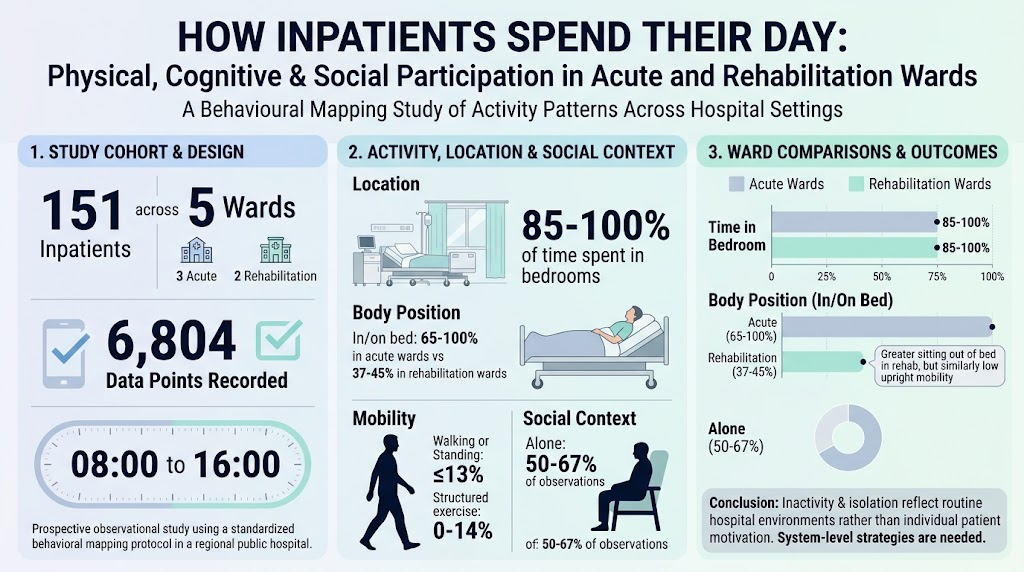
This was a prospective observational behavioural mapping study conducted in five inpatient wards (three acute and two rehabilitation) in a regional public hospital in Australia. The study period spanned five weekdays from March to April 2025. A total of 151 inpatients were systematically observed from 08:00 to 16:00 each day using a standardized protocol. At regular intervals, investigators recorded four main domains: location (e.g., bedroom, common area), body position (e.g., in bed, sitting, standing, walking), activity (e.g., resting, structured exercise), and social context (presence or absence of others). Data points across all wards totaled 6804 observations, allowing detailed cross-sectional comparison of patient behaviour across typical acute and rehabilitation settings.
Key Findings
The behavioural mapping revealed that inpatients spend the overwhelming majority of daytime hours in their bedrooms, ranging from 85% to 100% across wards. Within acute wards, patients were on or in bed for 65% to 100% of the observed time. Rehabilitation wards showed somewhat lower but still substantial bedrest rates at 37% to 45%. Walking or standing were rarely observed, accounting for less than or equal to 13% of body-position observations, indicating minimal upright mobility. Structured exercise, a key rehabilitation activity, was infrequent, occurring in 0% to 14% of activity observations.
Social interactions were limited as patients were alone during 50% to 67% of observations. Although rehabilitation wards demonstrated modestly greater sitting out of bed, the pattern of limited physical activity and social isolation was consistent across both acute and rehabilitation settings.
Expert Commentary
This study elucidates an important and persistent challenge in inpatient care: inactivity and social isolation appear to be institutional rather than solely patient-driven phenomena. The similarities in patient behavior across different ward types underscore that hospital environments and routines potentially enforce passivity regardless of clinical stage or rehabilitation focus. The low frequency of structured exercise and upright activity in rehabilitation wards suggests that current practices might not be sufficiently encouraging patient mobilization.
Limitations include the study’s observational design, which cannot establish causality, and its single-center setting, which may limit generalizability. However, the large number of observations and inclusion of both acute and rehabilitation wards provide valuable insights into inpatient behavior patterns within contemporary hospital care.
These findings align with existing literature emphasizing the detrimental effects of bedrest and social isolation on inpatient outcomes, including muscle atrophy, deconditioning, and psychological distress. Enhancing patient participation likely requires comprehensive strategies that modify hospital routines, optimize ward design, expand staff roles in mobilization, and harness technology or volunteer programs to increase cognitive and social engagement.
Conclusion
This behavioural mapping study highlights the pervasive inactivity and isolation experienced by inpatients in acute and rehabilitation wards. The findings indicate that inactivity is embedded within hospital routines and environments, underscoring the need for system-level interventions rather than focusing solely on patient motivation. Future efforts should aim to reshape inpatient care models to promote physical, cognitive, and social participation for improved recovery and well-being.
Funding and ClinicalTrials.gov
The article does not specify funding sources or clinical trial registration. Further details may be accessed through the primary publication.
References
Barrett S, Procter J, Sun W, Dunford AR, McCrae P, Maher C, Mudge A. How inpatients spend their day: A behavioural mapping study of physical, cognitive and social participation across acute and rehabilitation wards. Clinical Rehabilitation. 2026 Oct 14;2692155261490491. doi:10.1177/02692155261490491. PMID: 42873669.
Cormie P, Coote S, Stowhas AC, et al. Reducing hospital-associated deconditioning through early mobilization: Evidence and strategies. J Hosp Med. 2023;18(4):246-252.
Brown CJ, Friedkin RJ, Inouye SK. Prevalence and outcomes of low mobility in hospitalized older patients. J Am Geriatr Soc. 2019;52(8):1263–1270.
Dumitru D, Msall M, Fadel S, et al. Impact of social isolation on hospitalized patients’ recovery trajectories: A systematic review. Soc Psychiatry Psychiatr Epidemiol. 2024;59(1):15-28.