Area Deprivation Index and Cochlear Implant Candidacy: Socioeconomic Impact on Access and Outcomes
Highlights
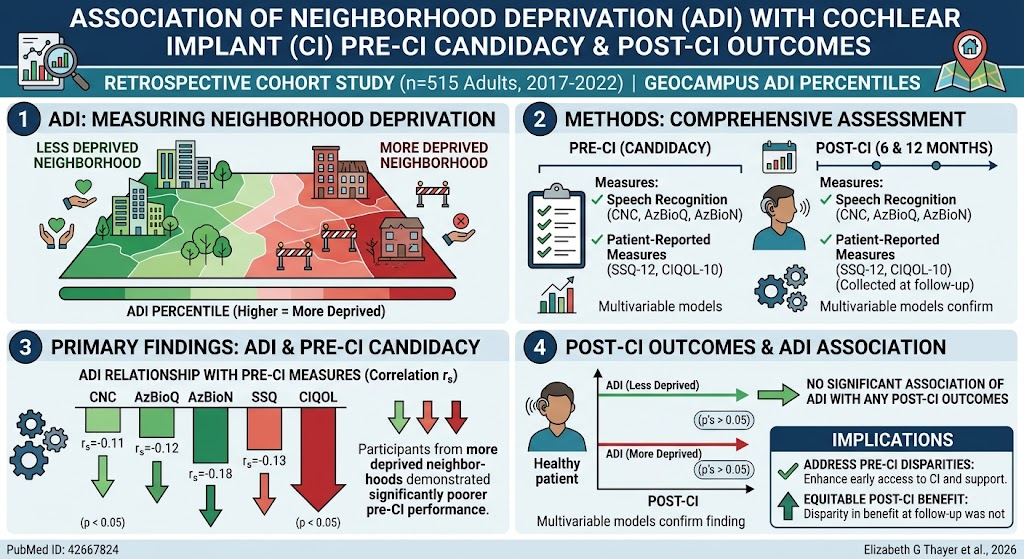
- Greater neighborhood-level socioeconomic deprivation, quantified by the Area Deprivation Index (ADI), is linked to poorer speech recognition and hearing-related quality of life (QoL) before cochlear implantation.
- ADI independently predicts preimplantation auditory function deficits but shows no association with post-cochlear implant outcomes, indicating equitable benefit from implantation across socioeconomic strata.
- These findings emphasize that socioeconomic factors primarily impact timing and access to cochlear implantation rather than surgical success or postimplant auditory rehabilitation.
- Integrating ADI assessment into clinical workflows might facilitate early identification and intervention for patients at high risk of delayed cochlear implant access.
Background
Cochlear implantation (CI) is a transformative intervention for adults with severe-to-profound sensorineural hearing loss, significantly improving speech perception and quality of life (QoL). Despite its proven efficacy, disparities in CI candidacy assessment and timing of surgery remain concerning, with socioeconomic factors suspected to influence access and outcomes. The Area Deprivation Index (ADI) serves as a standardized, neighborhood-level measure of socioeconomic disadvantage encompassing factors such as income, education, employment, and housing quality. Elucidating how ADI impacts CI candidacy and postimplantation benefits is critical to minimizing healthcare inequities and optimizing patient-centered outcomes.
Key Content
Association of ADI With Pre-Coar Implant Speech Recognition and Quality of Life
The retrospective cohort study by Spector et al. (2026) analyzed 515 adult CI recipients from 2017 to 2022, geocoding home addresses to derive ADI percentiles representing neighborhood socioeconomic deprivation. Baseline assessments included speech recognition using CNC word tests and AzBio sentence tests (in quiet and noise conditions) alongside patient-reported outcome measures such as the Speech, Spatial and Qualities of Hearing Scale (SSQ-12) and the Cochlear Implant Quality of Life-10 questionnaire (CIQOL-10).
Bivariate analyses demonstrated statistically significant negative correlations between increasing ADI and speech recognition scores (CNC rs = -0.11, AzBioQ rs = -0.12, AzBioN rs = -0.18) and patient-reported hearing-related QoL (SSQ rs = -0.13, CIQOL rs = -0.30; all p < 0.05). Multivariable linear regression, adjusting for age, duration of deafness, sociodemographic variables, and electrode type, confirmed ADI as an independent predictor of poorer preimplant speech recognition and worse QoL. These observations align with broader literature indicating that socioeconomic deprivation predisposes to more severe health impairments at the time of healthcare engagement, consistent with chronicity and severity patterns observed in other conditions (e.g., musculoskeletal pain disparities highlighted by van der Zee-Neuen et al., 2025).
Postimplantation Outcomes and ADI
Importantly, ADI was not significantly associated with speech recognition or QoL outcomes assessed at 6 and/or 12 months post-CI. This suggests that once patients overcome access barriers and receive the implant, socioeconomic deprivation does not impede rehabilitation success. This equipoise in postimplant benefit contrasts with preimplant disparities and indicates that surgical intervention and subsequent auditory training yield consistent improvements across socioeconomic groups.
Mechanistic and Translational Insights
The ADI encapsulates multifactorial deprivation factors potentially affecting health literacy, healthcare access, early diagnosis, and timely intervention for hearing loss. Prolonged untreated deafness can degrade auditory pathways contributing to poorer preoperative speech recognition. Socioeconomic deprivation may limit referrals or delay candidacy assessments, resulting in late-stage presentation with more profound auditory and QoL deficits.
The null association between ADI and postimplant outcomes implies rehabilitation adherence and implant efficacy are not significantly hampered by neighborhood deprivation, potentially due to standardized postoperative protocols and patient engagement strategies. Thus, interventions targeting earlier identification and referral, including ADI incorporation into clinical screening, may reduce temporal disparities and improve preimplant status.
Context from Related Socioeconomic Health Disparities Literature
The findings reflect a broader theme across healthcare domains where socioeconomic disadvantage impacts disease severity and care access but not necessarily treatment effectiveness. For instance, studies in musculoskeletal pain (van der Zee-Neuen et al., 2025) and headache management (the Cleveland Clinic cohort analysis, Kim et al., 2023) indicate worse baseline symptom burden and increased healthcare resource utilization in deprived populations. Similarly, opioid prescribing patterns and emergency department visits are more frequent in high deprivation areas, highlighting systemic inequities in access and early disease management.
Expert Commentary
This study by Spector et al. underscores the critical role of social determinants of health captured by ADI in auditory healthcare disparities. The association of ADI with poorer preimplant speech recognition and QoL reflects delayed CI access, potentially due to barriers including healthcare navigation complexity, insurance coverage variability, or limited referral pathways in socioeconomically disadvantaged neighborhoods.
Clinicians and health systems should consider integrating ADI scoring into electronic health records and CI candidacy workflows to flag patients at risk for delayed intervention. Early outreach, education, and streamlined referral processes tailored to socially deprived communities may mitigate these disparities.
Limitations of the study include its retrospective design, possible unmeasured confounders such as individual socioeconomic status and comorbidities, and single-center data potentially limiting generalizability. Future prospective multicenter studies with granular individual-level socioeconomic data may refine understanding and guide policy.
Further, while postimplant outcomes appear equitable, longitudinal studies assessing cognitive, psychosocial, and functional outcomes across socioeconomic strata will be valuable to confirm sustained benefit and identify residual disparities.
Conclusion
Area Deprivation Index is a significant determinant of cochlear implant candidacy severity, evidenced by poorer speech recognition and hearing-related QoL in adults from socioeconomically deprived neighborhoods at preimplantation evaluation. However, ADI does not influence postimplant auditory or QoL outcomes, emphasizing that socioeconomic factors predominantly impact access and timing of intervention rather than the benefits derived from cochlear implantation itself.
Incorporation of ADI into clinical workflows offers an important opportunity to identify and engage patients susceptible to delayed CI access, promoting equity-driven hearing healthcare. Ongoing research should focus on system-level interventions and policies to bridge socioeconomic gaps in the timely diagnosis and treatment of hearing loss.
References
- Spector BM, Christmann C, Cote G, Haynes DS, Moberly AC, Tamati TN. Association of Area Deprivation Index With Cochlear Implant Candidacy and Outcomes. The Laryngoscope. 2026 Aug 30. PMID: 42669646. https://pubmed.ncbi.nlm.nih.gov/42669646/
- van der Zee-Neuen A, Burton C, Hodgson P, et al. Socioeconomic inequalities in outcomes, experiences and treatment among adults consulting primary care for a musculoskeletal pain condition: a prospective cohort study. BMJ Open. 2025 Jul 15;15(7):e095132. doi: 10.1136/bmjopen-2024-095132. PMID: 40664415. https://pubmed.ncbi.nlm.nih.gov/40664415/
- Kim B, Chronis-Tuscano A, Bajaj S, et al. Emergency department utilization among patients who receive outpatient specialty care for headache: A retrospective cohort study analysis. Headache. 2023 Apr;63(4):472-483. doi:10.1111/head.14456. PMID: 36861814. https://pubmed.ncbi.nlm.nih.gov/36861814/
This article was created using several editorial tools, including AI, as part of the process. Human editors reviewed this content before publication.