Highlight
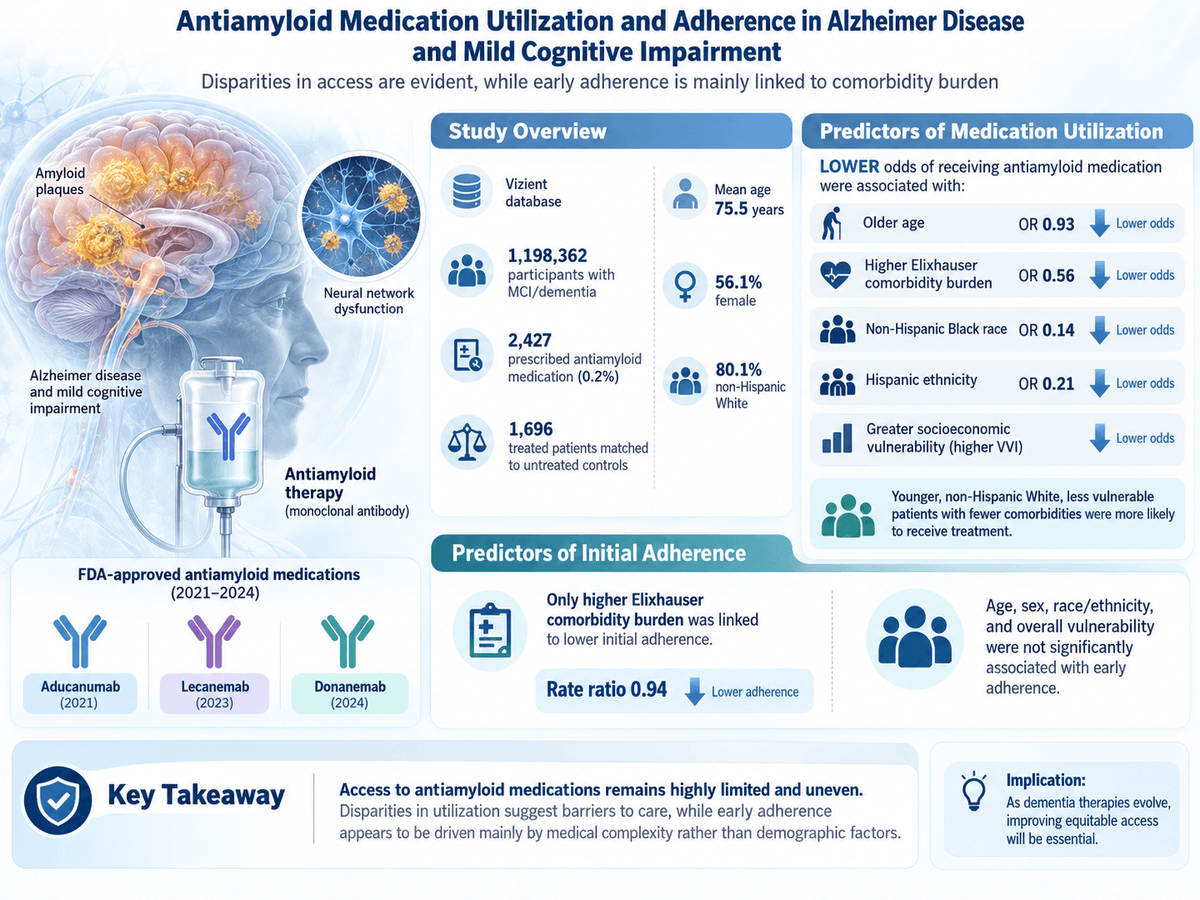
Among over 1.1 million patients with mild cognitive impairment or dementia, only 0.2% received FDA-approved antiamyloid monoclonal antibodies (aducanumab, lecanemab, donanemab) from 2021 to 2024.
Younger, non-Hispanic White patients with fewer comorbidities and lower socioeconomic vulnerability had higher odds of receiving these novel treatments.
Higher Elixhauser comorbidity score was associated with poorer initial adherence to antiamyloid medications, while age, sex, race/ethnicity, and neighborhood vulnerability did not significantly impact early adherence.
These findings expose potential disparities in access to emerging Alzheimer’s therapies that could hinder equitable dementia care advancement.
Study Background
Alzheimer disease (AD) and its prodromal stage, mild cognitive impairment (MCI), pose an escalating burden as populations age globally. Recently, the US Food and Drug Administration approved three amyloid-targeting monoclonal antibodies—aducanumab, lecanemab, and donanemab—between 2021 and 2024 for patients with MCI or mild dementia due to AD. These agents represent a novel disease-modifying approach aiming to reduce amyloid-beta plaques, a pathological hallmark of AD. However, the clinical adoption and equitable distribution of antiamyloid therapies remain challenged by high costs, complex eligibility criteria, and potential disparities related to sociodemographic factors. Understanding which patients receive these treatments and their adherence patterns is crucial for addressing gaps in dementia care and health equity.
Study Design
Researchers utilized the Vizient database encompassing routinely collected clinical and demographic data. Patients with MCI or dementia were identified using ICD-10 codes. The study population included over 1.19 million individuals diagnosed with MCI or dementia. Among them, those prescribed antiamyloid monoclonal antibodies were propensity-score matched by diagnosis date and follow-up duration with untreated counterparts to control for confounders.
Social determinants of health were quantified via the Vizient Vulnerability Index (VVI), a neighborhood-level socioeconomic vulnerability metric. The burden of medical comorbidities was measured using the Elixhauser comorbidity index. Logistic regression models assessed associations between demographic variables (age, sex, race/ethnicity), comorbidity score, VVI, and likelihood of medication utilization. Poisson regression evaluated factors linked with initial adherence, measured as days supplied of the prescribed antiamyloid therapy.
Key Findings
Among the 1,198,362 patients with MCI or dementia, only 2,427 (0.2%) received antiamyloid medications, reflecting limited uptake during early years of FDA approval. Of those treated, 1,696 were matched against untreated patients (mean age 75.5 years, 56.1% female, 80.1% non-Hispanic White).
Multivariable logistic regression identified several key factors associated with treatment receipt. Older age decreased odds (OR 0.93 per year increase), higher Elixhauser comorbidity index was strongly linked to lower odds (OR 0.56), and minority race/ethnicity substantially reduced likelihood (non-Hispanic Black OR 0.14, Hispanic OR 0.21) compared to non-Hispanic Whites. Additionally, greater social vulnerability as measured by VVI correlated with reduced medication utilization.
Conversely, analysis of initial adherence showed that among those who received antiamyloid drugs, only a higher comorbidity score significantly predicted lower initial medication adherence (rate ratio 0.94). Age, sex, race/ethnicity, and VVI did not significantly affect adherence early in therapy.
These results suggest that, despite adjustment for other factors, race/ethnicity, age, medical illness burden, and neighborhood socioeconomic context play pivotal roles in initial access to antiamyloid therapies, whereas medical comorbidity mainly influences early adherence.
Expert Commentary
The exceptionally low penetration of antiamyloid medications in this cohort during the initial years after FDA approvals denotes significant barriers to widespread implementation. These may include high drug costs, limited insurance coverage, logistical challenges related to intravenous administration, and concerns over adverse effects such as amyloid-related imaging abnormalities.
The prominent disparities observed along racial and socioeconomic lines raise concerns about equitable access to cutting-edge dementia therapies. Prior literature indicates that minority populations face multifactorial hurdles including reduced healthcare access, lower rates of specialist visits, and socioeconomic constraints that impede receipt of advanced treatments.
The association between higher comorbidity and both lower treatment initiation and adherence is clinically intuitive since patients with multiple chronic diseases may have competing health priorities, frailty, or contraindications. Strategies to optimize antiamyloid medication use should consider comorbidity profiles and engage multidisciplinary care to enhance adherence.
One limitation is that the Vizient database relies on administrative coding, which may misclassify MCI or dementia diagnoses and does not capture detailed cognitive or functional status. Moreover, initial adherence measured by days supplied captures short-term medication continuation but not long-term persistence or clinical efficacy outcomes.
Future studies integrating clinical, biomarker, and patient-reported data are warranted to validate these findings and guide interventions aimed at reducing disparities and improving outcomes in AD treatment.
Conclusion
The adoption of antiamyloid therapies for Alzheimer disease and mild cognitive impairment currently favors younger, non-Hispanic White patients with fewer comorbidities and lower neighborhood vulnerability. These disparities highlight a pressing need for policymakers, payers, and clinicians to address socioeconomic and racial inequities in access to emerging dementia treatments. While higher medical comorbidity impairs initial drug adherence, demographic factors do not appear to influence early medication continuation among treated individuals. Optimizing equitable utilization and adherence to disease-modifying therapies will be essential as the therapeutic landscape for AD evolves.
Funding and ClinicalTrials.gov
The study utilized de-identified database records and did not report specific external funding. No clinical trial registration was applicable.
References
1. Reynolds EL, Elafros MA, Muthukumar L, et al. Predictors of Antiamyloid Medication Utilization and Adherence Among People With Alzheimer Disease and Mild Cognitive Impairment. Neurology. 2026 Oct 15;107(9):e218594. doi:10.1212/WNL.0000000000208594.
2. US Food and Drug Administration. FDA Approves Leqembi for Alzheimer’s Disease. 2023. Available at: https://www.fda.gov/drugs/news-events-human-drugs/fda-approves-leqembi-alzheimers-disease
3. Elixhauser A, Steiner C, Harris DR, Coffey RM. Comorbidity measures for use with administrative data. Med Care. 1998;36(1):8-27.
4. Kind AJH, Buckingham WR. Making Neighborhood-Disadvantage Metrics Accessible — The Neighborhood Atlas. N Engl J Med. 2018;378(26):2456-2458.