Highlights
Ambient AI scribes decrease active physician note-writing time by approximately 2 to 3 minutes per encounter in emergency departments across multiple institutions.
Use of AI scribes is associated with delayed initiation of note documentation but does not prolong overall note completion or patient throughput metrics such as 72-hour ED return visits.
AI-scribed notes tend to be longer and contain more physician-generated content compared to unassisted notes, with no clear compromise in documentation quality.
Comparative studies suggest ambient AI scribes offer a scalable alternative to human scribes, reducing documentation burden while maintaining clinical productivity and note quality.
Background
The burden of documentation in emergency medicine is a well-recognized contributor to physician burnout and workflow inefficiency. Traditional medical scribes alleviate some burden but are constrained by cost and staffing logistics. Ambient artificial intelligence (AI) scribes, leveraging natural language processing and real-time transcription, offer a promising technology to automate clinical documentation from physician-patient interactions. Despite rapid commercial adoption, objective evidence on AI scribe effectiveness, especially in emergency department (ED) settings, has been limited by single-site designs, self-reported outcomes, and indirect exposure measurement. Comprehensive multisite analyses directly integrating electronic health record (EHR) audit logs are essential to validate claims of reduced documentation effort and clinical safety.
Key Content
Chronological Development and Multisite Observational Evidence
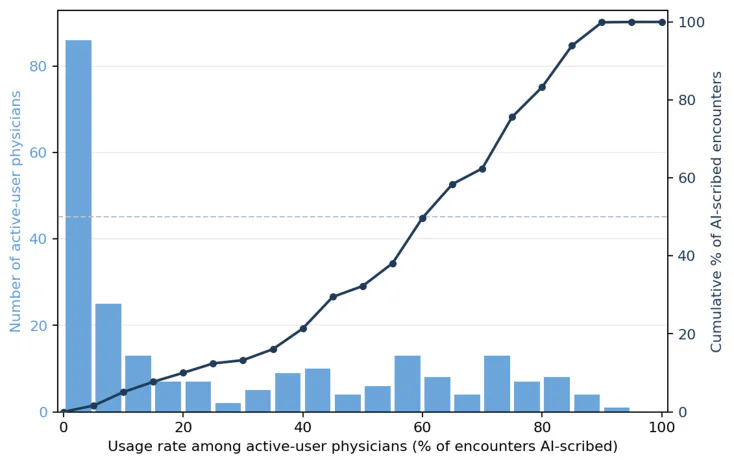
Early pilot studies and quality improvement projects from 2024 to early 2025 documented ambient AI scribe adoption in single academic centers, demonstrating feasibility and user preference over traditional dictation.3,4 A retrospective study at a tertiary academic center reported an 11.2% ambient AI scribe utilization rate, with notable time reductions in on-shift documentation (median 2:45 min vs 3:50 min) and total EHR interaction time, preferentially in lower acuity and non-interpreter encounters.5 This set the stage for broader, multisite analyses with larger physician cohorts.
Quantitative Impact on Documentation Time and Note Characteristics
The pivotal multisite network study by Martini et al. (2026) evaluated 275 attending emergency physicians across 20 EDs (3 academic and 17 community) using direct EHR-derived metrics over a mature adoption period starting December 2025.1 AI scribe utilization was flagged via patient consent statements embedded within ED notes, with analysis restricted to attending-only notes excluding teaching or attestation documentation.
Key findings included:
Less active time spent in notes with AI scribes (median 10.0 minutes) compared to unassisted notes (median 12.5 minutes), adjusted difference −2.4 minutes (p-value not specified but statistically significant).
Documentation initiation delayed by approximately 14 minutes (median 31 vs. 17 minutes after patient contact), suggesting deferred note-start without workflow disruption.
AI-scribed notes were approximately 14% longer in character count (median 5220 vs. 4468 characters; within-physician mean increase +629 characters), reflecting richer content or integration of automated transcription.
No delay in overall note completion time (−6 minutes difference) or increase in 72-hour ED returns (−0.8 percentage points; 95% CI −1.5 to −0.1), supporting patient safety.
Comparison with Human Scribes and Simulated Studies
A retrospective cross-sectional study across 4 hospitals compared ambient AI scribes with human scribes and no scribes, demonstrating a 1.6-minute median reduction in documentation time with AI scribes and 3.3 minutes with human scribes. Clinical productivity assessed by total work relative value units (wRVUs) per shift hour did not differ significantly.2
In simulated ED environments, AI scribes offered a 39% documentation time savings compared to traditional voice dictation, with minimal required editing and high user preference.3 Notably, 69% of AI-generated note sections required no edits, suggesting robust initial output quality.
One quality improvement pilot contrasting AI and human scribes found that AI-scribed notes required more time in the EHR notes section and had greater physician contribution length, though note quality was similar to slightly lower for pediatric patients.6
Broader Clinician Time and Productivity Implications Across Settings
A large longitudinal cohort study across 5 academic institutions involving ambulatory clinicians (including emergency physicians) associated AI scribe adoption with a moderate but significant decrease in total EHR time (−13.4 minutes) and documentation time (−16 minutes) per 8 scheduled patient hours. Weekly visit volumes slightly increased (+0.49 visits). These benefits were pronounced in primary care, advanced practice clinicians, and frequent AI scribe users.7
Application to Trainees and Educational Settings
Pilot data on trainee use of ambient AI scribes suggest improvements in documentation burden and cognitive load without increasing note-writing time. Furthermore, AI scribes can aid generation of high-quality narrative feedback notes in medical education settings, enhancing written feedback while not increasing faculty effort.8,9
Expert Commentary
Ambient AI scribes present a transformative approach to addressing the documentation burden that has long challenged emergency medicine workflows. Objective audit-log based evidence from Martini et al. confirms consistent reductions of active documentation time, aligning with existing single-center and simulated trial data, thereby strengthening confidence in AI scribe utility across diverse clinical sites. The observed deferment in note initiation may reflect shifts in documentation behavior facilitated by AI-generated drafts, potentially optimizing real-time clinical prioritization.
The increase in note length and physician contribution percentage challenges concerns that AI scribes might lead to excessively terse notes; instead, AI assistance appears to augment detail without increasing total documentation time or compromising patient safety—as indicated by stable short-term ED return rates.
Comparisons with human scribes suggest AI scribes hold promise for scalability with cost-efficiency, though nuanced differences in note quality, particularly in pediatric cases, warrant further scrutiny. Integration of AI scribes must consider local workflows, user training, and quality assurance to maximize benefits while minimizing risks of inaccuracies or physician overreliance.
From a mechanistic standpoint, ambient AI scribes capitalize on continuous speech-to-text conversion and natural language understanding, enabling real-time capture of clinical dialogue without explicit dictation. This reduces cognitive switching, enabling clinicians to focus more on patient care while maintaining documentation quality. As language models advance, AI scribes may evolve to support coding, decision support, and longitudinal documentation synthesis.
Limitations of the existing literature include relatively short follow-up periods, potential biases due to opt-in adoption, and predominance of attending physician data, with less evidence on trainees and advanced practice providers. Furthermore, real-world implementation challenges such as privacy, consent compliance, and integration with diverse EHR platforms remain pertinent areas for investigation.
Conclusion
Current evidence robustly supports that ambient AI scribe use reduces active documentation time by approximately 15–20%, delays note initiation without prolonging note completion, and increases note length without compromising safety or quality among emergency physicians. These findings, corroborated by multisite real-world data and controlled studies, position AI scribes as a valuable tool to alleviate physician workload and potentially mitigate burnout.
Future research should focus on long-term outcomes, pediatric and trainee populations, cost-effectiveness analyses, and integration with broader clinical decision-making frameworks. Strategic adoption and continuous evaluation will be key to realizing the full potential of ambient AI scribes in emergency medicine and beyond.
References
Martini WA, Heaton H, Walker L, Urumov A, Rappaport D, Hodgson N. Ambient Artificial Intelligence Scribe Use and Objective Documentation Effort Among Emergency Physicians. Ann Emerg Med. 2026 Oct 27. PMID: 42949694. https://pubmed.ncbi.nlm.nih.gov/42949694/
Martini WA, Zhang L, Davis R, et al. Medical Scribe and Ambient Artificial Intelligence Impact on Emergency Physician Documentation Burden and Clinical Productivity. Ann Emerg Med. 2026 Nov;88(5):570-576. PMID: 42283666. https://pubmed.ncbi.nlm.nih.gov/42283666/
Dahlin CM, Chen J, Miller L, et al. Human vs. artificial intelligence in medical charting: a comparative study in the simulated emergency medicine context. CJEM. 2026 May;28(5):431-437. PMID: 41917375. https://pubmed.ncbi.nlm.nih.gov/41917375/
Lee S, Himelfarb SL, O’Neill B, et al. Ambient Artificial Intelligence Scribe Adoption and Documentation Time in the Emergency Department. Ann Emerg Med. 2026 May;87(5):569-574. PMID: 41665590. https://pubmed.ncbi.nlm.nih.gov/41665590/
Martinez K, Nelson J, Barker K, et al. Changes in Clinician Time Expenditure and Visit Quantity With Adoption of Artificial Intelligence-Powered Scribes: A Multisite Study. JAMA. 2026 Apr 28;335(16):1408-1417. PMID: 41920565. https://pubmed.ncbi.nlm.nih.gov/41920565/
Thompson C, Ross D, Gibbs K, et al. Ambient Artificial Intelligence Versus Human Scribes in the Emergency Department. Ann Emerg Med. 2026 May;87(5):561-568. PMID: 41251650. https://pubmed.ncbi.nlm.nih.gov/41251650/
Williams J, Blair LC, Frost K, et al. The Effect of Ambient Artificial Intelligence Scribes on Trainee Documentation Burden. Appl Clin Inform. 2025 Aug;16(4):872-878. PMID: 40602775. https://pubmed.ncbi.nlm.nih.gov/40602775/
Roberts S, Chang TP. Ambient AI Scribes to Create Educational Feedback Notes for Medical Students: Randomized Trial. JMIR Med Educ. 2026 May 28;12:e89996. PMID: 42208058. https://pubmed.ncbi.nlm.nih.gov/42208058/