We use cookies

Our website uses essential cookies and, with your consent, additional cookies to measure performance and improve our services. Cookie Policy.

You can change your choice at any time.

MMedXYNews
HomeVideos
MedXY AI/MedXY News/Section: Clinical Updates

AI-Assisted Line-Field Confocal Optical Coherence Tomography for Early Detection of Subclinical Basal Cell Carcinoma: Current Evidence and Clinical Prospects
MedXY Editorial Team•Aug 26, 2026•Clinical Updates
basal cell carcinomaLC-OCTartificial intelligenceearly diagnosis

Highlights

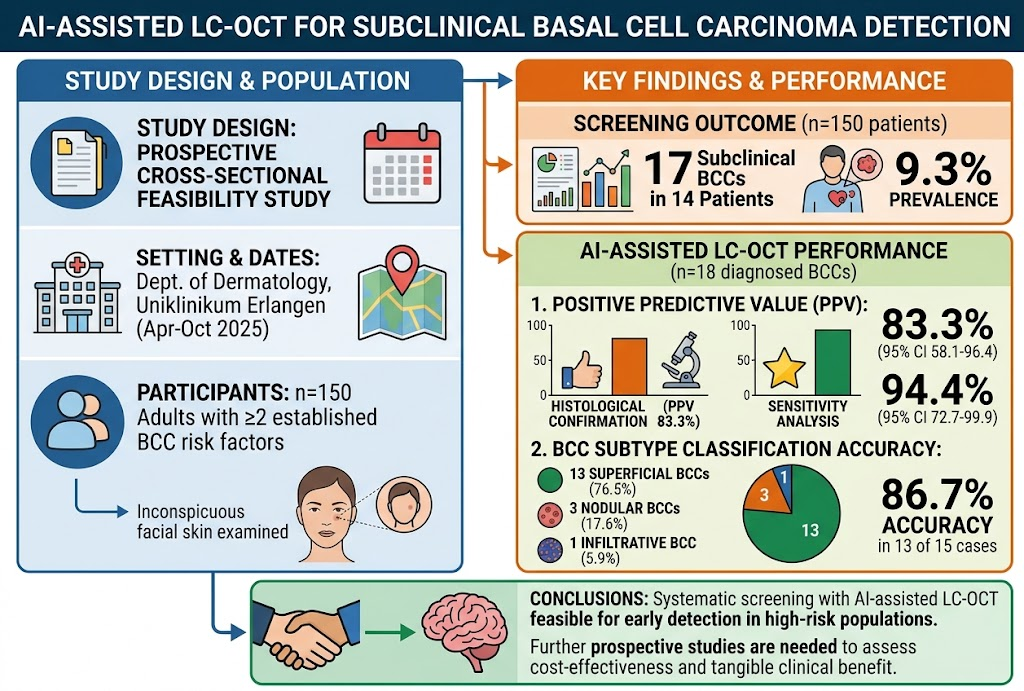
  • Basal cell carcinoma (BCC) is the most frequent skin cancer, with early detection critical to reduce morbidity from facial lesions.
  • Line-field confocal optical coherence tomography (LC-OCT) provides high-resolution, noninvasive imaging of skin architecture, enabling detection beyond visible lesions.
  • Artificial intelligence (AI) integration with LC-OCT enhances diagnostic accuracy for subclinical BCC in high-risk populations, with positive predictive values up to 94.4%.
  • Subtype classification of BCC via AI-assisted LC-OCT shows promising accuracy, aiding tailored clinical management.

Background

MedXY registered readers

Sign in free to continue reading

Create or use your MedXY account to unlock the complete article.

This article was created using several editorial tools, including AI, as part of the process. Human editors reviewed this content before publication.

Related articles

Open language-specific specialty feeds and department pages.

Impact of an AI-Powered Gamified Mobile Health Application on Blood Pressure Control in a Matched Patient CohortStudy found that use of an AI-driven gamified mobile app integrating home blood pressure monitoring significantly improved blood pressure control compared to usual care in hypertensive patients.Sep 17, 2026New International Consensus: Screening the General Population for Islet Autoantibodies to Detect Early-Stage Type 1 DiabetesAn international expert consensus recommends practical principles and minimum requirements for general‑population screening for islet autoantibodies to detect early-stage type 1 diabetes, reduce DKA, enable early care and access to disease‑Sep 13, 2026Evaluating Realism in Synthetic Videostroboscopic Laryngeal Images Generated by StyleGAN3This study assesses the perceptual realism of synthetic laryngeal images created using StyleGAN3, revealing high ambiguity between real and synthetic frames and highlighting efficient training durations for realistic image generation.Sep 3, 2026
Loading comments...
MedXY briefing

Get the free newsletter

Evidence-led clinical news, trends, and analysis—delivered to your inbox.

Ask MedXY AI

Most popular

Intimate Health
Five Benefits for Women Continuing Sexual Activity After Menopause
Intimate Health
Why Some Women Have a Strong Sex Drive—And Why Men Shouldn't Worry About It
Nursing & care
How often should a couple have sex?
Intimate Health
Classic Intimacy Recommendations: How to Help Women Reach Orgasm and Enjoy Mutual Pleasure
Intimate Health
What Makes a Woman "Physiologically Addicted" Is Never Money, But These Two Relationship Qualities
© 2026 MedXY
Contact usAbout usPrivacy PolicyMedXY story
Harnessing Artificial Intelligence for Early Detection of Ovarian Cancer: Development and Validation of a Predictive Risk Model
A novel AI-driven risk prediction model for ovarian cancer demonstrates high accuracy and potential to improve early detection in screening settings.
Aug 31, 2026
Revolutionizing Aortic Stenosis Screening: AI-Enabled Focused Cardiac Ultrasound with Novice OperatorsA novel deep learning algorithm accurately detects moderate or greater aortic stenosis using AI-guided focused cardiac ultrasound acquired by novice operators, presenting a scalable solution to expand screening accessibility.Aug 29, 2026
Cascade Genetic Screening in Hereditary Transthyretin Amyloidosis: Unlocking Earlier Diagnosis and Improved OutcomesCascade genetic screening in hereditary transthyretin amyloidosis (ATTRv) enables earlier diagnosis and intervention, improving survival and highlighting the need for variant-specific surveillance strategies.Aug 26, 2026