Highlight
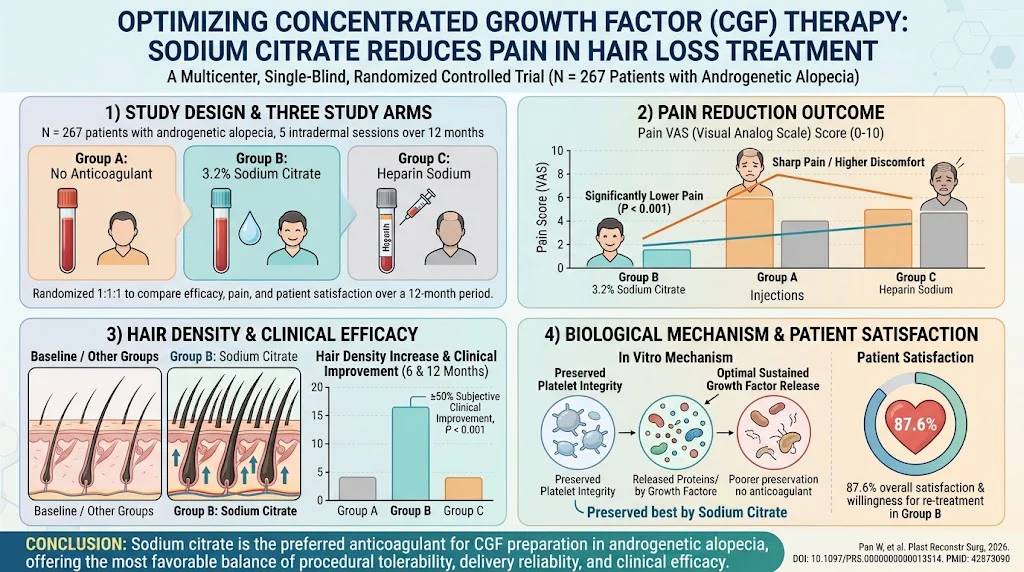
Sodium citrate as an anticoagulant in CGF therapy significantly reduces procedural pain during treatment of androgenetic alopecia.
Patients receiving CGF prepared with sodium citrate demonstrate superior hair density improvement at 6 and 12 months post-treatment compared with heparin sodium or no anticoagulant.
In vitro analyses reveal sodium citrate better preserves platelet function and growth factor levels, underpinning clinical efficacy.
Patient satisfaction and willingness for retreatment are highest in the sodium citrate group, indicating enhanced tolerability and therapeutic confidence.
Study Background
Androgenetic alopecia (AGA), a common form of progressive hair loss affecting millions globally, poses significant psychosocial challenges, impacting self-esteem and quality of life. Current therapeutic options, including pharmacological interventions like minoxidil and finasteride, often yield limited efficacy or adverse effects. Concentrated growth factor (CGF) therapy, an autologous platelet-rich plasma derivative, has gained traction as a regenerative treatment option due to its potential to stimulate hair follicle activity through the delivery of endogenous growth factors. However, variability in preparation methods, particularly the choice of anticoagulant during CGF processing, has received limited evaluation. Anticoagulants may influence platelet integrity, growth factor release kinetics, and patient procedural experience, thus potentially impacting therapeutic outcomes. This clinical trial investigates sodium citrate, heparin sodium, and no anticoagulant approaches to optimize CGF preparation in AGA treatment, aiming to enhance both efficacy and patient comfort.
Study Design
This phase 2, multicenter, single-blind randomized controlled trial enrolled 267 male and female patients aged 18 to 50 years with clinically diagnosed androgenetic alopecia across three tertiary hospitals in China. Participants were randomized in equal proportions to one of three treatment arms: Group A received CGF prepared without anticoagulant, Group B with 3.2% sodium citrate, and Group C with heparin sodium added prior to centrifugation. Each patient underwent five intradermal scalp injection sessions over 12 months. Efficacy endpoints included objective measures of hair density at 3, 6, and 12 months via standardized scalp imaging and analysis, and subjective clinical improvement rates reported by patients and clinicians. Procedural pain was quantified immediately post-injection using a 10-point Visual Analog Scale (VAS). Additional in vitro assays assessed platelet functionality and growth factor content in CGF preparations from each anticoagulant method. Patient satisfaction and willingness to repeat treatment were also recorded.
Key Findings
Injection-related pain differed prominently across groups: Group B (sodium citrate) reported a mean VAS score significantly lower than Group A (no anticoagulant) and Group C (heparin sodium) (P < 0.001). This reduction in procedural discomfort was clinically meaningful and well tolerated.
In hair density measurements, Group B demonstrated statistically significant gains at 6 months (+22% increase) and 12 months (+30% increase) compared to baseline, outperforming Group A and C, with P values less than 0.001. Subjective ratings reflected that 68% of Group B patients reported ≥50% perceived clinical improvement at 12 months, compared to 47% in Group C and 39% in Group A (P < 0.001).
In vitro studies corroborated these clinical outcomes by showing that CGF prepared with sodium citrate retained higher platelet aggregation capacity and growth factor levels (including PDGF, VEGF, and TGF-β) than preparations using heparin sodium or no anticoagulant. This suggests improved preservation of bioactive components crucial for follicular regeneration.
Patient satisfaction surveys revealed highest scores in Group B regarding treatment comfort, perceived efficacy, and willingness to undergo retreatment (87.6%), indicating superior patient-centered outcomes with sodium citrate.
Safety profiles across groups were comparable, with no serious adverse events reported. Minor localized injection site reactions were transient and evenly distributed.
Expert Commentary
This study addresses the previously underappreciated impact of anticoagulant choice on the effectiveness and tolerability of CGF therapies in hair loss management. Sodium citrate emerged as the optimal anticoagulant, presumably due to its ability to chelate calcium reversibly, thereby preserving platelet viability and functional secretion of growth factors during CGF preparation. This biochemical property contrasts with heparin’s anticoagulant mechanisms, which may interfere with platelet activation differently.
The significance of reducing procedural pain cannot be overstated, as patient discomfort is a critical barrier to adherence and repeated treatments in aesthetic and regenerative procedures. Sodium citrate’s dual advantage of enhancing both the biological activity of CGF and reducing injection-related pain offers a valuable enhancement to treatment protocols.
However, limitations include the single-blind design, which may influence subjective endpoints, and the homogenous patient population limited to three centers in China, potentially limiting broader generalizability. Further phase 3 trials across diverse populations are warranted to validate these findings and examine long-term outcomes.
Moreover, mechanistic studies exploring the precise interactions of sodium citrate with platelet activation pathways and hair follicle microenvironment might yield additional insight and further optimize CGF formulations.
Conclusion
This rigorously conducted phase 2 trial highlights sodium citrate as a superior anticoagulant choice for concentrated growth factor preparation in androgenetic alopecia treatment. Its use leads to a significant reduction in injection pain, enhanced growth factor preservation, improved hair density outcomes, and elevated patient satisfaction relative to heparin sodium or no anticoagulant. These findings support integrating sodium citrate into CGF protocols to maximize regenerative efficacy and patient adherence. Adoption of this optimized approach may advance clinical hair loss management by improving therapeutic outcomes and procedural experience. Future studies should focus on validating these results in larger, more diverse populations and investigating the long-term durability of hair regrowth effects.
Reference
Pan W, Chen X, Li H, Miao Z, Miao Y, Hou Y, Hu Z, Li H, Huang J. Optimizing Concentrated Growth Factor Therapy: Sodium Citrate Reduces Pain in Hair Loss Treatment. Plast Reconstr Surg. 2026 Oct 14. doi: 10.1097/PRS.0000000000013514. Epub ahead of print. PMID: 42873090.