Advancing Early Triple Negative Breast Cancer Care: Tissue-Free Circulating Tumor DNA Assays for Molecular Residual Disease Detection
Highlight
This study demonstrates that tissue-free circulating tumor DNA (ctDNA) assays, which do not require sequencing primary tumor tissue, can robustly detect molecular residual disease (MRD) in early triple negative breast cancer (TNBC). Such assays show strong prognostic value for recurrence, comparable lead times to tumor-informed assays, and potential to simplify clinical workflows.
Study Background
Triple negative breast cancer is an aggressive subtype characterized by lack of estrogen, progesterone, and HER2 receptors, associated with higher recurrence risk and limited targeted therapies. Early detection of residual disease post-treatment is crucial for identifying patients at high risk of relapse who might benefit from enhanced adjuvant interventions.
Circulating tumor DNA assays to detect MRD offer promising tools for noninvasive surveillance. Traditionally, tumor-informed ctDNA assays require sequencing of primary tumor DNA to identify patient-specific mutations for tracking, limiting applicability when tumor tissue is unavailable or of poor quality. Tissue-free assays circumvent this by leveraging cancer-specific aberrant DNA methylation signatures detectable in plasma without prior tumor sequencing, potentially streamlining processes and expanding access.
Study Design
This prognostic and exploratory analysis utilized plasma samples from 159 patients with TNBC at moderate to high risk of recurrence, enrolled in the multicenter phase 2 c-TRAK TN clinical trial. Patients underwent systematic plasma sampling every three months for up to two years after completing adjuvant therapy.
Three types of ctDNA detection assays were compared: (1) a tissue-free assay based on differential cancer methylation patterns, (2) a tumor-informed assay employing digital polymerase chain reaction (dPCR), and (3) a multivariant tumor-informed assay powered by whole-exome sequencing. The primary outcome was recurrence-free survival stratified by tissue-free ctDNA detection status. Lead times — duration between ctDNA detection and radiological recurrence — and concordance between assays were assessed. Data analysis was performed after median follow-ups extending to January 2023.
Key Findings
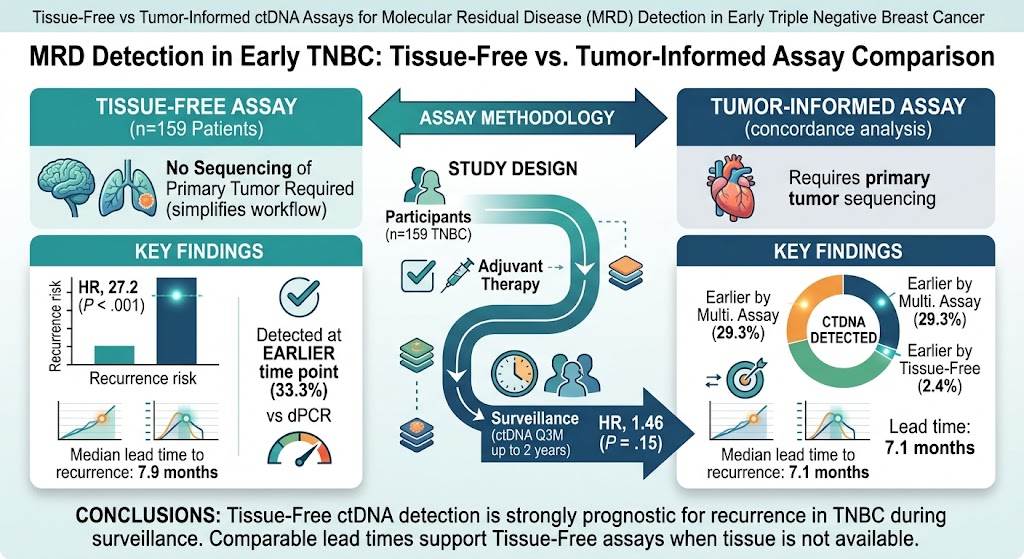
The tissue-free methylation-based assay detected ctDNA in 34.0% of patients (54/159), with detection associated with a hazard ratio (HR) for recurrence of 27.2 (95% confidence interval [CI], 13.7–54.2; P < .001), indicating a strong prognostic signal.
Among 42 patients positive by both tissue-free assay and dPCR, tissue-free detection was earlier in 33.3% (14 patients), whereas dPCR did not detect ctDNA earlier in any patient. Median lead time to clinical recurrence was significantly longer with tissue-free assay (7.9 months, 95% CI, 6.1–10.5) compared to dPCR (5.8 months, 95% CI, 3.3–10.0; HR 0.57, 95% CI 0.34–0.95; P = .03), suggesting earlier molecular relapse detection.
Comparing the tissue-free assay to the multivariant tumor-informed test, concordance was good. Among 41 patients positive by both tests, 29.3% (12) had earlier ctDNA detection by the tumor-informed assay and 2.4% (1) by the tissue-free assay. Median lead times were similar: 7.6 months (95% CI, 4.6–10.5) for tissue-free versus 7.1 months (95% CI, 5.7–10.0) for tumor-informed assays (HR 1.46; 95% CI, 0.87–2.44; P = .15).
Expert Commentary
This study provides compelling evidence that tissue-free ctDNA assays based on methylation analysis can match the prognostic accuracy and lead time performance of tumor-informed assays, potentially overcoming logistical hurdles related to tissue procurement and sequencing delays.
While tumor-informed assays remain highly sensitive due to patient-specific mutation tracking, their reliance on tumor sequencing limits immediate applicability across all clinical settings. The tissue-free approach’s earlier or comparable detection ability observed in this cohort suggests a transformative shift to more accessible surveillance tools could be safely pursued in clinical trials and practice.
Limitations include the phase 2 study design and the need for further validation in larger, diverse populations. Additionally, the impact of MRD detection on guiding clinical decisions and improving survival remains to be determined through interventional trials.
Conclusion
The tissue-free methylation ctDNA assay demonstrated strong prognostic value for MRD detection in early TNBC, with comparable lead times to established tumor-informed assays. This supports its use in clinical trial settings where tumor tissue is unavailable or impractical to sequence. Adoption of tissue-free ctDNA detection could enable wider MRD surveillance, aiding precision-tailored adjuvant therapy and earlier intervention to improve outcomes.
Funding and ClinicalTrials.gov
The study was conducted as part of the c-TRAK TN phase 2 multicenter clinical trial. Funding sources and specific trial registration numbers were detailed in the original publication.
References
1. Cunningham N, Cutts RJ, Swift C, et al. Tissue-Free vs Tumor-Informed ctDNA Assays for Molecular Residual Disease Detection in Early Triple Negative Breast Cancer. JAMA Oncol. 2026 Aug 13. PMID: 42593771.
2. Garcia-Murillas I, Schiavon G, Weigelt B, et al. Mutation tracking in circulating tumor DNA predicts relapse in early breast cancer. Sci Transl Med. 2015;7(302):302ra133.
3. Liu MC, Oxnard GR, Klein EA, et al. Sensitive and specific multi-cancer detection and localization using methylation signatures in cell-free DNA. Ann Oncol. 2020;31(6):745-756.
This article was created using several editorial tools, including AI, as part of the process. Human editors reviewed this content before publication.