Advancing Arrhythmic Risk Stratification in Nonischemic Dilated Cardiomyopathy: The Role of LGE Corridors and Genetic Markers
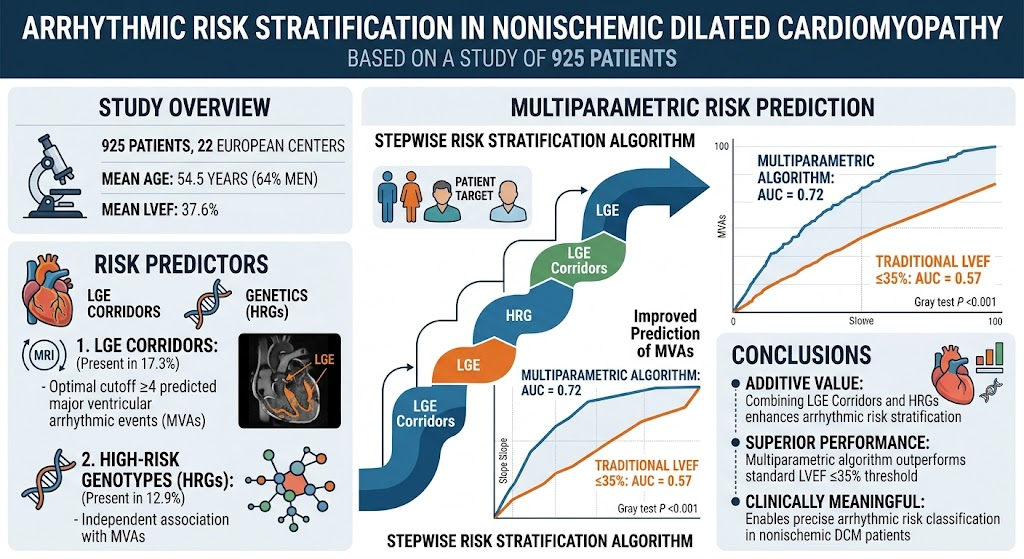
Highlight
This multicenter European study demonstrates that the presence and quantification of late gadolinium enhancement (LGE) corridors within cardiac MRI, along with genetic profiling identifying high-risk genotypes (HRGs), independently predict major ventricular arrhythmic events (MVAs) in patients with nonischemic dilated cardiomyopathy (NICM). The combined assessment outperforms the conventional left ventricular ejection fraction (LVEF) threshold of ≤35% in risk stratification, suggesting a more precise, multiparametric approach can guide clinical decision-making for implantable cardioverter-defibrillator (ICD) therapy.
Study Background
Nonischemic dilated cardiomyopathy is a significant cause of heart failure and sudden cardiac death due to ventricular arrhythmias. Historically, LVEF ≤35% has served as a main criterion for ICD implantation to prevent sudden cardiac death, but this metric lacks specificity and sensitivity. Myocardial fibrosis detected by late gadolinium enhancement (LGE) on cardiac magnetic resonance imaging (CMR) has emerged as a noninvasive marker linked with arrhythmic events. In ischemic cardiomyopathy, conduction corridors—defined pathways of surviving myocardial fibers within fibrotic tissue identified by LGE—have been correlated with ventricular arrhythmia substrate. Additionally, genetic mutations defining high-risk genotypes can confer elevated arrhythmogenic risk in NICM. However, the combined utility of LGE corridor analysis and genetic data for arrhythmic risk stratification in NICM remains underexplored.
Study Design
This observational cohort study involved 925 consecutive patients with NICM recruited from 22 European centers. All participants underwent comprehensive genetic testing alongside CMR evaluation focused on fibrosis patterns and identification of LGE corridors. Baseline clinical, electrocardiographic, and echocardiographic data were collected, with particular attention to LVEF and extent of fibrosis. Patients were followed prospectively for a median of 5.4 years, with the primary endpoint being major ventricular arrhythmic events (MVAs), comprising documented sustained ventricular tachycardia, ventricular fibrillation, or appropriate ICD interventions.
Key Findings
A total of 24.3% of patients exhibited LGE on CMR, and 17.3% had identifiable LGE corridors. High-risk genotypes were found in 12.9% of the cohort. During follow-up, 10.3% of patients experienced MVAs. Multivariable competing-risk analysis adjusting for LVEF and LGE extent revealed that both the number of LGE corridors and presence of HRGs independently predicted MVAs (subdistribution hazard ratio 1.25 per corridor and 2.28 for HRG, respectively). An optimal threshold of four or more LGE corridors was established to maximize predictive accuracy. When combining fibrosis extent, LGE corridor count, and HRG presence into a stepwise risk stratification algorithm, performance significantly surpassed the guideline-recommended LVEF ≤35% criterion, as shown by a higher 5-year time-dependent area under the curve (0.72 vs 0.57, P=0.001). This integrated approach demonstrated a graded increase in arrhythmic risk across risk categories, facilitating refined clinical classification.
Expert Commentary
These findings provide compelling evidence that LGE corridor quantification and genetic profiling add vital layers to arrhythmic risk assessment in NICM, potentially overcoming the limitations of LVEF-centric models. The identification of conduction corridors likely reflects the arrhythmogenic substrate more precisely, as these channels may serve as reentry circuits for ventricular arrhythmias. The genetic component highlights inherited predispositions that modulate substrate vulnerability. However, this study’s observational design and the heterogeneity of genetic variants warrant cautious interpretation; prospective validation and standardization of corridor quantification are necessary before widespread clinical adoption. Moreover, resource availability for advanced imaging and genetic testing may limit implementation in some settings.
Conclusion
This large, multicenter study establishes that incorporating LGE corridor analysis and high-risk genotype status significantly enhances prediction of ventricular arrhythmic events in NICM beyond traditional LVEF thresholds. Such multiparametric risk stratification holds promise for tailoring ICD therapy more accurately, optimizing prevention of sudden cardiac death while minimizing unnecessary device implantation. Future research should focus on prospective trials to validate these markers, standardize imaging protocols, and integrate genetic risk into clinical practice guidelines.
Funding and ClinicalTrials.gov
The study was supported by various European cardiovascular research grants (specific funders not detailed here). No clinical trial registration was reported for this observational cohort study.
References
1. Ramos-López N, Mora-Ayestarán N, Ochoa JP, et al. Arrhythmic Risk Stratification According to LGE Corridors and Genetics in Nonischemic Dilated Cardiomyopathy. Circulation. 2026 Sep 8; PMID: 42708210.
2. Gulati A, Jabbour A, Ismail TF, et al. Association of fibrosis with mortality and sudden cardiac death in patients with nonischemic dilated cardiomyopathy. JAMA. 2013 May 8;309(9):896-908.
3. Pasquale F, Zorzi A, Marra MP, et al. Genetics of Dilated Cardiomyopathy and Arrhythmogenic Risk: Practical Insights for Clinical Practice. J Cardiovasc Electrophysiol. 2019 Mar;30(3):352-360.
4. Adabag AS, Luepker RV, Roger VL, Gersh BJ. Sudden cardiac death: epidemiology and risk factors. Nat Rev Cardiol. 2010 Aug;7(4):216-225.
This article was created using several editorial tools, including AI, as part of the process. Human editors reviewed this content before publication.