USP8 as a Therapeutic Target in B Cell Proteostasis and Multiple Myeloma Resistance
Highlight
This study uncovers the critical role of ubiquitin-specific protease 8 (USP8) in regulating proteostasis pathways during B-cell development and in multiple myeloma (MM). USP8 deletion disrupts B-cell maturation, impacting immune responses, and induces accumulation of mixed ubiquitin/NEDD8 chain-modified proteins, a marker of proteotoxic stress. In patient-derived MM cells, USP8 knockdown impairs survival through lysosomal dysfunction, underscoring USP8 as a therapeutic vulnerability. Intriguingly, the USP8 inhibitor DUB-IN-2 enhances ER stress when paired with the proteasome inhibitor Bortezomib (BTZ), suggesting alternative or off-target mechanisms and a potential combinatorial strategy against BTZ-resistant MM.
Study Background
Multiple myeloma is a hematologic malignancy marked by malignant proliferation of plasma cells in the bone marrow. Despite advances, including the use of proteasome inhibitors like Bortezomib (BTZ), drug resistance remains a significant clinical challenge leading to relapse and mortality. Proteostasis—the balance of protein synthesis, folding, and degradation—is crucial for plasma cell survival given their high secretory function. Ubiquitin-specific proteases (USPs), such as USP8, are deubiquitinating enzymes that regulate proteostasis pathways, including endosomal trafficking and lysosomal degradation, processes essential for cell survival and stress response. Understanding USP8’s role in normal B-cell maturation and myeloma pathogenesis may reveal actionable vulnerabilities to overcome drug resistance and improve patient outcomes.
Study Design
The study employed a staged genetic deletion approach of Usp8 in mice to assess its effect on B-cell development and immune function, using Usp8f/fCd19-Cre mice. This model allowed cell stage–specific analysis during B-cell maturation. In parallel, human patient-derived MM cell lines, including those sensitive or resistant to BTZ, were examined. USP8 functional perturbation was achieved via genetic knockdown and pharmacologic inhibition using DUB-IN-2, a reported USP8 inhibitor. Proteomic analyses identified substrate modifications, while biochemical and cellular assays evaluated proteostasis, lysosomal function, ER stress response, and apoptosis.
Key Findings
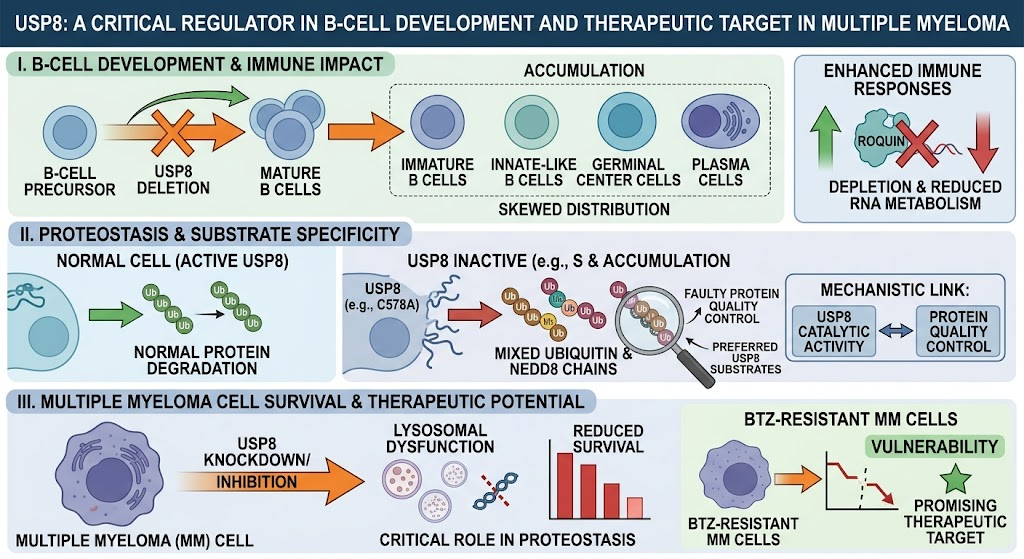
B-cell Development and Immune Impact: USP8 deletion substantially impaired B-cell survival and differentiation, favoring accumulation of immature and innate-like B cells along with germinal center and plasma cells. This skewed distribution was accompanied by enhanced immune responses and depletion of Roquin, a regulatory protein involved in RNA metabolism and immune regulation.
Proteostasis and Substrate Specificity: Cells expressing catalytically inactive USP8 accumulated proteins modified with mixed ubiquitin and NEDD8 chains. These mixed modifications signify proteotoxic stress and identify preferred substrates for USP8’s deubiquitinating activity. This finding highlights a unique mechanistic link between USP8’s catalytic activity and protein quality control pathways in B cells.
Multiple Myeloma Cell Survival: USP8 knockdown in MM cell lines reduced survival owing to lysosomal dysfunction, demonstrating USP8’s crucial role in maintaining proteostasis in malignant plasma cells. Importantly, this vulnerability was evident even in BTZ-resistant MM cells, underscoring USP8 as a promising therapeutic target.
Pharmacological Inhibition with DUB-IN-2: Contrary to expectations, DUB-IN-2 treatment augmented ER stress when combined with BTZ rather than simply inhibiting USP8’s function. Biochemical validation indicated that DUB-IN-2 may not be a specific USP8 inhibitor. Nevertheless, the combined DUB-IN-2 and BTZ treatment elicited a novel anti-myeloma response, providing a potential clinically relevant approach for overcoming BTZ resistance.
Expert Commentary
This comprehensive investigation elegantly demonstrates USP8’s pivotal role in balancing proteostasis during B-cell maturation and in MM pathophysiology. The identification of USP8 as a regulator of mixed ubiquitin/NEDD8 chain turnover provides mechanistic insight into how faulty protein degradation contributes to proteotoxic stress and cellular dysfunction. In the clinical context, USP8’s perturbation selectively endangers myeloma cell viability, especially in proteasome inhibitor–resistant disease subsets, addressing a crucial unmet need.
However, the use of DUB-IN-2 as a USP8 inhibitor reveals the complexity of drug targeting. The unexpected synergistic ER stress induction in combination with BTZ suggests off-target effects or multifunctional drug actions, calling for the development of more specific USP8 inhibitors and detailed pharmacodynamic studies to optimize therapeutic combinations.
Limitations include potential differences between murine B-cell development and human immunobiology, as well as challenges in translating molecular findings to clinical therapeutics. Future studies should explore the therapeutic window, safety profiles, and possible resistance mechanisms arising from USP8 targeting.
Conclusion
This study provides compelling evidence that USP8 is a critical regulator of proteostasis in B cells and multiple myeloma, influencing cell survival, differentiation, and stress responses. USP8 represents a promising therapeutic target, especially in BTZ-resistant MM cases where current options are limited. The synergy observed between DUB-IN-2 and BTZ treatment opens new avenues for combination therapies, although the precise molecular mechanisms warrant further elucidation. Ultimately, this work lays a foundation for clinical translation and improved management strategies in multiple myeloma by exploiting the vulnerabilities in ubiquitin-mediated proteostasis pathways.
Funding and ClinicalTrials.gov
The study was supported by institutional research grants and collaborations detailed in the original publication. No clinical trial registration was mentioned, as this study primarily involved preclinical models and patient-derived cell lines. Future clinical studies are needed to evaluate USP8-targeted therapies.
References
Dufner A, et al. USP8 controls proteostasis pathways in B cells and multiple myeloma. Leukemia. 2026 Aug 11; PMID: 42581242.
Kumar SK, et al. Multiple myeloma. Nat Rev Dis Primers. 2017 Mar 23;3:17046.
Leung-Hagesteijn C, et al. Proteostasis and pathogenesis of multiple myeloma. Blood. 2019 Nov 7;134(19):1607-1617.
Colland F. The therapeutic potential of deubiquitinating enzyme inhibitors. Biochem Soc Trans. 2010 Aug;38(Pt 1):137-143.
This article was created using several editorial tools, including AI, as part of the process. Human editors reviewed this content before publication.