Unintentional Weight Loss Not a Predictor of Poor Outcomes in Zenker Diverticulum
Zenker diverticulum is a pharyngoesophageal pouch that often causes dysphagia, regurgitation, and aspiration. Unintentional weight loss is frequently considered a red flag for severe disease or poor prognosis. This study challenges that assumption by examining whether weight loss in patients with cricopharyngeal muscle dysfunction (with or without diverticula) is linked to symptom duration, diverticulum size, or postoperative complications.
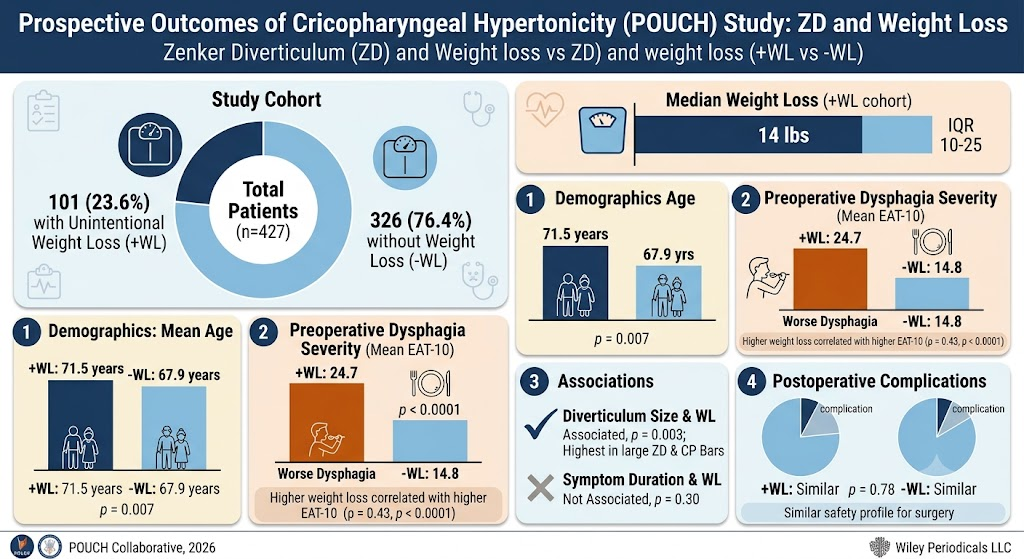
Unintentional weight loss occurred in 23.6% of patients with cricopharyngeal muscle dysfunction, regardless of diverticulum presence.
Weight loss was associated with worse dysphagia symptoms (higher EAT-10 scores) but not with longer symptom duration or larger diverticulum size.
Surgical complication rates were similar between patients with and without weight loss, and those with weight loss experienced greater symptom improvement.
Study Snapshot
Design: Prospective, multicenter observational study
Population: 427 patients with cricopharyngeal muscle dysfunction, with or without Zenker diverticulum, enrolled in the POuCH database
Exposure: Unintentional weight loss prior to enrollment
Key outcomes: Dysphagia severity (EAT-10), diverticulum size, symptom duration, postoperative complications
Main finding: Weight loss was common but did not predict poor outcomes; surgery was equally safe and more beneficial in weight-loss patients.
How the Study Was Conducted
Researchers analyzed data from the Prospective Outcomes of Cricopharyngeal Hypertonicity (POuCH) database, a multicenter registry. A total of 427 patients were included, all with cricopharyngeal muscle dysfunction (CPMD). Among these, 101 patients (23.6%) reported unintentional weight loss (+WL) and 326 reported no weight loss (−WL). The median weight loss in the +WL group was 14 pounds (interquartile range 10–25 pounds).
The study compared baseline characteristics, symptom severity using the Eating Assessment Tool (EAT-10), diverticulum size, and postoperative complications between the two groups. Statistical analyses included Spearman correlation and group comparisons.
What the Researchers Found
Patients with weight loss were slightly older (mean age 71.5 vs. 67.9 years, p = 0.007) and had significantly worse dysphagia symptoms before treatment (mean preoperative EAT-10 score 24.7 vs. 14.8, p < 0.0001). Higher weight loss correlated with higher EAT-10 scores (Spearman ρ = 0.43, p < 0.0001).
Diverticulum size was associated with weight loss (p = 0.003), but notably, weight loss was greatest in patients with either large diverticula or cricopharyngeal bars alone. Duration of symptoms did not differ between groups (p = 0.30). Most importantly, postoperative complications were similar in +WL and −WL patients (p = 0.78), indicating that weight loss does not increase surgical risk. Furthermore, patients with weight loss experienced greater improvement in dysphagia after surgery.
What the Findings May Mean
These results suggest that unintentional weight loss in Zenker diverticulum is primarily a marker of dysphagia severity rather than a predictor of poor surgical outcomes. Weight loss does not appear to reflect longer disease duration or larger diverticulum size in a linear fashion. The similar complication rates and greater symptom improvement in weight-loss patients support that surgery is safe and effective even in this subgroup.
However, as an observational study, the findings show association, not causation. Residual confounding, such as differences in nutritional status or comorbid conditions, may influence outcomes.
Strengths and Limitations
Strengths include the prospective, multicenter design and use of a validated patient-reported outcome measure (EAT-10). Limitations include the abstract-only source, which prevents assessment of full methodology, missing data on specific complications, and potential selection bias from registry participation. The study cannot address long-term outcomes beyond the perioperative period.
Implications for Practice and Research
Clinicians should not view unintentional weight loss in Zenker diverticulum as a contraindication to surgery. Instead, weight loss may identify patients with more severe dysphagia who stand to benefit substantially from intervention. Future research should examine weight loss trajectories, nutritional optimization strategies, and longer-term patient-reported outcomes.
References
Schuman AD, Allen J, Altaye M, et al. Unintentional Weight Loss Does Not Predict Poor Outcomes in Zenker Diverticulum. The Laryngoscope. 2026. PMID: 42470432. https://pubmed.ncbi.nlm.nih.gov/42470432/
This article was created using several editorial tools, including AI, as part of the process. Human editors reviewed this content before publication.