We use cookies

Our website uses essential cookies and, with your consent, additional cookies to measure performance and improve our services. Cookie Policy.

You can change your choice at any time.

MMedXYNews
HomeVideos
MedXY AI/MedXY News/Tag: myocardial injury
MedXY News
EnglishTag

myocardial injury

Ask MedXY AI
type 2 diabetesclinical trialheart failureimmunotherapyobesitycardiovascular riskatrial fibrillationbiomarkerscritical careclinical trialsHypertensionartificial intelligenceCardiologyoncologypublic healthtype 1 diabetesdiabetesMortalityAlzheimer's diseasecardiovascular diseasebreast cancerepidemiology

Latest news

Tag

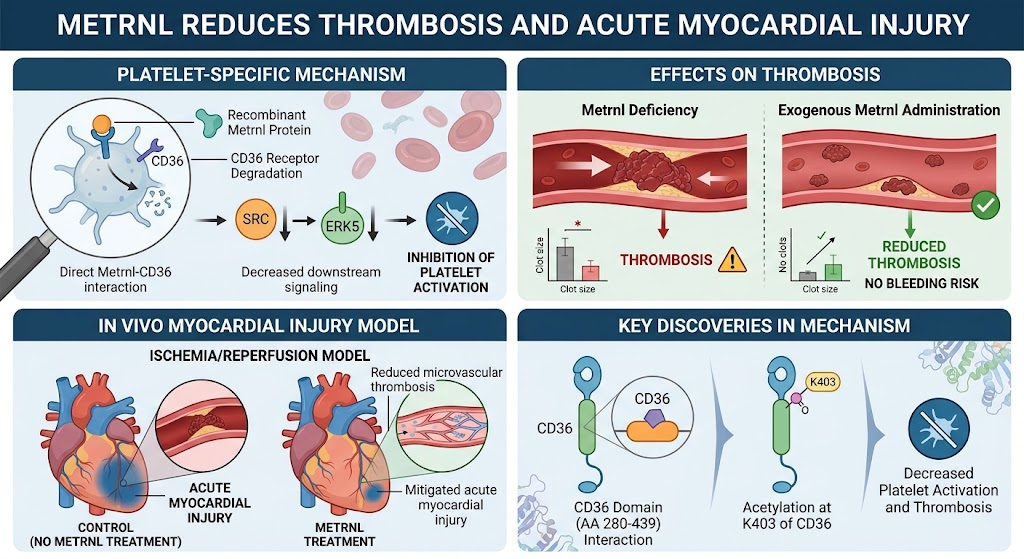
Metrnl: A Novel Inhibitor of Platelet Activation Targeting CD36 to Mitigate Thrombosis and Acute Myocardial Injury
CardiologyCD36 receptorMetrnl

Metrnl: A Novel Inhibitor of Platelet Activation Targeting CD36 to Mitigate Thrombosis and Acute Myocardial Injury

By MedXY|Aug 21, 2026

Metrnl reduces platelet activation and thrombus formation by promoting CD36 degradation, offering a promising therapeutic strategy for thrombotic diseases including acute myocardial infarction without increasing bleeding risk.


Why the cTnI/cTnT Ratio May Matter: A New Signal for Distinguishing Acute Necrotic From Chronic Myocardial Injury
Cardiologybiomarkers
© 2026 MedXY
Contact usAbout usPrivacy PolicyMedXY story
Cardiac troponin

Why the cTnI/cTnT Ratio May Matter: A New Signal for Distinguishing Acute Necrotic From Chronic Myocardial Injury

By MedXY|May 12, 2026

A large multicohort and experimental study suggests the cTnI/cTnT ratio is biologically informative, separates acute from chronic myocardial injury, and modestly improves type 1 versus type 2 MI discrimination.

Beyond Insulin Resistance: Why Diabetes Status Dictates the Cardiovascular Risk of the Triglyceride-Glucose Index
Cardiologycardiovascular riskdiabetes

Beyond Insulin Resistance: Why Diabetes Status Dictates the Cardiovascular Risk of the Triglyceride-Glucose Index

By MedXY|Dec 24, 2025

A prospective ARIC cohort study reveals that diabetes fundamentally modifies the relationship between the triglyceride-glucose (TyG) index and subclinical myocardial injury, shifting the risk profile from an L-shaped to a J-shaped associati

Myocardial Injury Is Common After Major Head and Neck Surgery and Predicts Early Mortality: Insights from the VISION Cohort
CardiologyHead and neck surgerymyocardial injury

Myocardial Injury Is Common After Major Head and Neck Surgery and Predicts Early Mortality: Insights from the VISION Cohort

By MedXY|Nov 21, 2025

A VISION cohort analysis found myocardial injury after major head and neck surgery (MINS) in 11.9% overall and 23.8% of patients ≥75, strongly associated with 30‑day mortality and longer hospital stay; most events were clinically silent wit

Ivabradine Fails to Reduce Myocardial Injury After Noncardiac Surgery: Insights from a Large RCT
Cardiologymyocardial injurynoncardiac surgery

Ivabradine Fails to Reduce Myocardial Injury After Noncardiac Surgery: Insights from a Large RCT

By MedXY|Oct 6, 2025

A large randomized trial shows that ivabradine, despite effectively lowering heart rate during surgery, does not reduce myocardial injury after noncardiac surgery, highlighting the complexity of perioperative cardiac risk management.

Periprocedural Myocardial Injury after Elective PCI: Incidence and Impact on Long-Term Mortality
Cardiologylong-term mortalitymyocardial injury

Periprocedural Myocardial Injury after Elective PCI: Incidence and Impact on Long-Term Mortality

By MedXY|Oct 3, 2025

Post-PCI myocardial injury defined by elevated CKMB is common and linked to increased long-term mortality, with more complex coronary anatomy predicting the injury occurrence.

Ask MedXY AI

Most popular

Intimate Health
Five Benefits for Women Continuing Sexual Activity After Menopause
Intimate Health
Why Some Women Have a Strong Sex Drive—And Why Men Shouldn't Worry About It
Nursing & care
How often should a couple have sex?
Intimate Health
Classic Intimacy Recommendations: How to Help Women Reach Orgasm and Enjoy Mutual Pleasure
Intimate Health
What Makes a Woman "Physiologically Addicted" Is Never Money, But These Two Relationship Qualities