We use cookies

Our website uses essential cookies and, with your consent, additional cookies to measure performance and improve our services. Cookie Policy.

You can change your choice at any time.

MMedXYNews
HomeVideos
© 2026 MedXY
Contact usAbout usPrivacy PolicyMedXY story
MedXY AI/MedXY News/Tag: ASCVD
MedXY News
EnglishTag

ASCVD

Ask MedXY AI
type 2 diabetesclinical trialheart failureimmunotherapyobesitycardiovascular riskatrial fibrillationbiomarkerscritical careclinical trialsHypertensionartificial intelligenceCardiologyoncologypublic healthtype 1 diabetesdiabetesMortalityAlzheimer's diseasecardiovascular diseasebreast cancerepidemiology

Latest news

Tag

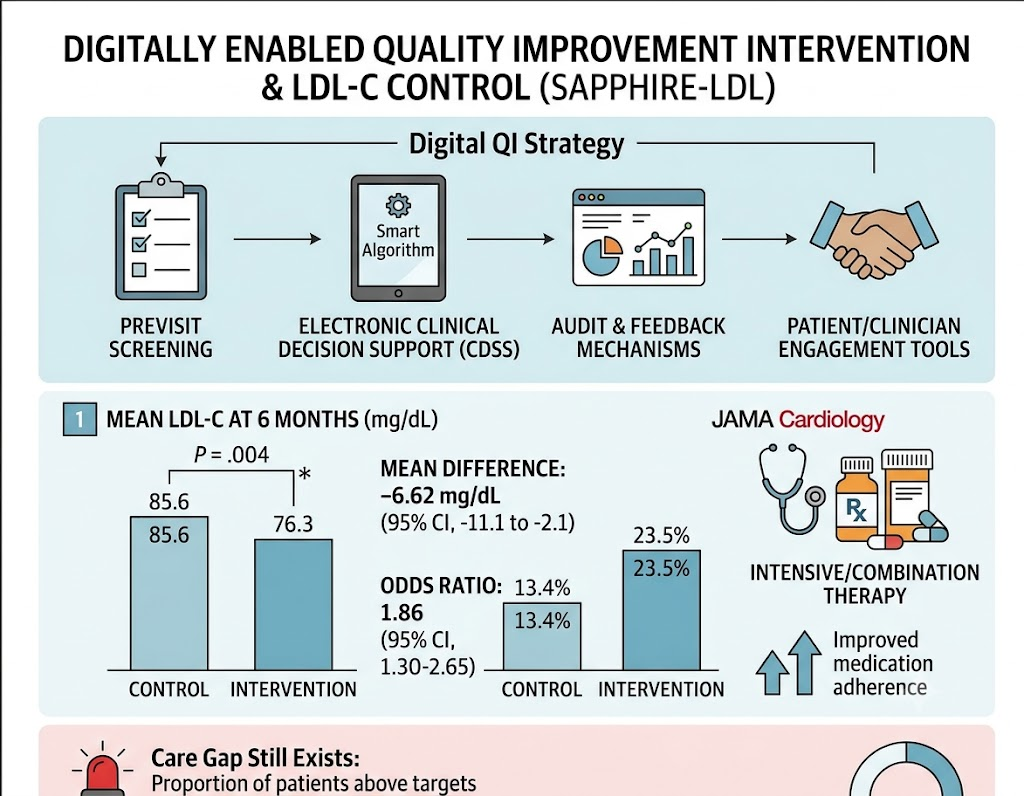
Digitally Enabled QI Intervention Modestly Improves LDL-C Control in ASCVD: SAPPHIRE-LDL Trial
CardiologyLDL-CASCVD

Digitally Enabled QI Intervention Modestly Improves LDL-C Control in ASCVD: SAPPHIRE-LDL Trial

By MedXY|Jul 25, 2026

A cluster RCT in Brazil found that a digitally enabled quality improvement intervention modestly reduced LDL-C and increased treatment intensification in ASCVD patients, but a care gap remained.


Semaglutide Drives Vascular Regeneration: The SEMA-VR CardioLink-15 Trial Reveals a Shift in Progenitor Cell Flux
CardiologyASCVDGLP-1 receptor agonists

Semaglutide Drives Vascular Regeneration: The SEMA-VR CardioLink-15 Trial Reveals a Shift in Progenitor Cell Flux

By MedXY|Mar 9, 2026

The SEMA-VR CardioLink-15 trial demonstrates that semaglutide shifts bone marrow-derived progenitor cells toward an anti-inflammatory, pro-regenerative profile, potentially enhancing endogenous vessel repair in high-risk cardiovascular pati

The Silent Genetic Threat: Why Most Patients with Familial Hypercholesterolemia Are Still Falling Through the Clinical Cracks
CardiologyASCVDFamilial Hypercholesterolaemia

The Silent Genetic Threat: Why Most Patients with Familial Hypercholesterolemia Are Still Falling Through the Clinical Cracks

By MedXY|Mar 6, 2026

A massive cohort study of 245,388 US adults reveals that 1 in 287 carries a familial hypercholesterolemia mutation. Despite high risks for premature heart disease, most carriers remain undertreated, with fewer than 20% of those with establi

The Hidden Burden of Heart and Brain Health: ASCVD Linked to Significantly Elevated Suicide Risk
CardiologyASCVDCardiology

The Hidden Burden of Heart and Brain Health: ASCVD Linked to Significantly Elevated Suicide Risk

By MedXY|Jan 7, 2026

A large-scale nationwide study reveals that individuals with atherosclerotic cardiovascular disease (ASCVD), including myocardial infarction and stroke, face a 43% higher risk of suicide. The risk nearly doubles for those suffering from bot

High BMI, High Benefit: How PCSK9 Inhibition Optimizes Outcomes in Obese Patients with ASCVD
CardiologyASCVDEvolocumab

High BMI, High Benefit: How PCSK9 Inhibition Optimizes Outcomes in Obese Patients with ASCVD

By MedXY|Dec 25, 2025

A prespecified analysis of the FOURIER trial reveals that patients with obesity and atherosclerotic cardiovascular disease experience significantly higher absolute and relative risk reductions with evolocumab, particularly those with a BMI

Calprotectin: A Mechanistically Informed Biomarker for Predicting Atherosclerotic Cardiovascular Disease
CardiologyASCVDbiomarkers

Calprotectin: A Mechanistically Informed Biomarker for Predicting Atherosclerotic Cardiovascular Disease

By MedXY|Dec 24, 2025

A longitudinal study from the Dallas Heart Study identifies calprotectin as a significant, independent predictor of ASCVD events, linking neutrophil activation to endothelial dysfunction and increased cardiovascular risk across diverse popu

Evaluating AHA PREVENT Equations and Lipoprotein(a) in Cardiovascular Risk Stratification: Integrative Insights from MESA and UK Biobank Cohorts
CardiologyASCVDcardiovascular risk

Evaluating AHA PREVENT Equations and Lipoprotein(a) in Cardiovascular Risk Stratification: Integrative Insights from MESA and UK Biobank Cohorts

By MedXY|Dec 3, 2025

This review synthesizes evidence on the performance of AHA PREVENT equations in individuals with elevated lipoprotein(a), emphasizing its independent risk association and potential to enhance personalized ASCVD risk prediction.

Ask MedXY AI

Most popular

Intimate Health
Five Benefits for Women Continuing Sexual Activity After Menopause
Intimate Health
Why Some Women Have a Strong Sex Drive—And Why Men Shouldn't Worry About It
Nursing & care
How often should a couple have sex?
Intimate Health
Classic Intimacy Recommendations: How to Help Women Reach Orgasm and Enjoy Mutual Pleasure
Intimate Health
What Makes a Woman "Physiologically Addicted" Is Never Money, But These Two Relationship Qualities