Sustained Genetic Silencing of BCL11A Using shmiR Vector in Sickle Cell Disease: Long-Term Safety and Efficacy
Highlight
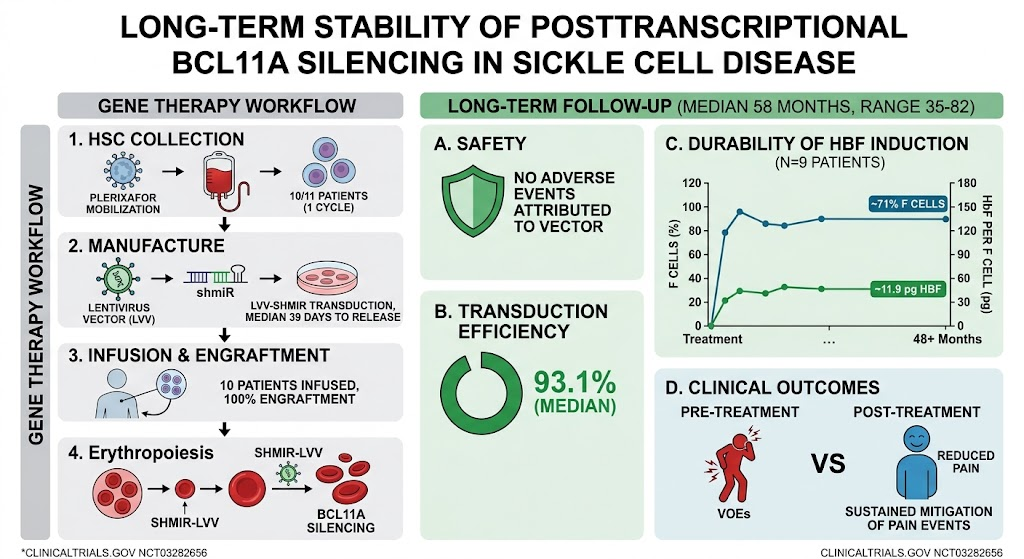
This pioneering study demonstrates that lentiviral vector-mediated posttranscriptional silencing of BCL11A via a short hairpin microRNA (shmiR) achieves stable, long-term induction of fetal hemoglobin (HbF) in patients with sickle cell disease (SCD). The gene therapy showed excellent manufacturing success, effective engraftment, a strong safety profile, sustained HbF expression, and clinical mitigation of vaso-occlusive episodes (VOEs) over a median 58-month follow-up.
Study Background
Sickle cell disease is an inherited hemoglobinopathy causing red blood cells to adopt a sickled shape, leading to chronic hemolysis, vaso-occlusion, pain crises, and significant morbidity and mortality. Elevated fetal hemoglobin (HbF) levels diminish polymerization of sickle hemoglobin (HbS), ameliorating disease severity. BCL11A is a key transcriptional repressor of HbF expression in adult erythrocytes. Targeting BCL11A to reactivate HbF production has emerged as a promising genetic therapeutic approach to reduce SCD complications.
Previous therapeutic attempts to induce HbF have been limited by inconsistent and transient effectiveness or off-target effects. Lentiviral vector modification of autologous hematopoietic stem/progenitor cells (HSPCs) to deliver short hairpin RNAs embedded in microRNAs (shmiRs) targeting BCL11A offers a novel posttranscriptional silencing strategy with potential for durable HbF induction and minimal adverse effects.
Study Design
This first-in-human phase 1/2 clinical trial (NCT03282656) enrolled 11 eligible patients with sickle cell disease. Plerixafor was used to mobilize HSPCs into peripheral blood. Collection aimed to harvest sufficient CD34+ cells for manufacturing. Patients’ HSPCs were transduced ex vivo with a lentiviral vector expressing a shmiR targeting BCL11A selectively in erythroid cells.
Ten patients subsequently received autologous transplantation of the genetically modified HSPCs, following myeloablative conditioning. The primary endpoints included feasibility of HSC collection/manufacturing, safety and tolerability post-infusion, engraftment success, and assessment of HbF induction and durability over long-term follow-up.
Key Findings
Hematopoietic Stem Cell Collection and Manufacturing: Plerixafor mobilization enabled successful stem cell collection in 10 of 11 patients after a single cycle. All 11 collected products were efficiently manufactured with a median release time of 39 days, highlighting robust manufacturing feasibility.
Engraftment and Vector Transduction Efficiency: All 10 infused patients engrafted successfully. Transduction efficiency was high, with a median 93.1% of target cells modified. One patient exhibited low engraftment of transduced cells and correlated suboptimal HbF induction.
HbF Induction and Stability: In the nine patients with satisfactory engraftment, peripheral blood showed that 71% of erythrocytes were F cells (HbF-containing) two years after treatment, with an average 11.9 pg HbF per F cell. These parameters remained stable through follow-up reaching 48 months or more, indicating long-term durability of gene silencing and HbF production.
Clinical Outcomes and Safety: The ten treated patients demonstrated sustained amelioration of painful vaso-occlusive episodes, translating molecular benefits into meaningful clinical improvement. Over a median follow-up exceeding 4.5 years, no adverse events were attributed to the shmiR lentiviral vector, affirming an excellent safety profile.
Expert Commentary
This study provides compelling evidence that targeting BCL11A with a shmiR-expressing lentiviral vector is a viable strategy for durable reactivation of HbF in sickle cell disease. Its erythroid-specific silencing minimizes off-target effects, a concern with approaches that globally knockdown BCL11A. The stable maintenance of HbF expression and the associated clinical benefit over years post-infusion are major strengths compared to pharmacologic HbF inducers, which are often limited by adherence and variable response.
While one patient with suboptimal engraftment highlights the importance of achieving adequate modified HSPC repopulation, the near-universal success in the cohort with durable clinical response indicates robust scalability. Limitations include the small sample size and a single-arm design without randomized comparator, which are being addressed in the ongoing multisite pivotal phase 2 trial (NCT05353647).
Mechanistically, posttranscriptional silencing via shmiR targeting BCL11A mRNA presents a precise genetic modification approach that preserves the essential functions of BCL11A in non-erythroid lineages, reducing potential hematopoietic toxicity. This approach exemplifies advances in gene therapy vector engineering and functional selectivity.
Conclusion
This landmark first-in-human trial substantiates the long-term safety, efficacy, and manufacturing feasibility of posttranscriptional BCL11A silencing using a shmiR lentiviral vector in sickle cell disease. The durable HbF induction achieved translates into meaningful clinical benefits, mitigating vaso-occlusive pain episodes with an excellent safety profile.
These promising results support ongoing investigations in larger, controlled multisite trials that will further delineate efficacy, safety, and impact on clinical outcomes, potentially reshaping curative treatment paradigms for patients suffering from this debilitating hemoglobinopathy.
Funding and ClinicalTrials.gov Registration
This study was supported by institutional and government funding as detailed in the original publication. The initial trial was registered on ClinicalTrials.gov as NCT03282656 and the ongoing pivotal phase 2 trial as NCT05353647.
References
- Esrick EB, Lehmann L, Federico A, et al. Long-term stability of posttranscriptional genetic silencing of BCL11A using a shmiR vector in sickle cell disease. Blood. 2026;148(8):957-966. PMID: 42233421.
- Pawliuk R, et al. Correction of sickle cell disease following lentiviral gene therapy. Nat Med. 2001;7(10):1193-9.
- Bauer DE, et al. An erythroid enhancer of BCL11A subject to genetic variation determines fetal hemoglobin level. Science. 2013;342(6155):253-7.
This article was created using several editorial tools, including AI, as part of the process. Human editors reviewed this content before publication.