We use cookies

Our website uses essential cookies and, with your consent, additional cookies to measure performance and improve our services. Cookie Policy.

You can change your choice at any time.

MMedXYNews
HomeVideos
MedXY AI/MedXY News/Section: Dermatology

Risk Stratification Models in Blood or Marrow Transplant Recipients for Predicting Cutaneous Malignant Neoplasms
MedXY Editorial Team•Aug 17, 2026•Dermatology
risk stratificationBlood or marrow transplantcutaneous malignant neoplasmsdermatologic surveillance

Introduction and Clinical Background

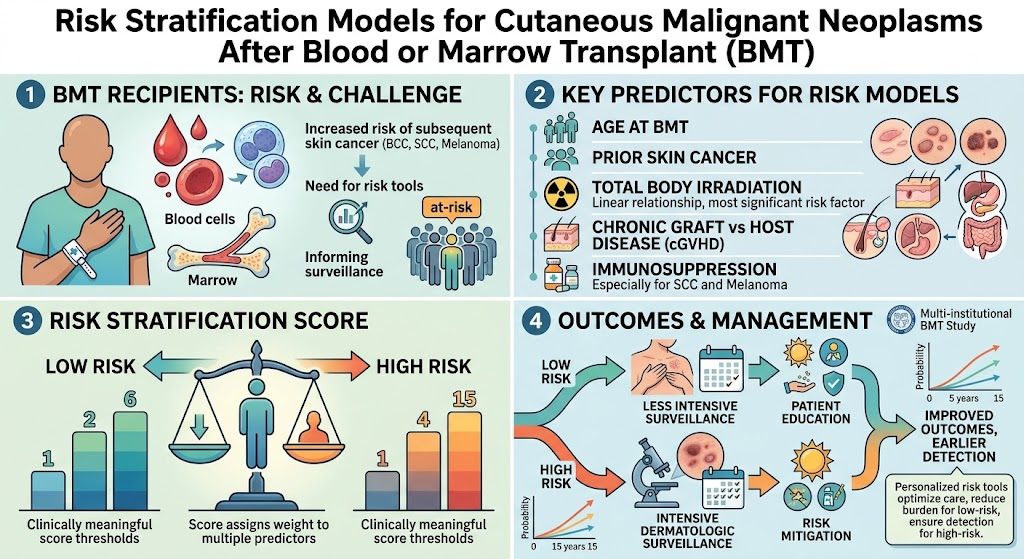
Recipients of blood or marrow transplants (BMT), encompassing both autologous and allogeneic procedures, are at a recognized increased risk of developing subsequent cutaneous malignant neoplasms (CMNs), including basal cell carcinoma (BCC), squamous cell carcinoma (SCC), and melanoma. This elevated risk derives from multiple factors such as prior cancer therapies including total body irradiation, immunosuppressive regimens post-transplant, chronic graft versus host disease (GVHD), and the underlying immunocompromised state associated with transplantation. Given the considerable morbidity and mortality burden posed by skin cancers, identifying transplant survivors at greatest risk for CMNs is critically important for guiding dermatologic surveillance, counseling, and potentially implementing tailored preventive measures.

Previous efforts to characterize risk among BMT survivors have lacked comprehensive, validated tools that integrate patient-specific and treatment-related factors. This gap undermines the ability to efficiently target high-risk individuals for early detection and risk mitigation strategies, which could improve long-term outcomes.

MedXY registered readers

Sign in free to continue reading

Create or use your MedXY account to unlock the complete article.

This article was created using several editorial tools, including AI, as part of the process. Human editors reviewed this content before publication.

Related articles

Open language-specific specialty feeds and department pages.

Stratifying Risk for Further Retinal Intervention After Laser Retinopexy: The Impact of Cumulative Clinical FactorsA novel, cumulative risk factor approach identifies patients at increased risk for additional retinal intervention after laser retinopexy for retinal tears, improving surveillance and management strategies.Sep 15, 2026β-Cell Dysfunction Enhances Prediction of Type 1 Diabetes Progression in Individuals with Single Autoantibody PositivityAssessment of β-cell dysfunction using stimulated glucose and C-peptide measures improves risk stratification for type 1 diabetes progression among single autoantibody-positive relatives, enabling personalized monitoring and targeted intervSep 15, 2026Physiological Left Atrial Staging as a Predictor of New-Onset Atrial Fibrillation in Hypertrophic CardiomyopathyA novel left atrial (LA) staging system, integrating hemodynamic load and contractile function, predicts new-onset atrial fibrillation risk in hypertrophic cardiomyopathy and may guide tailored AF surveillance.Sep 15, 2026
Loading comments...
MedXY briefing

Get the free newsletter

Evidence-led clinical news, trends, and analysis—delivered to your inbox.

Ask MedXY AI

Most popular

Intimate Health
Five Benefits for Women Continuing Sexual Activity After Menopause
Intimate Health
Why Some Women Have a Strong Sex Drive—And Why Men Shouldn't Worry About It
Nursing & care
How often should a couple have sex?
Intimate Health
Classic Intimacy Recommendations: How to Help Women Reach Orgasm and Enjoy Mutual Pleasure
Intimate Health
What Makes a Woman "Physiologically Addicted" Is Never Money, But These Two Relationship Qualities
© 2026 MedXY
Contact usAbout usPrivacy PolicyMedXY story
Continuous Glucose Monitoring Using the FreeStyle Libre Pro iQ in Presymptomatic Type 1 Diabetes: Advancements in Early Detection and Risk Stratification
This review examines the role of FreeStyle Libre Pro iQ CGM in differentiating presymptomatic stages of type 1 diabetes and predicting progression to clinical disease, comparing its performance with Dexcom G6 and discussing implications for
Sep 12, 2026
Validated Risk Stratification for RYR2-Mediated Catecholaminergic Polymorphic Ventricular Tachycardia on Beta-Blocker TherapyThis article reviews a validated clinical risk model predicting arrhythmic events in patients with RYR2-mediated CPVT receiving beta-blockers, facilitating personalized management to reduce life-threatening arrhythmias.Sep 6, 2026
Enhancing Early Detection of Neonatal Hearing Loss: A Machine Learning Risk Stratification ApproachThis article discusses a novel machine learning-based tool, especially XGBoost, to predict hearing loss risk in high-risk neonates using clinical factors for targeted early intervention.Aug 31, 2026