Relapse and Survival Benchmarks in Non-Transplanted AML Patients Achieving First Complete Remission
Highlight
- Survival outcomes for non-transplanted AML patients in first remission are under-characterized, presenting an unmet need for clinical benchmarks.
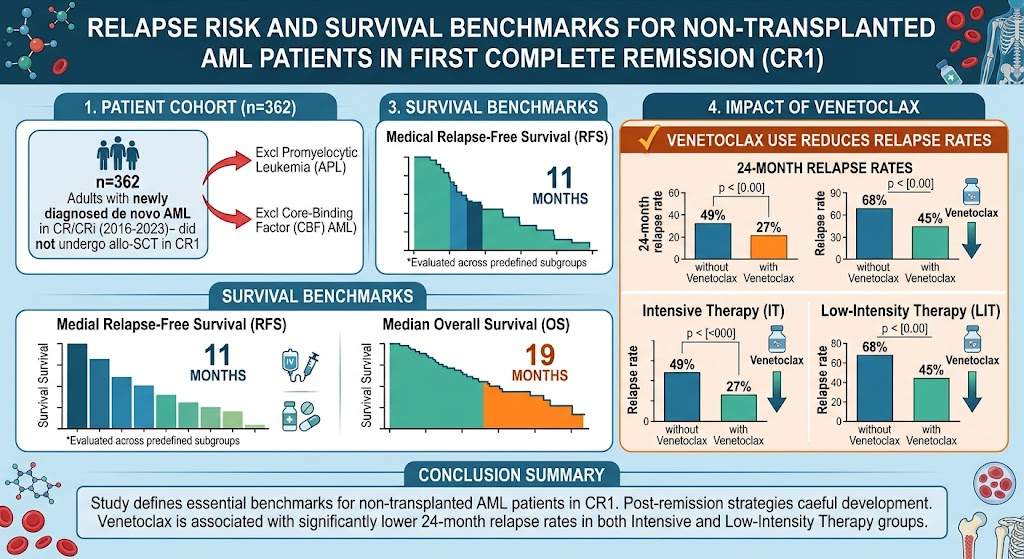
- A retrospective cohort of 362 patients demonstrated median relapse-free survival (RFS) of 11 months and overall survival (OS) of 19 months without allo-SCT.
- Venetoclax-containing regimens significantly reduced 24-month relapse rates in both low-intensity and intensive therapy subgroups.
- These real-world benchmarks facilitate risk stratification and inform post-remission management strategies in AML.
Study Background
Acute myeloid leukemia (AML) is an aggressive hematologic malignancy characterized by clonal proliferation of myeloid precursors. Achieving first complete remission (CR) is an important milestone, but relapse remains a major challenge, limiting long-term survival. Allogeneic stem cell transplantation (allo-SCT) is a curative-intent consolidation option; however, many patients either are ineligible or opt out due to toxicity or donor availability. Nonetheless, survival data and relapse risk estimates for patients achieving remission without transplantation remain inadequately defined. Such benchmarks are essential for optimizing post-remission therapies and guiding clinical decision-making, especially with emerging agents including venetoclax-based regimens gaining traction in frontline AML management.
Study Design
This study retrospectively analyzed adult patients (n=362) with newly diagnosed de novo AML treated between 2016 and 2023. Patients included achieved complete remission (CR) or incomplete CR (CRi) but did not receive allo-SCT during first remission. The cohort excluded acute promyelocytic leukemia (APL) and core binding factor (CBF) AML subtypes, as these patients are infrequently consolidated with allo-SCT.
Treatment strategies were categorized into two groups: low-intensity therapy (LIT, n=257) and intensive therapy (IT, n=105). LIT primarily included hypomethylating agents combined with or without venetoclax, while IT entailed conventional high-dose chemotherapy with or without venetoclax. The main endpoints were median relapse-free survival (RFS), defined as time from remission to relapse or death, and overall survival (OS). The impact of venetoclax on relapse rates was also evaluated.
Key Findings
The median RFS was 11 months and OS was 19 months across all patients who did not undergo allo-SCT post-remission. Notably, venetoclax-based therapy significantly decreased relapse risk at 24 months, with relapse rates reduced from 68% to 45% in the LIT group and from 49% to 27% in the IT group (p values indicating strong statistical significance though exact values were incomplete in the abstract).
Subgroup analyses revealed consistent benefit of venetoclax addition irrespective of treatment intensity, suggesting its pivotal role in consolidative post-remission therapy outside of SCT. This supports the growing clinical adoption of venetoclax combinations for AML patients unfit or unwilling to undergo transplant.
Importantly, the study excluded APL and favorable-risk CBF AML, focusing on patients with less defined natural histories in the absence of allo-SCT. These data form pragmatic benchmarks for clinicians, highlighting that median RFS and OS without transplant remain limited despite remission, underscoring the need for continued therapeutic innovation.
Expert Commentary
These findings address a critical gap in AML management by providing robust survival metrics for a sizeable real-world cohort avoiding allo-SCT. It is increasingly recognized that not all patients derive equal benefit or tolerate transplantation, and thus validated benchmarks are essential for individualized care. Furthermore, the documented efficacy of venetoclax-containing regimens aligns with emerging evidence from multiple clinical trials supporting their use as frontline or consolidation therapies.
Limitations of retrospective design and heterogeneous treatment protocols should be acknowledged; prospective validation is warranted. Additionally, molecular risk stratification and minimal residual disease (MRD) status were not detailed but are crucial to refine relapse risk further. Future studies integrating genomic and MRD markers will enhance personalized post-remission strategies.
Conclusion
This study delineates relapse and survival benchmarks in non-transplanted AML patients achieving first complete remission, revealing median RFS of 11 months and OS of 19 months. Venetoclax-containing regimens significantly reduce relapse risk, affirming their growing role beyond intensive chemotherapy and allo-SCT. These real-world data equip clinicians with critical reference points for prognostication and treatment selection, emphasizing the persistent challenge of relapse and the imperative for ongoing therapeutic advancements.
Funding and ClinicalTrials.gov
No funding information or clinical trial registration details were provided in the abstract or citation.
References
1. Kugler E, Ravandi F, Bazinet A, et al. Relapse risk and survival benchmarks for non-transplanted acute myeloid leukemia patients in first complete remission. Haematologica. 2026 Jul 23. PMID: 42489069.
2. DiNardo CD, Pratz KW, Letai A, et al. Venetoclax combined with decitabine or azacitidine in treatment-naïve, elderly patients with acute myeloid leukemia. Blood. 2019;133(1):7-17.
3. Döhner H, Estey E, Grimwade D, et al. Diagnosis and management of AML in adults: 2022 ELN recommendations from an international expert panel. Blood. 2022;140(12):1345-1377.
These references provide additional insights into the evolving landscape of AML treatment and post-remission management.
This article was created using several editorial tools, including AI, as part of the process. Human editors reviewed this content before publication.