Refining Prognostic Stratification in Hepatocellular Carcinoma: The Critical Role of Vascular Invasion Type and Extent
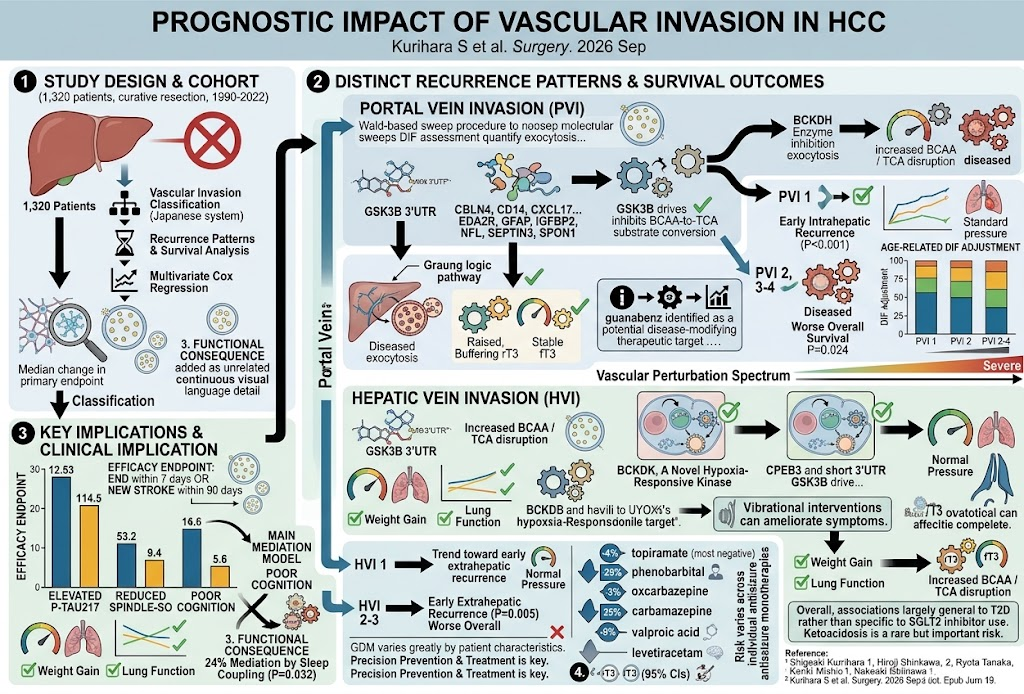
Highlight
- Vascular invasion is a pivotal factor influencing recurrence and survival in hepatocellular carcinoma (HCC) post-resection.
- Distinct types and extents of vascular invasion—classified as portal vein invasion (PVI), hepatic vein invasion (HVI), and bile duct invasion—differentially affect recurrence patterns and prognosis.
- PVI graded 2 and above and HVI graded 2-3 are significantly associated with early recurrence and decreased overall survival, underscoring their prognostic importance.
- Bile duct invasion showed no significant prognostic impact, suggesting a nuanced role of invasion type in HCC outcomes.
Study Background
Hepatocellular carcinoma (HCC) is a leading cause of cancer-related mortality worldwide. Vascular invasion, indicating tumor thrombus presence within blood vessels, is a well-recognized adverse prognostic factor that often portends aggressive disease behavior and higher recurrence rates following curative surgery. However, the prognostic implications of invasion involving different vascular structures—namely the portal vein, hepatic vein, and bile ducts—and the gradations within these invasion patterns remain incompletely understood. Clarification of these differences is clinically relevant to refine staging, inform prognosis, and optimize postoperative surveillance and treatment strategies.
Study Design
This retrospective cohort study analyzed 1,320 patients who underwent curative resection of HCC between 1990 and 2022. Vascular invasion was meticulously classified according to a refined Japanese classification system that categorizes invasion by type (portal vein, hepatic vein, bile duct) and by extent or grade. The primary endpoints were overall survival (OS), recurrence-free survival (RFS), and recurrence patterns at two years, focusing on intrahepatic and extrahepatic recurrence. Multivariate Cox proportional hazards regression models were utilized to adjust for potential confounders and to ascertain independent prognostic effects of vascular invasion type and grade.
Key Findings
The study disentangled nuanced associations between vascular invasion subtypes and clinical outcomes.
Portal Vein Invasion (PVI)
PVI was stratified into four grades. Grade 1 invasion correlated significantly with early intrahepatic recurrence (P < .001) but did not impact early extrahepatic recurrence or overall survival. Higher grades, specifically PVI 2 and PVI 3-4, were strongly associated with both early intrahepatic recurrence (P = .004 and P < .001, respectively) and worse overall survival (P < .001 and P = .024, respectively). These data suggest increasing PVI extent corresponds to more aggressive tumor behavior with significant survival detriment.
Hepatic Vein Invasion (HVI)
HVI demonstrated a distinct prognostic pattern. Grade 1 HVI was associated with a trend toward early extrahepatic recurrence and was significantly associated with early recurrence overall, but it did not affect long-term survival outcomes. However, more extensive invasion classified as HVI 2-3 correlated with significantly higher early extrahepatic recurrence risk (P = .005) and poorer overall survival (P = .034). These findings implicate advanced hepatic vein involvement in promoting distant metastases and survival decrement.
Bile Duct Invasion
Bile duct invasion failed to show a statistically significant association with either recurrence-free survival or overall survival, suggesting it may not be an independent prognostic factor in this setting.
Expert Commentary
This rigorous, large-scale analysis highlights the complexity of vascular invasion as a prognostic marker in HCC. The differential impact of portal versus hepatic vein involvement aligns with biological differences in tumor dissemination pathways—portal vein invasion tends to foster intrahepatic spread whereas hepatic vein invasion may facilitate systemic or extrahepatic dissemination via the systemic venous circulation.
Interestingly, the lack of significant prognostic impact from bile duct invasion may reflect either a lower incidence, less aggressive tumor biology, or challenges in detection and classification that require further investigation.
The application of the Japanese classification system for detailed vascular invasion grading provides a valuable framework for enhanced risk stratification. However, as a retrospective study spanning decades, the findings might be influenced by changes in surgical techniques and perioperative management. Prospective validation and exploration of molecular correlates could further refine prognostication and therapeutic decision-making.
Conclusion
In sum, the extent and type of vascular invasion in HCC after curative resection have distinct prognostic implications. Portal vein invasion grades 2-4 and hepatic vein invasion grades 2-3 identify subgroups with higher risk for early recurrence and reduced overall survival, warranting intensified postoperative surveillance and consideration for tailored adjuvant therapies. Integration of detailed vascular invasion assessment into staging paradigms could significantly enhance personalized management and improve clinical outcomes in hepatocellular carcinoma.
Funding and ClinicalTrials.gov
The original study did not report specific funding sources or ClinicalTrials.gov identifiers.
References
- Kurihara S, Shinkawa H, Tanaka R, Nishimura S, Tauchi J, Watanabe G, et al. Reappraising the T category in hepatocellular carcinoma: Prognostic impact of the type and extent of vascular invasion. Surgery. 2026 Jun 19;197:110403. PMID: 42424765.
- Forner A, Reig M, Bruix J. Hepatocellular carcinoma. Lancet. 2018 Mar 31;391(10127):1301-1314.
- Clavien PA, Barkun J, de Oliveira ML, et al. The Clavien-Dindo classification of surgical complications: five-year experience. Ann Surg. 2009 Aug;250(2):187-96.
This article was created using several editorial tools, including AI, as part of the process. Human editors reviewed this content before publication.