We use cookies

Our website uses essential cookies and, with your consent, additional cookies to measure performance and improve our services. Cookie Policy.

You can change your choice at any time.

MMedXYNews
HomeVideos
MedXY AI/MedXY News/Section: Hematology-Oncology

Real-World Impact of Post-Treatment Circulating Tumor DNA Monitoring in Large B-Cell Lymphoma Using an Immunoglobulin-Based Assay
MedXY Editorial Team•Aug 25, 2026•Hematology-Oncology
measurable residual diseaseLarge B-Cell Lymphomaimmunoglobulin-based assaycirculating tumor DNA

Highlight

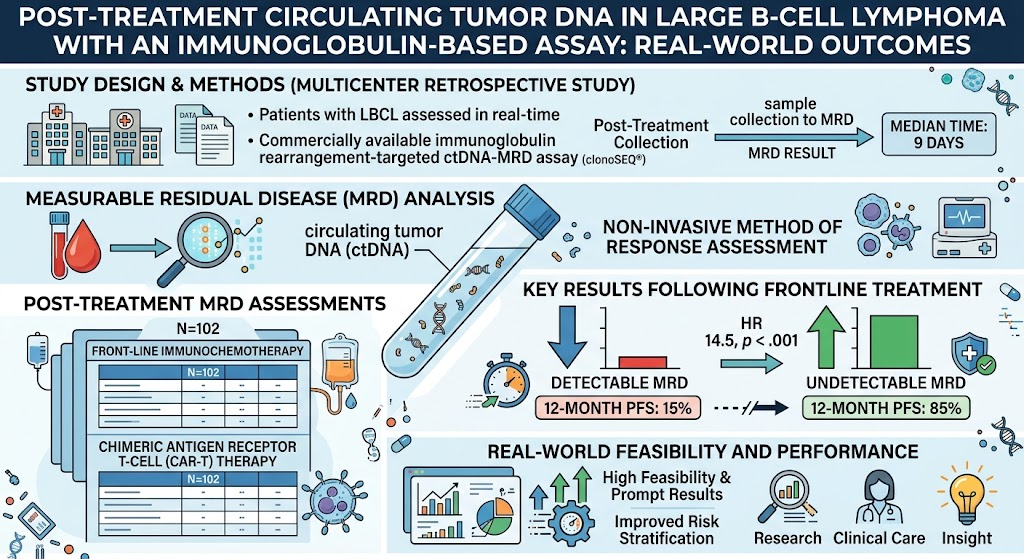
  • Post-treatment measurable residual disease (MRD) assessment via ctDNA offers a non-invasive, real-time response evaluation in large B-cell lymphoma (LBCL).
  • A commercially available immunoglobulin rearrangement-targeted ctDNA assay (clonoSEQM) enabled rapid MRD detection within a median of 9 days in a multicenter real-world cohort.
  • Detectable ctDNA MRD at end of frontline or CAR-T therapy strongly predicted inferior progression-free survival (PFS), underscoring its prognostic value.
  • The study supports integration of ctDNA MRD testing into routine clinical practice to guide personalized management strategies in LBCL.

Study Background

MedXY registered readers

Sign in free to continue reading

Create or use your MedXY account to unlock the complete article.

This article was created using several editorial tools, including AI, as part of the process. Human editors reviewed this content before publication.

Related articles

Open language-specific specialty feeds and department pages.

Five-Year Survival and Durable Remission with Lisocabtagene Maraleucel in Relapsed/Refractory Large B-Cell Lymphoma: Insights from the TRANSCEND NHL 001 StudyLisocabtagene maraleucel demonstrates durable five-year survival and potential cure in relapsed/refractory large B-cell lymphoma, with manageable long-term safety, based on data from the TRANSCEND NHL 001 trial and its long-term follow-up.Sep 18, 2026Pre-Transplant KMT2A-PTD Measurable Residual Disease as a Prognostic Biomarker in Acute Myeloid Leukemia Allogeneic Stem Cell TransplantationThe presence of measurable residual KMT2A partial tandem duplication before allogeneic stem cell transplantation in AML significantly predicts poorer survival outcomes, highlighting its potential as a critical MRD biomarker for risk stratifSep 11, 2026Optimizing Monitoring in Head and Neck Squamous Cell Carcinoma: Tissue-Informed ctDNA Assay Shows High Accuracy and FeasibilityTissue-informed circulating tumor DNA assays demonstrate high detection rates and exceptional sensitivity and specificity in monitoring HPV-positive and HPV-negative head and neck squamous cell carcinoma, supporting their clinical utility iSep 7, 2026
Loading comments...
MedXY briefing

Get the free newsletter

Evidence-led clinical news, trends, and analysis—delivered to your inbox.

Ask MedXY AI

Most popular

Intimate Health
Five Benefits for Women Continuing Sexual Activity After Menopause
Intimate Health
Why Some Women Have a Strong Sex Drive—And Why Men Shouldn't Worry About It
Nursing & care
How often should a couple have sex?
Intimate Health
Classic Intimacy Recommendations: How to Help Women Reach Orgasm and Enjoy Mutual Pleasure
Intimate Health
What Makes a Woman "Physiologically Addicted" Is Never Money, But These Two Relationship Qualities
© 2026 MedXY
Contact usAbout usPrivacy PolicyMedXY story
Integrating Genetics and Measurable Residual Disease to Optimize Therapy in Philadelphia Chromosome-Negative Adult ALLCombining genetic risk stratification with measurable residual disease enables precise treatment allocation in adult Philadelphia chromosome-negative acute lymphoblastic leukemia, improving survival outcomes and guiding the use of allogeneiAug 25, 2026
Response Kinetics Following CAR T-Cell Therapy for Large B-Cell Lymphoma: Insights from the LYSA DESCAR-T RegistryThis review synthesizes real-world data from the DESCAR-T registry on CAR T-cell therapy response kinetics in large B-cell lymphoma, highlighting the prognostic impact of early response patterns and factors influencing conversion from partiAug 24, 2026
Prognostic Impact of IPI Risk Factors on CAR T-Cell Therapy Versus Allogeneic Stem Cell Transplantation in Relapsed/Refractory Large B-Cell LymphomaThis study compares outcomes of CAR T-cell therapy and allogeneic stem cell transplantation based on IPI risk factors in relapsed/refractory LBCL, highlighting favorable survival with CAR T-cell therapy in low-risk patients but advocating aAug 17, 2026