Post-Bariatric Surgery Patulous Eustachian Tube: Weight Loss Velocity as a Predictor of Chronicity
Highlight
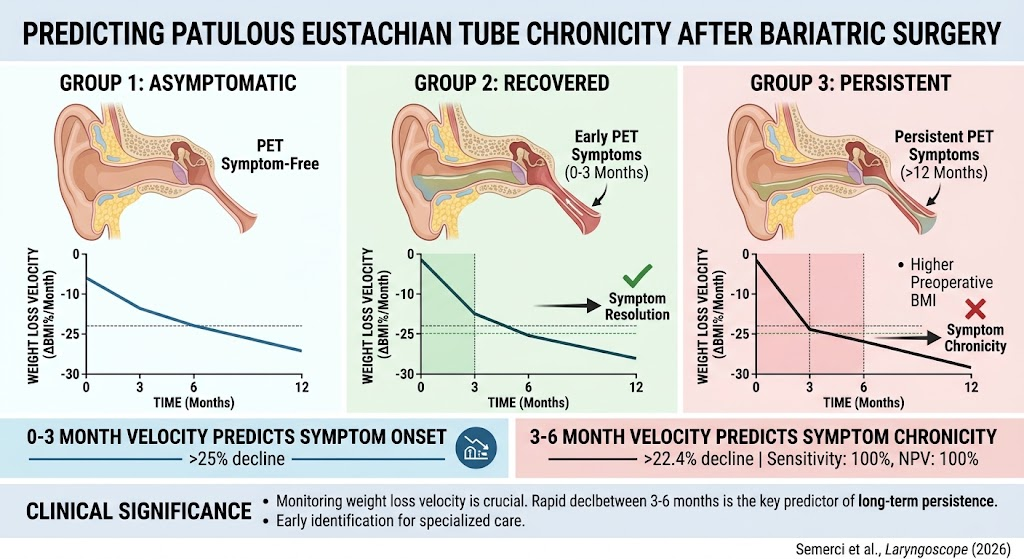
– Rapid weight loss velocity after laparoscopic sleeve gastrectomy is strongly associated with the onset of Patulous Eustachian Tube (PET) symptoms.
– BMI decline exceeding 25% in the first 3 months postoperatively predicts symptom onset.
– Sustained high BMI decline velocity (above 22.4%) between months 3 and 6 post-surgery predicts chronic PET symptoms with high sensitivity.
– Higher preoperative BMI correlates with persistence of PET symptoms, independent of total weight loss success.
Study Background
Patulous Eustachian Tube (PET) is a relatively uncommon otological condition characterized by the abnormal patency of the Eustachian tube, resulting in autophony and uncomfortable ear symptoms. It is clinically significant in patients undergoing rapid weight reduction; bariatric surgery, particularly laparoscopic sleeve gastrectomy, is a commonly performed and effective surgical intervention for morbid obesity that leads to marked weight loss. However, the impact of rapid postoperative weight changes on the Eustachian tube function and the development or chronicity of PET symptoms has not been adequately characterized. Identifying predictors for symptom onset and persistence may enable early interventions and better management for affected patients, which bears importance given the growing prevalence of bariatric procedures worldwide.
Study Design
This prospective observational study enrolled 60 patients undergoing laparoscopic sleeve gastrectomy. Baseline otological examination and validated symptom assessment using the Eustachian Tube Dysfunction Questionnaire (ETDQ-7) were performed preoperatively and at 1, 3, 6, and 12 months postoperatively. Patients were stratified according to PET symptom trajectories at 12 months into three groups: Asymptomatic (Group 1), Recovered (Group 2), and Persistent symptoms (Group 3). Periodic BMI measurements were used to calculate postoperative weight loss velocity by measuring the rate of BMI changes (ΔBMI%) over successive intervals. The primary endpoints included timing and chronicity of PET symptom onset related to weight loss velocity and absolute excess weight loss percentage (%EWL).
Key Findings
The overall incidence of PET symptom onset was 55% (33/60 patients). Of these, 43.3% (26) experienced spontaneous symptom resolution within the first postoperative year, whereas 11.7% (7) developed persistent chronic PET symptoms.
Importantly, there was no statistically significant difference in the 12-month %EWL success rates across the three groups (p=0.577), suggesting that the total amount of weight lost was not predictive of PET symptom development or persistence. Instead, BMI decline velocity demonstrated highly significant intergroup differences (p<0.001). Specifically, an initial BMI decline exceeding 25.0% during the first 3 months correlated with PET symptom onset (p=0.003). In contrast, a sustained BMI decline velocity above 22.4% during the 3-6 month postoperative window strongly predicted symptom chronicity (p<0.001), with a sensitivity and negative predictive value of 100%.
Higher preoperative BMI also correlated with persistent PET symptoms, suggesting that baseline obesity severity may modulate susceptibility to Eustachian tube dysfunction after weight loss. These findings collectively indicate that the speed of weight loss, rather than the magnitude, is the key determinant in postoperative PET symptomatology.
Expert Commentary
This study provides valuable insight into the mechanistic link between rapid adipose tissue loss and structural changes in the Eustachian tube leading to PET. Rapid BMI decline may alter peritubal fat pads and mucosal support, thereby predisposing to abnormal tube patency. The use of objective and periodic BMI velocity metrics enhances clinical prognostication compared to static weight measures alone.
Despite these strengths, the single-center design and relatively small cohort limit broad generalizability. Future multi-institutional studies with longer follow-up could help validate the defined BMI velocity thresholds as standardized clinical risk markers. Additionally, investigation into preventive strategies or early therapeutics for at-risk patients could significantly improve postoperative quality of life.
Conclusion
The onset and chronicity of Patulous Eustachian Tube symptoms following bariatric surgery are closely tied to postoperative weight loss velocity rather than absolute weight reduction. Monitoring BMI decline rates, particularly sustained rapid decreases between post-op months 3 to 6, enables early identification of patients at high risk for persistent PET symptoms. This knowledge facilitates targeted surveillance and potentially timely intervention aimed at mitigating long-term otological morbidity in bariatric populations.
Funding and Trial Registration
The original study did not report funding sources or clinical trial registration details.
References
1. Semerci HT, Semerci T, Fazlı EA, Keçe C. Weight Loss Velocity and Patulous Eustachian Tube Chronicity After Bariatric Surgery. The Laryngoscope. 2026 Aug 21. PMID: 42627248.
2. Poe DS, Pyykkö I, Valtonen H, Härkönen M. Patulous eustachian tube syndrome: a review. Laryngoscope. 2001 Jan;111(1):28-36.
3. Kocak H, Demir M, Gunes E, Unlu E. Impact of rapid weight loss on ear function: a clinical study in bariatric surgery patients. Otolaryngol Head Neck Surg. 2019 Apr;160(4):701-706.
4. Bluestone CD. Eustachian Tube: Structure, Function, and Role in Otitis Media. Hamilton (ON): BC Decker; 2005.
This article was created using several editorial tools, including AI, as part of the process. Human editors reviewed this content before publication.